




Highlights
Why This Matters to You
|
“How much does this funding for my eCommerce store actually cost me?”
That is the basis for making final capital decisions for your business. You don’t want to make decisions based on the headline rate.
Please make sure you understand the full cost, including what you give up in ownership, how repayment works, and how the tax treatment affects your effective rate.
Debt and equity financing are the two foundational options. Both get capital into your business. But they work very differently, and choosing between them without understanding the mechanics can lead to costly mistakes.
This guide breaks down both options with real numbers, explains non-dilutive alternatives, and gives you a practical framework for making the right call at your current growth stage.
What is Debt and Equity Financing
Debt financing is borrowed capital. You receive funds now and repay them over time, with interest. Common forms include term loans, lines of credit, and inventory financing. With debt financing, the lender takes no ownership stake, and the business retains full control.
Equity financing is selling ownership. An investor gives you capital in exchange for a percentage of your company, and by extension, a share of future profits and, often, influence over strategic decisions. Common forms include angel investment, venture capital, and stock issuance.
The simplest way to understand the difference is that debt incurs interest costs. Equity costs you a piece of every dollar your business will ever make.
Debt vs. Equity Financing at a Glance
Debt and equity financing create very different obligations. The table below shows how each option compares across cost, ownership, repayment, tax treatment, control, and ideal use cases.
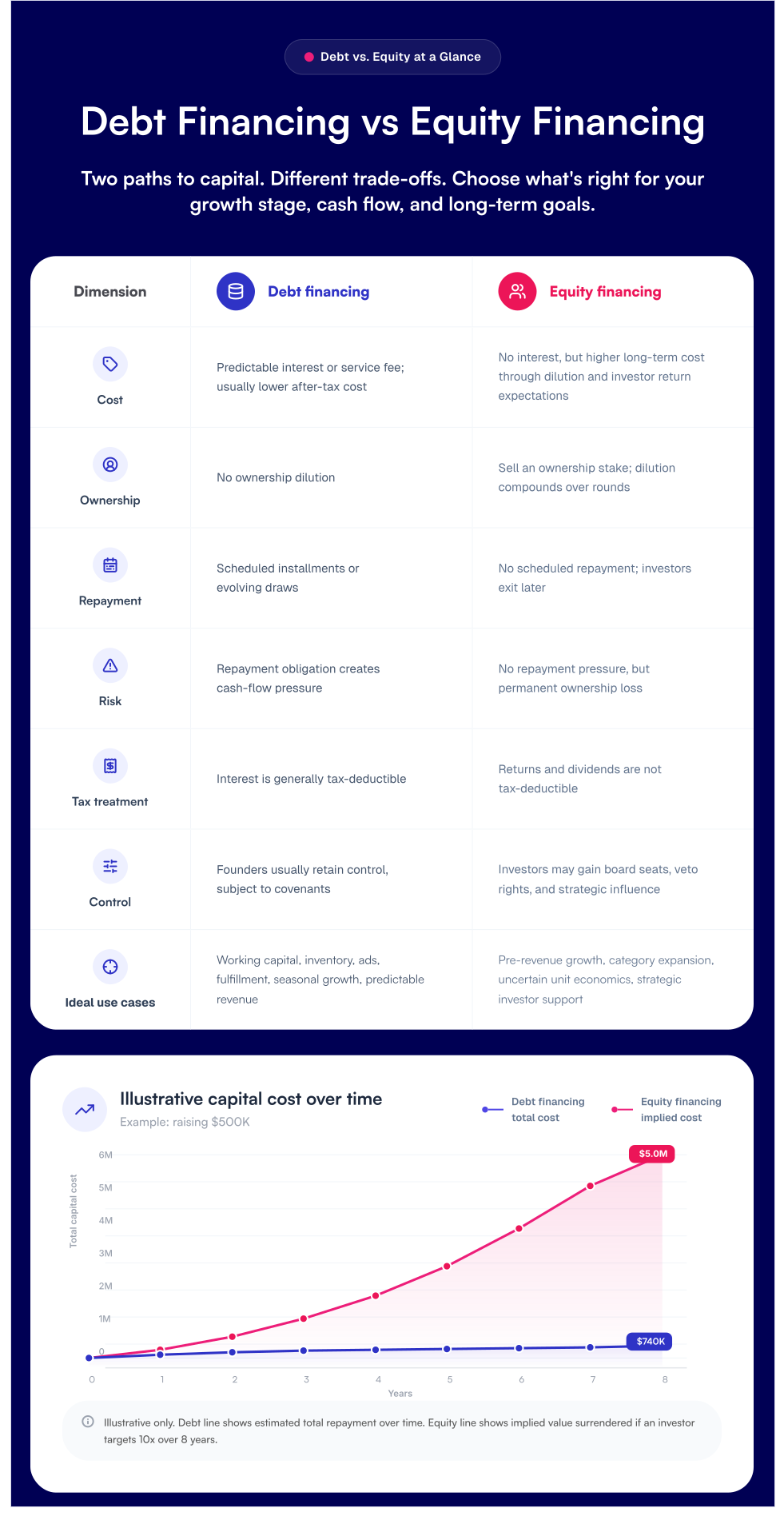
Pros of debt financing for eCommerce businesses
- You retain full ownership and every dollar of future profit
- Interest payments are tax-deductible, reducing your real borrowing cost
- Repayment terms are fixed, making cash flow planning straightforward
- Builds credit history that supports larger facilities as revenue grows
Cons of debt financing for eCommerce businesses
- Requires consistent cash flow, and missed payments create compounding pressure
- Some lenders include covenants that restrict future financing decisions
- Borrowing capacity is tied to revenue, limiting access for early-stage sellers
Pros of equity financing for eCommerce businesses
- No repayment schedule, as the capital stays in the business during loss-making periods
- Strategic investors can bring networks, distribution access, and operational expertise
- Better suited for long-horizon bets where payback timing is genuinely uncertain
- Equity investors absorb the downside, too, if the business struggles; there is no personal repayment obligation to you
Cons of equity financing for eCommerce businesses
- Dilution is permanent, as investors own a share of every future dollar you earn
- Investors often expect influence over strategy, hiring, and key business decisions
- Closing an equity round takes months and involves going through pitching rounds, due diligence and legal documentation
- Profit-sharing applies at your peaks too, including your strongest sales periods
The True Cost of Debt vs. Equity Financing
Debt shows up as interest, service fees, or scheduled repayments. Equity often feels cheaper at the point of funding because there is no monthly repayment.
But the cost of equity financing appears later through dilution, investor return expectations, and reduced upside when the business becomes more valuable.
For eCommerce businesses, this matters quite a lot because most capital needs in this space are not abstract. They are tied to clear operating cycles: inventory deposits, freight, ads, marketplace fees, payroll, fulfilment, and restocking.
So, if the capital is being used to fund a measurable revenue cycle, the cost of that capital should be measured against the margin it helps unlock.
Debt has a visible cost, which makes it easier to plan around
The after-tax cost of debt typically ranges from 5.5% to 9% for established businesses, reflecting current pre-tax SMB bank loan rates of 6.8–11% adjusted for a 21% corporate tax rate. This is clear, as it already tells business owners what to expect when repaying the interest.
If you know your expected gross margin, inventory turnover, repayment schedule, and campaign payback period, you can decide whether the capital improves or weakens your business.
For example, an eCommerce seller using debt to fund a purchase order can compare the financing cost against the expected contribution margin from that inventory cycle. If the margin comfortably exceeds the cost of capital, the debt supports growth instead of eating into it.
This is a major advantage of debt because it creates a known repayment obligation. Though it may put pressure on cash flow, it also gives the business owner a defined number to plan around.
Equity looks cheaper upfront, but the return expectation is much higher
Equity works differently. There may be no fixed repayment, but investors expect the business to grow enough for their ownership stake to be worth significantly more than the capital they put in.
A stronger way to evaluate equity is not only by investor return targets. It is by the actual percentage of the company typically sold in each round.
In Q1 2025, the median startup gave up 18.8% ownership at seed and 17.9% at Series A. In 2024, the median dilution was 20.5% at seed, 20.1% at Series A, and 15% at Series B.
Many startups give up around one-fifth of the company in a single early funding round. Dilution eased slightly in 2025, but each round still takes a meaningful share of future ownership.
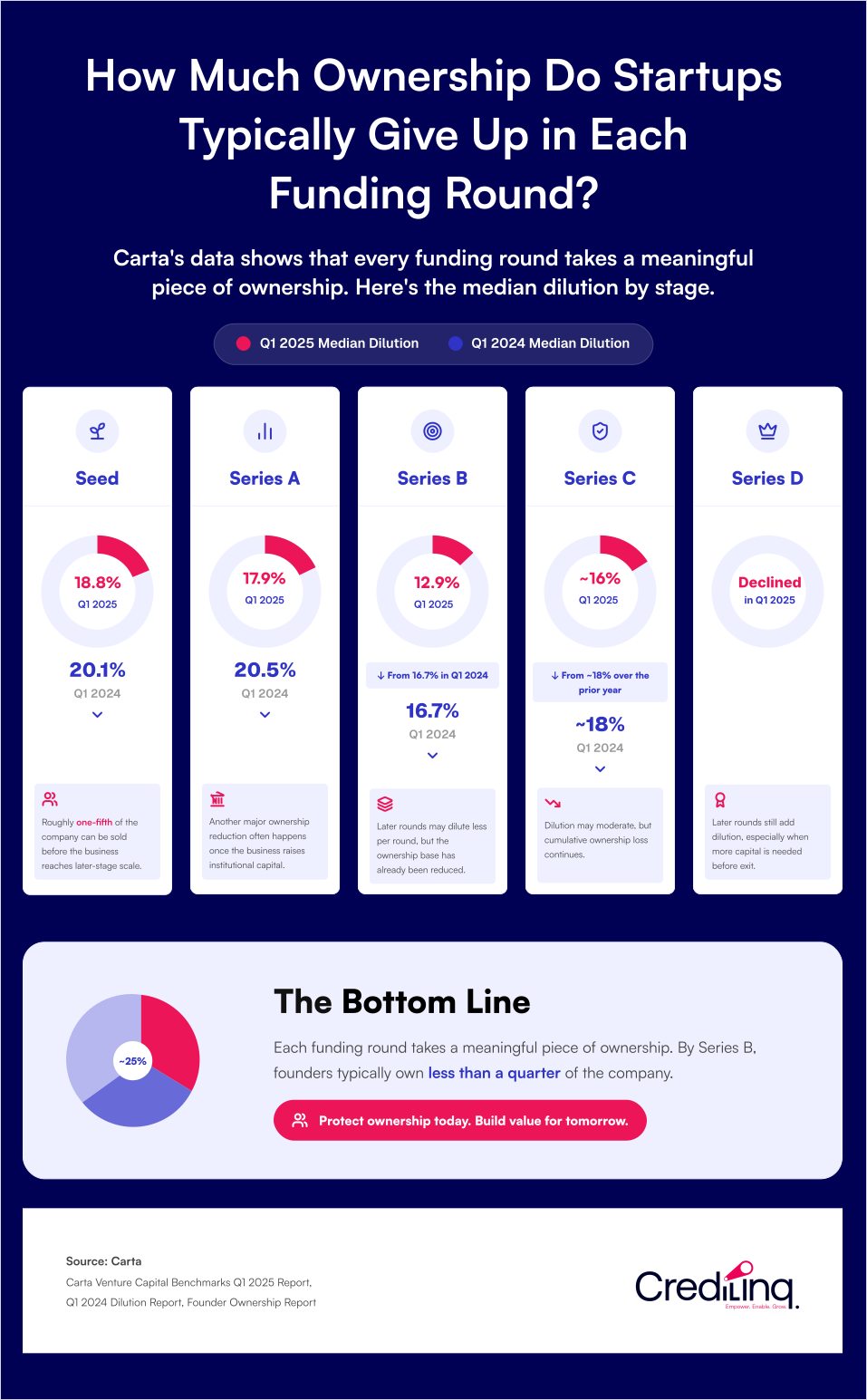
Carta’s Venture Capital Benchmarks Q1 2025 Report shows that after a seed round, the median founding team collectively owns 56.2% of the startup. By Series A, that falls to 36.1%. By Series B, it falls to 23%.
All of this return logic makes sense for investors because they are taking a portfolio risk. But for an eCommerce business owner, it can take control away bit by bit.
A 20% equity stake may not feel expensive when the business is still small. But if the company becomes more valuable, that same 20% becomes a claim on a much larger outcome.
Illustration
Let’s consider a simple example to illustrate this:
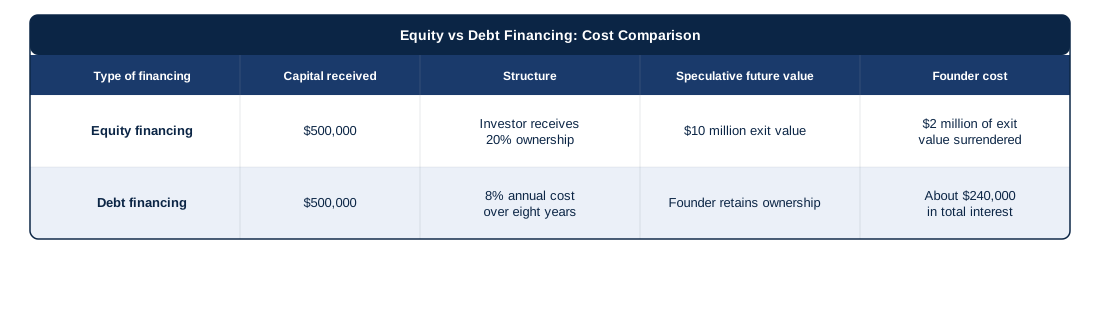
In this example, the equity investor’s $500,000 becomes a $2 million claim if the company later exits for $10 million.
The business owner gives up $1.5 million more than the original capital received, before considering any profit distributions, governance rights, or future dilution. By comparison, the debt facility has a defined interest cost and does not transfer ownership.
The gap becomes even more visible if the business growth keeps up:

That is why equity can be rational for venture-scale businesses but expensive for eCommerce operators solving working capital problems.
If the capital is used to buy inventory, fund ads, or bridge payout timing, the capital need may last 60 to 180 days. The ownership cost can last for the life of the business.
Y Combinator advises founders that most seed rounds require up to 20% dilution, and its separate dilution guidance suggests companies think about selling 10–15% in seed.
Venture Capitalists (VCs) often need meaningful ownership because venture is a hits-driven business. This is because they are betting on a portfolio, of which your business is one part.
Think of it like a wholesale supplier who gives you favorable payment terms upfront, but buries clauses that let them reprice your inventory, take first pick of your stock, or pull funding if you miss targets.
Equity investors can do something similar through deal terms that protect their return at your expense, especially if growth slows or the business needs to raise again at a lower valuation.
What ecommerce sellers should watch out for
|
Always match the capital structure to the problem you are trying to solve
Equity makes sense when the business needs patient capital for uncertain, high-upside bets like category creation, new technology, market expansion, acquisitions, or a long period of unprofitable growth.
In those cases, the lack of fixed repayment may be worth the dilution.
But most mature eCommerce financing needs are different. They are operational. Inventory has to be bought before it is sold. Ad spend has to be deployed before revenue lands. Marketplace payouts arrive after fulfillment costs have already left the business.
That is a working-capital timing gap, not necessarily an ownership problem.
The better test to use here is simple: if the capital will generate measurable revenue within a defined cycle, debt or a revolving line of credit usually offers cleaner economics. You pay for the capital, use it, repay it, keep the upside and extend growth without diluting your equity. |
The tax system is structurally biased toward debt, and most business owners do not use it
The Congressional Budget Office estimated the effective marginal tax rate on equity financing at 20.5% in 2024, vs. just 5.5% for debt. That 15-point gap exists because interest on debt is tax-deductible and equity returns are not.
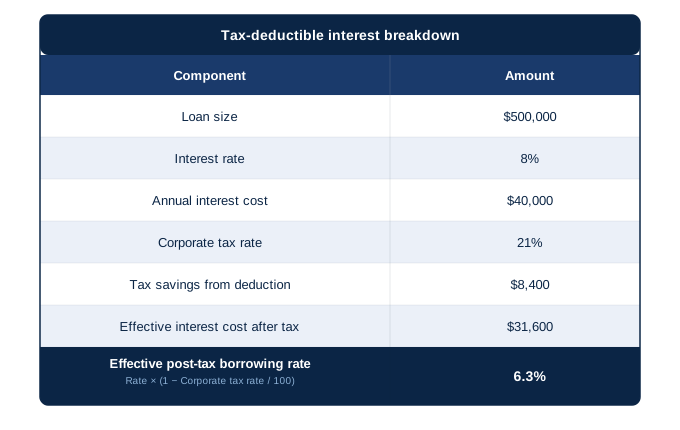
Suppose a company borrows $500,000 at an 8% annual interest rate. That creates $40,000 in yearly interest expense.
If the business pays a 21% corporate tax rate, that $40,000 interest expense reduces taxable income by the same amount.
A 21% tax reduction on $40,000 equals $8,400 in tax savings.
Note: Tax rates and deductibility rules are subject to legislative changes. The example above uses a 21% corporate tax rate and current interest deductibility rules, both of which may be affected by ongoing or future tax legislation. Consult a tax advisor for guidance specific to your business and jurisdiction.
So while the headline loan rate is 8%, the real after-tax cost falls closer to 6.3%.
Equity does not receive this advantage because investor returns are not tax-deductible.
The government is effectively subsidizing part of your borrowing cost every time you service a business loan, a benefit that disappears entirely when you fund growth through equity instead.
How to Choose Between Debt or Equity Financing for Your eCommerce Business
Both financing structure is may sound good in theory, but you need to match the capital type to your business’s reality.
These four questions will tell you where you stand:
1. Can your business reliably service a fixed repayment?
Run the numbers on your last six months of revenue. If monthly cash flow comfortably covers a biweekly or monthly repayment, with margin to spare, debt is serviceable. If revenue is inconsistent, seasonal, without predictability, or still being established, the repayment obligation creates risk rather than removing it.
2. What is the capital actually for?
Operational needs with a defined revenue cycle; inventory, ad spend, freight and restocking are debt problems. The capital goes in, generates a measurable return, and comes back out. Equity is better suited for bets with no defined payback horizon, such as new market entry, technology investment, or category expansion that may take years to return capital.
3. How long do you need the capital?
Short-cycle needs of 30 to 180 days favour debt, particularly revolving structures that reset as you repay. If the capital need is open-ended, funding an unprofitable growth phase with no clear end date, equity removes the repayment pressure that debt would otherwise create.
4. What is ownership worth to you at exit?
If you plan to sell the business, every percentage of equity surrendered early is a direct reduction in your exit proceeds. A seller who gives up 20% in an early equity round and exits for $5 million has permanently transferred $1 million of that outcome. Debt has a defined, finite cost. Equity does not.
|
Watch out for: For debt, watch the timing. Drawing down debt ahead of a slow trading period, post-peak restocking lulls, off-season months, or marketplace payout delays can put repayment obligations on top of already thin cash flow.
For equity, the eCommerce unit economics rarely justify the dilution. Most capital needs in this space are operational and repeatable. These are problems with a defined cost and a measurable return. Giving up permanent ownership to solve a 90-day cash flow timing gap is structurally mismatched unless there’s a specific reason to use it. |
Non-Dilutive Funding Alternatives Worth Considering
Between traditional bank debt and full equity, there are options worth knowing.
Revolving lines of credit
This option sits right between a term loan and a credit card. You draw only what you need, repay on a set schedule, and the facility resets for future draws.
How does a credit line differ from term loans?
A term loan gives you a lump sum and a single repayment schedule. A revolving line lets you draw $30,000 for a supplier deposit this month, repay it as inventory sells, then draw again for ad spend the following month. The facility stays open and available, which means your cost of capital only runs when you are actually using it.
This structure fits eCommerce businesses well because capital needs rarely arrive in a single, clean amount but rather come in stages: supplier deposits, freight, ad spend and restocking.
It also builds borrowing history. Each draw-and-repay cycle strengthens your relationship with the lender and can support higher limits over time as your revenue grows.
How does a credit line differ from credit cards?
The main difference from a credit card is discipline in pricing. Credit cards carry variable rates that can spike unpredictably.
A revolving line of credit from a business lender typically comes with a fixed fee or rate structure, making the cost of each draw predictable and easier to factor into margin calculations.

Revenue-based financing (RBF)
This provides capital upfront in exchange for a fixed percentage of future revenue until a set repayment cap is reached. It is non-dilutive, and no equity changes hands.
Repayments flex with revenue, which helps during slow periods, but the trade-off is higher costs. RBF repayment caps typically run at 1.5–1.6x the advanced amount.
On a $25,000 advance, you may end up repaying $37,500–$40,000. A traditional business loan at 15.5% over five years on the same amount totals approximately $36,000.
For shorter cycles, revenue-based financing can be efficient. For longer capital needs, fixed-rate debt is typically cheaper.
There is also a structural issue specific to high-revenue events: RBF sweeps harder precisely when your business is performing best.
If you run a large promotional event and revenue spikes, repayments accelerate as well, hitting working capital at the moment you need it most for restocking or ad spend.
Inventory financing
This is an asset-backed borrowing that is structured around stock. You borrow against the value of the inventory you are purchasing, which becomes the collateral.
You identify a purchase order or restocking need, borrow against that inventory’s value, fulfill the order, and repay once the goods sell. The capital moves with your stock cycle rather than as a fixed obligation on your balance sheet.
It is particularly useful in three situations:
- When a supplier requires a large upfront deposit before shipping
- When you are scaling into a seasonal peak and need to build stock ahead of demand
- When a bulk purchase opportunity arises that would strain working capital if funded solely with cash.
Like other debt-based options, inventory financing is non-dilutive and the cost is fixed and predictable. The main constraint is that the loan amount is tied to the appraised or purchase value of the inventory, so the facility scales with your stock rather than your broader revenue.
|
Suggested read: Inventory Financing Rates Explained |
Why CrediLinq Fits the Ecommerce Capital Problem
Inventory deposits are due before goods ship. Marketing spend is required before settlements clear. Restocking decisions are made mid-event, when cash is already deployed elsewhere.
That gap between when capital is needed and when revenue arrives is the structural challenge. And it is not solved by a single lump-sum disbursement.
CrediLinq provides a revolving line of credit built around how eCommerce cash flow actually works. Established eCommerce businesses with at least 12 months of operating history and $30,000 or more in monthly revenue can draw capital when needed, repay on a predictable biweekly schedule, and draw again without reapplying.
Typical drawdowns range from $25,000 to $250,000, with limits reaching higher for qualified sellers (up to $2M).
Pricing starts at a flat 1.5% monthly service fee, with a simple, fixed APR structure as low as 18%. No revenue share or equity dilution is involved.
For sellers evaluating debt vs. equity financing, the question is not which option sounds better in theory. It is the structure that keeps costs predictable, preserves ownership, and moves at the speed your business actually operates.
For eCommerce businesses with proven revenue, the math consistently favors non-dilutive debt.
Key Takeaways
Every percentage of equity you give up early is a permanent claim on a business you are still building. The decision between debt and equity determines who benefits when the work you are doing right now eventually pays off.
For established eCommerce operators with predictable revenue, non-dilutive debt is almost always the cheaper, cleaner, and more strategically sound choice. Traditional loan debt can work, but it takes too long to get approved and may require a credit check before approving five- or six-figure loans.
CrediLinq offers a revolving line of credit with a seamless digital application, flat-fee pricing, no equity involved, and a repayment structure designed around how eCommerce businesses actually generate and hold cash.
Explore CrediLinq’s funding option for your eCommerce business to meet your capital needs while you retain full control.
Frequently Asked Questions
Is debt financing always better than equity for eCommerce businesses?
Not always, but it usually is for eCommerce operators with stable revenue. Debt preserves ownership and is cheaper on a long-term cost basis for businesses with measurable cash flow. Equity makes more sense when the business is early-stage, pre-revenue, or needs capital that can tolerate extended uncertainty.
Does revenue-based financing count as debt or equity?
It is non-dilutive, so no equity changes hands. Structurally, it behaves like debt, with capital advanced and repaid, but repayments are tied to a percentage of revenue rather than to fixed installments. It occupies a middle ground between traditional debt and equity.
Does taking on business debt affect my ability to raise equity later?
It can, depending on how lenders have structured the debt. Some loan agreements include covenants that restrict additional financing without lender approval. Others require the debt to be repaid before equity investors will take a clean position on the cap table. If an equity raise is on your horizon, disclose existing debt early in due diligence conversations.
Can I use debt financing and still raise equity later if I need to?
Yes, but the existing debt will come up in due diligence and needs to be handled carefully. Some loan agreements include covenants that restrict additional financing without lender approval, and equity investors will want a clean view of your cap table and liabilities before committing capital.
Is there a point at which taking equity actually makes more financial sense than taking on debt for an eCommerce business?
Yes. If your business is burning cash with no near-term path to profitability, equity removes the repayment pressure that debt would otherwise create.
It also makes sense when the capital need is genuinely transformational, like funding something that could 10x the business but has a long and uncertain payback horizon.
Debt requires serviceable cash flow. If that cash flow does not exist or is highly unpredictable, mandatory repayments can accelerate failure rather than prevent it.
Citation References
- https://carta.com/data/state-of-private-markets-q4-2024/
- https://carta.com/data/state-of-private-markets-q1-2025/
- https://www.kansascityfed.org/surveys/small-business-lending-survey/small-business-lending-continues-to-increase-q4-2025/
- https://www.nerdwallet.com/article/small-business/small-business-loan-rates-fees
- https://bipartisanpolicy.org/explainer/paying-the-2025-tax-bill-business-interest-deductions/
- https://www.shopify.com/blog/revenue-based-financing
- https://www.investopedia.com/terms/c/costofdebt.asp
- https://corporatefinanceinstitute.com/resources/valuation/cost-of-debt/