



FBA Prep Partner Essentials: Costs, Services, and What to Look For
Overview
- Amazon has ended all FBA prep and labeling services from January 1, 2026.
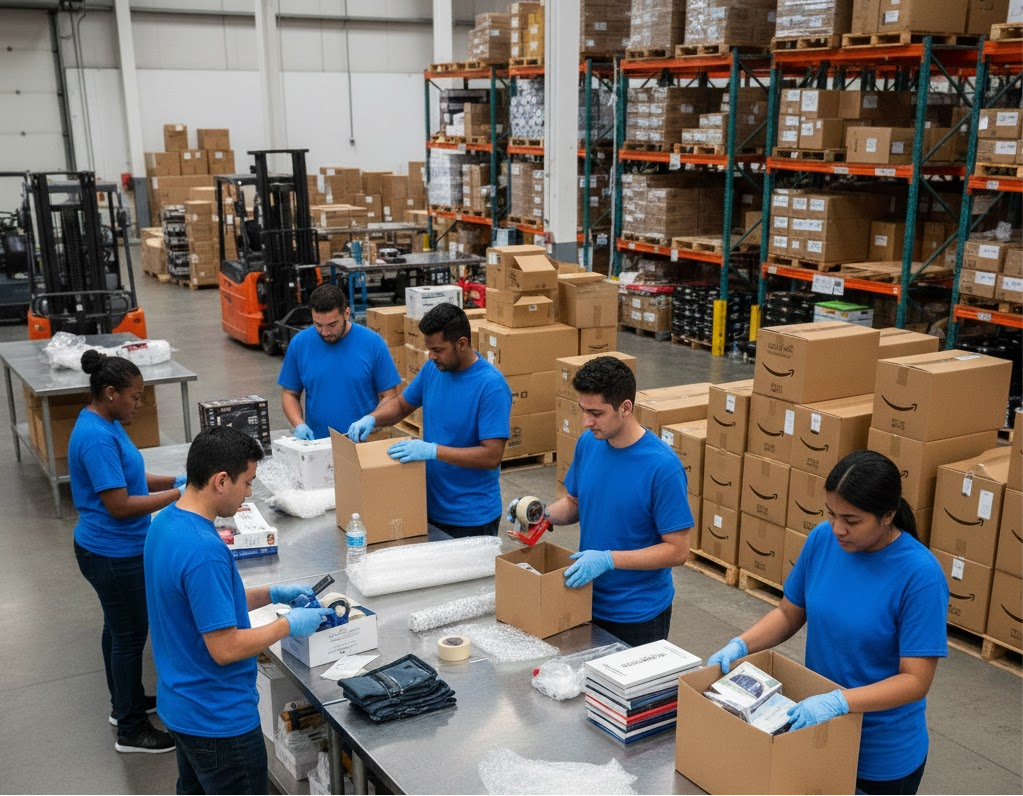
- FBA prep partners step in to handle inspection, labeling, bundling, protective packaging, and shipment creation to Amazon standards.
- Choosing the right partner means looking at Amazon-specific expertise, quality controls, turnaround times, tech, scalability, and transparent pricing.
- Prep costs vary widely by product type and complexity. Typical partners charge per unit for labeling, bagging, wrapping, bundling, and pallet prep.
- Whether you are small, seasonal, or established, a reliable prep setup—internal, external, or hybrid—keeps inventory moving.
Why This Matters to You
- Amazon will no longer fix prep issues for you. Every mistake now sits on the seller, raising the stakes on accuracy and compliance.
- Prep time directly affects replenishment, inventory health, and Buy Box (Featured Offer) performance; delays quickly impact revenue.
- With prep now fully on your plate, having the right support system prevents bottlenecks, errors, and unexpected costs
Starting January 1, 2026, Amazon permanently discontinued all prep and item-labeling services for FBA shipments in the United States.
This means sellers can no longer pay Amazon to handle fulfillment network stock-keeping unit (FNSKU) labeling, polybagging, bubblewrapping, or any other product preparation. Everything must arrive at fulfillment centers ready to ship.
Since about 82% of Amazon sellers use FBA, this change affects a significant share of businesses that depend on Amazon’s fulfillment workflow. Amazon says the change reflects “a significant improvement in seller packaging capabilities”, noting that most sellers now handle prep themselves or work with third-party providers.
For sellers who have not made that transition yet, or those still weighing their options, the clock is ticking. So, in this post, we will break down what FBA prep partners actually do, how to evaluate and choose the right one for your business, and what this Amazon policy shift really means for your operations and bottom line.
What Amazon’s FBA Prep Shutdown Means for Sellers
Amazon’s decision to end prep services does not just shift packaging and labeling responsibilities back to sellers. It creates a cascading set of operational challenges that affect your entire FBA workflow:
- Staying updated with rules and regulations — Amazon frequently updates requirements across categories, from suffocation warnings to expiration-date formats to hazmat labels. Now, you must track these changes, either yourself or through 3rd-party FBA prep services, or risk shipment rejections and delays at fulfillment centers.
- Need for dedicated storage and workspace — To handle these requirements, you need physical infrastructure: space for receiving inventory, storing packaging materials, setting up labeling stations, and staging outbound shipments. Even occasional sellers need a functional workspace to consistently execute preparation tasks.
- Training staff on Amazon-specific standards — Amazon’s preparation guidelines are detailed, category-specific, and very different from standard warehouse norms. Teams must learn FNSKU placement, case pack rules, hazmat documentation, and dozens of small but critical requirements.
- Longer preparation and turnaround times — Once you factor in receiving stock, inspecting units, training time, labeling, packaging, and coordinating carrier pickups, your inventory cycle stretches considerably. What Amazon once handled in days now takes weeks from the supplier to the FBA warehouse.
- More complexity in inventory planning — Those added prep days directly impact replenishment. You must now factor in preparation time when forecasting stock to avoid late shipments, stockouts, or lost Buy Box opportunities. Coordinating suppliers, preparation, and FBA receiving becomes far more layered.
- Greater risk of non-compliance — With more moving parts, there is a greater opportunity for error. Missing a polybag requirement or applying labels incorrectly can trigger rejections, fees, or removal orders. Every mistake now impacts your bottom line.
With Amazon stepping back, every seller—regardless of size or setup—must handle FBA prep consistently and to Amazon’s standards. Third-party FBA prep centres and partners have therefore become relevant across the board. They offer additional support where needed, help smooth out peaks in demand, and take on the more technical parts of preparation so sellers maintain accuracy and compliance without stretching their internal teams.
While all sellers must now handle FBA prep independently, some groups feel the operational impact far more sharply than others.
Who is affected most by Amazon’s FBA prep shutdown?
Every Amazon seller in the USA must now take on full responsibility for FBA preparation, but the impact is not evenly distributed. Some seller segments face significantly more operational strain than others.
- Sellers without internal prep capacity — Many have no physical space or trained staff to absorb prep tasks; 57% are turning to external logistics providers or exploring in-house alternatives to keep inventory moving.
- Sellers with steady or high order volumes — These sellers depend on predictable turnaround times to maintain inventory flow. 64% expect the loss of FBA prep to significantly impact their business, largely due to disruptions in restocking cycles.
- Sellers operating on thin margins — With 92% anticipating higher operational costs, margin-sensitive sellers feel the shift most acutely as variable 3PL pricing and seasonal surcharges increase cost pressure.
- Sellers with complex or fragile SKUs — Items requiring multi-step prep, kitting, bundling, or special compliance are the hardest hit. More than 50% of sellers plan to change their product assortment, dropping complex items as prep becomes harder to manage.
- Sellers with time-sensitive replenishment — Inventory cycles stretch when prep shifts outside Amazon’s controlled system, and 62% expect greater logistical complexity as a result.
- Sellers with wide product assortments — Large catalogs mean multiple packaging types, compliance rules, and prep workflows to manage simultaneously. As a result, 37.6% of sellers plan to reduce SKU variety, while others shift toward higher-margin (43.6%) and more selectively sourced (42.8%) products to keep operations manageable post-shutdown.
What Is FBA Prep?
FBA Prep means getting your products ready to Amazon’s strict packaging, labeling, and quality standards before they are sent to Amazon’s fulfillment centers for storage and shipping to customers. It is a structured process where accuracy, compliance, and cost optimization is crucial.
What are FBA Prep Services?
FBA prep services are third-party providers that handle the physical preparation of your inventory before it ships to Amazon’s fulfillment centers. They ensure every unit meets Amazon’s requirements, then forward it to the designated FBA warehouse.
With Amazon discontinuing its in-house prep, the responsibility shifts entirely to sellers and the 3PL partners they work with. This decision is reshaping a significant segment of the U.S. logistics industry, which reached $231.5 billion in 2023 and continues to grow at 9.2% annually, driven by e-commerce fulfillment demands.

Essentially, they act as a bridge between your supplier and Amazon, taking the prep workload off your plate. Core services typically include the following:
- Inspecting incoming units for accuracy, damage, and packaging gaps before processing
- Performing protective prep such as poly-bagging, bubble wrapping, or shrink-wrapping based on product category
- Assembling compliant bundles and multipacks, including required suffocation warnings and set labeling
- Printing and applying FNSKU labels as per Amazon’s placement and size requirements
- Preparing cartons and pallets within Amazon’s weight and dimension limits for smooth receiving
- Creating inbound shipments with correct routing, box content information, and required documentation
- Updating inventory records to reflect what has been received, prepped, and shipped
While these tasks form the core of FBA prep, partners differ in specialization and operational depth.
Some are general 3PLs that handle basic labeling and boxing for multiple platforms, while others specialize exclusively in Amazon and know the ins and outs of category-specific rules. Some have experience with fragile, oversized, or regulated products, such as supplements or electronics, while others stick to standard, lightweight inventory. These differences matter when you are choosing a provider.
The right fit depends on what you are selling, how complex your workflow is, and how much Amazon-specific expertise you actually need.
How to Choose the Right FBA Prep Partner

When you are looking for the right FBA prep partner, look beyond who offers the cheapest per-unit rate. The partner you choose becomes part of your supply chain, and a poor fit creates problems that ripple through your entire operation.
Here is what actually matters when evaluating potential partners.
1. Amazon-specific expertise
Generic logistics providers handle shipments for multiple platforms, but Amazon operates differently. The prep requirements for toys differ from those for supplements or electronics. A partner without deep FBA experience will not know that topicals need different labeling than books, or that bundles require specific suffocation warnings depending on the items inside.
What to verify:
- Years working exclusively with Amazon sellers (five-plus years means they have weathered policy changes)
- Experience with your specific product category—consumables, hazmat, fragile items, or oversized products
- Knowledge of all shipment types: Small Parcel Delivery, full pallets
- Ability to navigate Seller Central for shipment creation and prep requirements
A prep partner asking you to explain Amazon’s requirements is one you should skip.
2. Quality assurance and compliance controls
Amazon rejects shipments for mislabeled units, incorrect poly bag thickness, and missing suffocation warnings.
Strong prep partners inspect inventory multiple times: upon arrival, before prep begins, and after prep finishes. Each checkpoint catches different problems: shipping damage at receiving, quantity discrepancies during pre-prep, and labeling errors post-prep.
Look for the following:
- Multi-step inspection processes documented in writing
- Staff training programs based on current Amazon guidelines
- Photo documentation at key stages for dispute resolution
- Monitoring systems for Amazon policy updates with workflow adjustments
Ask how they handle errors discovered after prep. Partners who catch and correct issues before shipment save you rejection fees and delays.
3. Turnaround time and seasonal reliability
Most quality prep partners process inventory within 24 to 72 hours of receiving it. Anything longer suggests capacity constraints.
Peak season is the real test. Ask directly what turnaround times look like during Q4 and specific events such as Prime Day or BFCM. Do they guarantee processing windows even in November and December, or do delays become routine when volume spikes?
Express FBA prep services provide flexibility for urgent restocks. Some partners limit new client onboarding during peak season to protect existing clients—a signal they prioritize service quality over revenue growth.
4. Scalability and operational capacity
Prime Day, Black Friday, and Q4 create spikes that overwhelm underprepared partners. Visit the warehouse if possible, or ask detailed questions:
- How many prep stations do they operate?
- What is their daily processing capacity during peak season?
- Can they absorb a sudden doubling of volume without extending turnaround times?
Seasonal sellers need partners who scale up for 3 months and scale down afterward, without locking you into minimum-volume commitments. Check their staffing model—partners relying entirely on temporary seasonal workers see quality drop when order volume surges.
5. Storage and inventory handling
How inventory sits between receiving and shipping affects product condition and efficiency. Climate control matters for electronics, consumables, and health items. A warehouse that gets too hot in summer can ruin inventory before it reaches Amazon.
Ask how they organize storage. Labeled bins, shelving systems, or pallet racks with clear locations prevent errors and speed retrieval.
For products with expiration dates: First in, first out (FIFO) or first-expired, first-out (FEFO) rotation ensures older stock ships first, reducing waste and preventing Amazon from flagging expired inventory.
For high-value items: CCTV, restricted access, inventory tracking, and insurance coverage protect against theft or damage.
6. Technology and integrations
FBA prep centres relying on spreadsheets and manual data entry make more mistakes and move slower.
Core systems to verify:
- Seller Central integration – Pulls shipment plans, prints labels, and updates inventory automatically without manual data entry
- Inventory management dashboard – Shows real-time status of what has been received, what is in progress, and what has shipped
- Barcode scanning – Verifies units at receiving, during prep, and before shipment to catch errors immediately
- Automated billing – Ties invoices to actual units processed for straightforward reconciliation
- Data security protocols – Ask about how they protect sensitive business information, including access controls and security practices.
7. Geographic advantage
Prep centers near major Amazon fulfillment centers reduce freight expenses and shorten transit times. Shipping a pallet cross-country can cost $500 to $800 more than shipping regionally. Multiply that across dozens of shipments, and proximity saves thousands of dollars.
Partners with multiple warehouse locations offer routing flexibility. You send West Coast inventory to California and East Coast inventory to New Jersey, optimizing both cost and delivery speed.
Experienced partners also know which Amazon fulfillment centers have faster receiving times.
8. Communication and visibility
Strong prep partners send receiving confirmations when inventory arrives, prep completion notifications when units are ready, and tracking information when shipments leave. You get updates without asking.
A client portal showing real-time prep status eliminates guesswork. A dedicated account manager who knows your business handles issues faster than rotating through generic support tickets.
9. Pricing structure and transparency
Standard rates should be straightforward: a specific amount per unit for labeling, another for poly bagging, another for bubble wrapping. Avoid partners who give vague ranges or refuse clear pricing before you commit.
Confirm what the base rate includes and what costs extra. Common add-ons: receiving fees, storage beyond a certain period, palletizing, and custom packaging. Ask about volume discounts if you consistently send high volumes.
Itemized invoices let you verify charges against units processed without digging through unclear statements.
10. Legal and regulatory compliance
Confirm they hold the necessary state and local permits for warehousing and logistics operations. Verify insurance coverage for both the inventory in custody and the general liability.
If you sell restricted categories—hazmat, topicals, supplements—verify they have the certifications and documentation requirements in place. Request proof of insurance and business licenses during evaluation.
No single factor should dominate your decision.
Expertise without scalability leaves you stuck during growth periods. Great pricing without quality control costs more in rejected shipments. Fast turnaround without compliance creates bigger problems. Prioritize what matters most for your products and business model, but make Amazon expertise, quality assurance, and reliable communication non-negotiable.
Cost Considerations When Outsourcing FBA Prep
Not every SKU requires every prep step. Simple standard-size units may only need labeling and inspection, while fragile, liquid, odd-shaped, or multipack items require more hands-on prep. Understanding these cost components helps you budget accurately and select a partner whose pricing model matches your category and growth stage.
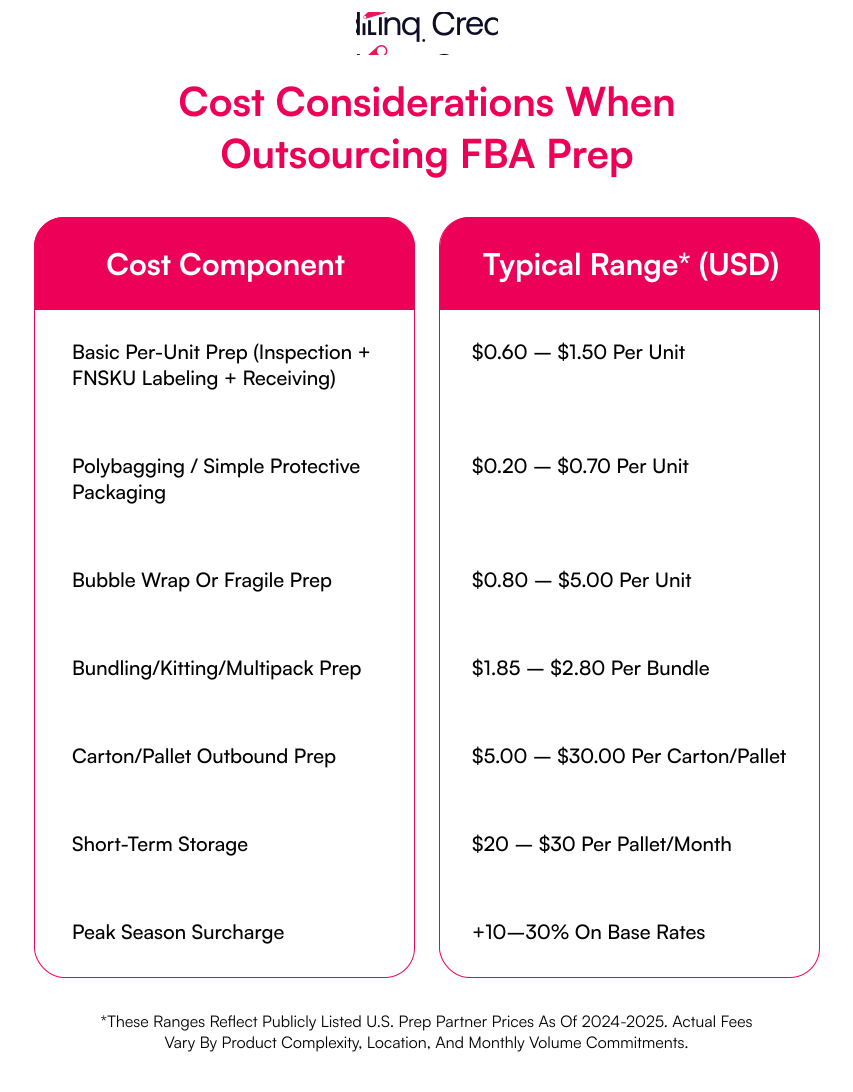
Outsourcing prep gives you predictable unit-based costs and helps you handle seasonal surges or complex SKUs without increasing internal overhead.
Staying Cash-Ready as You Shift to Third-Party FBA Prep
Moving from Amazon’s controlled prep environment to a third-party provider introduces more operational variability than most sellers are used to. Turnaround times, SKU-based pricing, seasonal surcharges, and error rates can vary from partner to partner, creating short-term cash gaps during replenishment or scale-up phases. A flexible credit line helps you manage these swings without slowing down your FBA operations.
CrediLinq’s credit line is built for environments with fast-moving inventory cycles and shifting backend costs. It underwrites your business using real-time sales data from Amazon, Shopify, eBay, TikTok Shop, Lazada, or Shopee—giving you access to up to $2 million in working capital without collateral, financial statements, or heavy paperwork. Approvals take as little as 24 hours, allowing you to respond quickly when prep requirements change.
With CrediLinq, you get:
- Pay only for what you draw, with service fees starting at just 1.5% per month or a simple fixed annual percentage rate (APR) of 18%
- Short 3-6* month repayment options that match typical FBA restock cycles
- No lock-ins, no hidden charges, and no restrictions on how the funds are used
- Freedom to support prep fees, buffer inventory, peak-season stock-ups, or onboarding new partners
As prep workflows shift outside Amazon’s standardized system, CrediLinq gives you the liquidity and flexibility to keep inventory moving smoothly and maintain performance across changing conditions.
The Shift, In Context
Amazon stepping back from prep means every seller now needs a reliable way to manage these tasks. For many brands, FBA prep partners have become a practical part of operations—specialized teams who understand Amazon’s requirements and support your workflow where it matters most.
Some sellers work with them consistently. Others bring them in only during busy months. Many established teams use them alongside in-house operations to manage volume spikes or handle specific prep needs like fragile items or bundling. You can use a prep partner in a way that matches the way you run your business.
Whether you are managing your first 500 units or shipping 50,000 monthly, the operational model stays the same: prep stays compliant, inventory keeps moving, and you stay focused on growth.

Final Takeaways
- If you are an Amazon seller in the USA, FBA Prep is now fully your responsibility. Amazon will not handle labeling, packaging, or compliance anymore.
- FBA prep partners are not necessarily a “replacement” for in-house teams. They simply support you where prep gets complex, technical, or time-sensitive.
- Their relevance isn’t limited to small sellers. Seasonal, growing, and established sellers all use prep partners in different ways.
- The right partner keeps your workflow steady. Fewer mistakes, smoother replenishment, and consistent Amazon-ready inventory.
- A credit line like CrediLinq’s supports your transition, helping you handle prep-related volatility without slowing down your operations.