




Highlights
- eBay’s loan final value fee is 13.6% on most categories, plus a per-order fee of $0.30–$0.40 depending on order size, before shipping, ads, or returns even come into play.
- eBay Seller Capital now routes sellers to three financing partners (Liberis, iBusiness Funding, and Fundbox), each covering a different product, from a $500/month-eligible cash advance to a $50,000/year term loan.
- Payout delays are common: funds typically sit for days after a sale before they are available, which can be the window when restocking, ad spend, or a bulk buy can not wait.
- For sellers who have outgrown a single-platform cash advance, especially those running inventory across eBay, Amazon, Shopee, Lazada, and TikTok Shop at once, CrediLinq’s flexible line of credit scales with that complexity instead of capping it.
Why This Matters to You:
- Sales delays cost growth.
You might be making sales, but payouts can take days or weeks, leaving you cash-strapped during critical restock periods.
- Platform fees eat into margins.
With eBay’s 13.25% final value fee plus ad costs, cash drains fast; funding fills the gap.
- One-size funding does not work.
A new seller and a high-volume store have different capital needs. Your financing model must match your growth stage.
Plenty of financing options exist, but choosing the right one can be difficult.
Hidden fees, strict eligibility rules, and long paperwork make things confusing. One wrong move, and you could end up with more debt and a hit to your credit score.
For eBay sellers, it is even trickier.
Cash flow can be unpredictable. Expenses pop up last minute. To stay ahead, keep inventory fresh, follow trends, and maintain top seller ratings, even when the system feels tilted in the buyer’s favor.
At the same time, you may face delayed payouts or order defaults. So while you need money to grow, you are also losing money along the way.
In this guide, we break down the financing options for eBay sellers—plus our top picks for both new and experienced sellers.
Why eBay Sellers Need Financing
Running an eBay store looks simple from the outside. But behind the scenes, it takes money to keep things going, and even more to grow.
Whether you are trying to stay stocked or planning for the holiday season, having cash when you need it makes all the difference.
And that is why smart sellers turn to eCommerce financing, especially in the following scenarios:
1. Upfront inventory payment
You usually have to buy products upfront, weeks or even months before you get paid. That ties up your money. It also means you cannot restock until your listings start bringing in cash.
Financing fills that gap. You get the inventory now and repay it as your sales come in.
2. Shipping costs

Between eBay fees and shipping, a big chunk of your sale goes out before you see profit.
eBay charges a 13.25% final value fee on most items, plus an extra $0.30 for orders $10 or under and $0.40 for orders over $10. Some categories run higher, like Books, Movies & Music at 15.3% and Jewelry & Watches at 15% up to $5,000. Add in tracked or international shipping, and your total cost per sale spikes fast.
Financing helps cover these upfront expenses, so you can ship orders quickly without dipping into your cash flow.
3. Ads, discounts, and listing improvements

To get seen on eBay, you need ads and promos. Maybe even better photos or SEO tweaks. All of that costs money before you make a sale.
With funding, you can invest in marketing now and grow sales over time. Many sellers use flexible financing that adjusts to their earnings, so they are not locked into fixed monthly payments.
4. Sudden sales spikes
One viral product or a seasonal rush can clean out your inventory overnight. Without backup cash, you cannot restock fast enough. That means missed sales and bad reviews. Financing helps you buy more stock when demand is high, so you do not miss out.
5. Trying new products or bundles
Want to test a new product or bundle a few items together? You need money for samples, packaging, and the first batch.
Financing lets you experiment without risking your main inventory or running into a cash crunch.
6. Selling on multiple stores or platforms
If you sell internationally across eBay stores or beyond eBay to Amazon, Shopify, or social media, you will need more money upfront. More listings, more tools, more inventory.
Financing helps you scale without slowing down. It lets you grow at your own pace without worrying about upfront costs.
Financing Options for eBay Sellers
Here, we break down common financing options for eBay sellers—how they work, when to consider them, and what to watch out for.
1. Credit cards and bank overdrafts
These are the most accessible funding tools for many eBay sellers.
You can use a business or personal credit card to pay for ads, shipping, or last-minute inventory. Similarly, a bank overdraft allows you to withdraw more money than your account holds, usually with automatic approval if you qualify.
The upside is convenience. No lengthy application, and you can use it instantly. But the downsides add up: interest rates often cross 20% annually, and credit limits are usually low, especially for new sellers. One missed payment can affect your credit score.

|
Good for: Short-term needs, emergencies, and early-stage sellers just starting out |
2. Revenue-based financing (RBF)
With revenue-based financing, you get funding upfront and repay it as a fixed percentage of your daily or weekly eBay sales.
Instead of charging interest, lenders charge a flat fee, so you know the total cost from the start. Repayments rise and fall with your sales, making it a flexible option when revenue is seasonal or fluctuates.
The structure helps avoid fixed repayment stress, but not all RBF providers are transparent. Some charge high fees disguised as low percentages, and if sales slow down, repayment still strains cash flow.

|
Good for: Sellers with steady volume and predictable sales flow |
3. Line of credit
A line of credit gives you access to a pool of funds you can draw from as needed, similar to a credit card but with generally lower interest rates and higher limits. You only pay interest on the amount you use.
It offers flexibility and control, making it ideal for managing uneven cash flow or covering regular inventory restocks. But it may require a strong credit profile or business history, and some lenders charge fees even if you don’t use the funds (e.g., annual or maintenance fees).

|
Good for: Sellers who need flexibility to manage cash cycles or recurring costs |
4. Term loans
A term loan gives you a lump sum upfront, which you repay in fixed installments over a set period, anywhere from a few months to a few years. Businesses typically use these for larger investments, such as purchasing equipment, opening a new warehouse, or buying major bulk inventory.
They offer predictability and clear repayment terms, but require solid documentation, a strong credit profile, and often collateral. And once the loan is taken, you are committed, so it is less flexible than other options.

|
Good for: Larger, one-time investments or long-term expansion plans |
Best Financing Picks for eBay Sellers at Different Growth Stages
Whether you are just getting started or scaling across multiple platforms, the right funding tool should match your business size, sales volume, and flexibility needs.
Here are our top financing picks based on your current stage in the seller journey.
Just starting or growing on eBay.
When you are new or still building momentum, traditional financing is out of reach. You likely do not have years of credit history or high monthly volume yet, but you still need cash to stay stocked, run ads, or cover fees.
Flexibility is key at this stage, and that is where eBay Seller Capital fits in.
eBay Seller Capital now works with three financing partners, each covering a different product:
- A Business Cash Advance or Flexible Cash Advance (via Liberis or iBusiness Funding), with eligibility starting around $5,000 in sales over the last 12 months, or $500 in sales in the past month for the flexible version.
- A Business Line of Credit (via Fundbox, working with Lead Bank), also starting around $5,000 in trailing-12-month sales.
- A Term Loan, available to sellers with roughly $50,000 or more in annual sales.
eBay Seller Capital has no penalties for early payoff, and partner repayment amounts adjust down automatically if sales slow, so a rough month doesn’t mean a missed payment.
Offers surface right inside Seller Hub or the eBay app, though you’ll still complete a short application and the lending decision sits with the partner and not eBay itself. Fee structure varies by product, so confirm your specific rate before accepting an offer rather than assuming a flat percentage.
|
Suitable for: New or growing sellers who want quick, low-hassle funding built into the eBay system |
How the eBay Seller Capital Application Process Works
eBay’s eligibility and application guidance is in six stages:
- Define what you need the funds for, whether that is inventory, operating costs, or growth spend. Your product choice depends on this.
- Choose a product, from a cash advance to a term loan, based on your goal and eligibility.
- Gather documents ahead of time. eBay states lenders “typically require business bank statements, tax returns, and sales records.”
- Submit the application. Some sellers see pre-qualified offers appear directly in Seller Hub because the program pulls real-time sales data to pre-qualify accounts.
- The partner lender underwrites the application and reviews your financial performance.
- If approved, the lender disburses funds within 24 to 72 hours.
The lender’s decision factors in business and personal credit scores. Do not assume prequalification in Seller Hub means guaranteed approval; the partner lender still underwrites the application separately.
Does Applying for eBay Seller Capital Affect Your Credit Score?
What eBay does confirm is that prequalification runs on your sales data first, before any formal underwriting step, which is typically how a soft-pull or no-pull prequalification flow works for other sales-based financing products.
If a hard inquiry matters to you, specifically ask your assigned partner lender (Liberis, iBusiness Funding, or Fundbox) before submitting a full application, since the answer lies with them.
This is also where the financing type matters. A cash advance or revenue-based facility, like the ones eBay’s partners offer, is underwritten primarily on sales history rather than personal credit, which is part of why newer sellers without an established credit file can still qualify. A term loan relies more on your credit profile, so expect closer scrutiny.
Selling across multiple stores or platforms
Once you expand internationally on eBay or across Amazon, TikTok Shop, Shopify, Shopee, or Lazada, your cash flow gets more complex. You need higher limits and repayment plans that match your own cycle.
That is where Credilinq steps in.
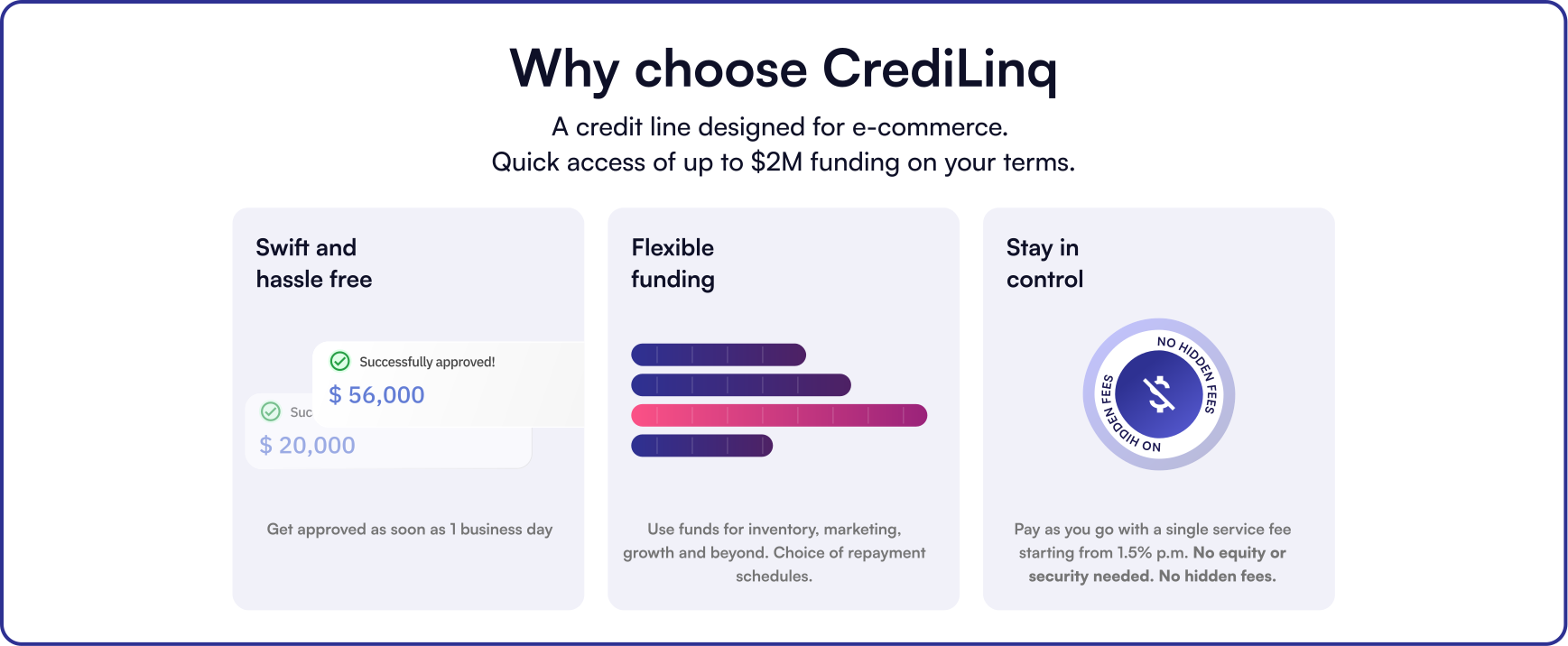
- Scalable line of credit: Need to restock across five marketplaces? Launch a new category? Credilinq offers a revolving credit line up to $2 million.
- Fast, paperwork-free approval: No balance sheets or profit and loss required. Applications take minutes, and approvals can come through in as little as 1 business day.
- Works across platforms and countries: Credilinq is built for high-growth, multi-store and multi-channel sellers. It supports sellers with multiple stores across Amazon, Lazada, Shopee, TikTok Shop, and eBay, all under one credit line.
- Flat monthly fees, no surprises: You pay only for what you use, with fees from 1.5% per month or a simple fixed annual percentage rate (APR) of 18% on the amount withdrawn. No hidden platform or processing charges.
- Flexible usage and repayment: Use the funds however you like. Repay in 3-6 months, in flexible bi-weekly installments that align with your sales rhythm and cash flow. Customized solutions are available upon request. Loan tenors can extend up to 12 months on a case-by-case basis.
- Cross-border currency support: Receive your funds in USD, GBP, or SGD, ideal for sellers operating across countries.
|
Suitable for: Experienced, multi-store and multi-platform sellers who need a flexible, transparent funding partner for ongoing growth |

Bridge the Gap Between Sales and Growth with the Right Financing
Even if your sales are steady, cash can take weeks to reach your bank. That delay can keep you from restocking or running ads when you need to.
The right financing tool helps bridge that gap. It is not just a backup; it gives you the freedom to act when opportunities come up.
But choosing one is not just about low fees. It is about finding a model that matches your growth stage and cash flow.
A bank overdraft might help new sellers get cash quickly. But mature sellers need higher limits and longer terms. On the flip side, a line of credit can be great for scaling, but only if you qualify.
So, instead of chasing the biggest loan or the lowest rate, focus on what fits. The right financing lets you grow with confidence, without overextending.
Frequently Asked Questions (FAQs)
What are the options for eBay loans?
eBay sellers can access financing through the eBay Seller Capital program, which partners with iBusiness Funding and Liberis. These partners offer merchant cash advances or business loans. Alternatively, sellers can use platforms like CrediLinq to connect their eBay store and apply for flexible credit lines up to $2 million.
Can I borrow money from eBay?
No, eBay does not lend money directly. Instead, it connects eligible sellers to third-party lenders, such as iBusiness Funding and Liberis. You can also consider lenders like CrediLinq, which allows you to link your store data to access credit lines quickly based on your performance.
Does eBay have a financing option?
Yes, through the eBay Seller Capital program. eBay works with financing providers iBusiness Funding and Liberis to offer seller-friendly loans and cash advances. Eligibility is based on your sales performance, not your credit score. These partners, not eBay itself, issue funds themselves.
What is eBay financing?
eBay financing refers to any funding a seller secures to run or grow their eBay store. This can include merchant cash advances, lines of credit, bank loans, credit cards, or programs like eBay Seller Capital. Financing helps cover expenses like inventory, ads, or shipping before customers pay.
Final Takeaways
- The “cheapest” option can cost you more in lost opportunities if it does not align with your business rhythm.
- Are you a new seller? Then go for flexible, low-barrier options. If you are an established store, choose higher limits with scalable terms.
- If you sell across platforms and need fast capital with flexible repayment, Credilinq offers a seller-first solution that moves at your speed.