




Overview
|
Why This Matters
|
Unsold inventory in your warehouse actively costs your business through storage fees, tied-up capital, and missed opportunities to invest in products that actually sell.
The cost of dead inventory can end up being a shocking 30% more than the inventory’s value on average.
Amidst fast-moving trends, shorter product lifecycles, and rising customer expectations around speed and availability, avoiding dead stock is increasingly difficult. Products lose relevance quickly, turning what was once a planned investment into “zombie inventory”, stock that sits unsold and unlikely to move.
This article breaks down how dead stock affects your business, liquidation strategies, and steps you can take to prevent excess inventory going forward.
How Dead Stock Impacts eCommerce Sellers
Dead stock is usually the result of poor inventory health, fast-moving trends, seasonal demand shifts, or overestimating what will sell. A product that looked promising a few months ago can quickly lose relevance, leaving sellers with zombie inventory that no longer matches demand.
- Blocks storage space: Unsold products occupy shelf space that could be used for faster-moving SKUs.
- Locks working capital: Money invested in dead stock cannot be redeployed into products that generate revenue.
- Adds carrying costs: Storage, handling, and fulfillment costs continue to accrue over time, reducing margins.
- Creates opportunity loss: Holding on to non-performing inventory delays your ability to act on new demand.
- Erodes margins: To move unsold inventory, sellers often resort to heavy discounts, which erode margins.
Liquidation Strategies For Dead Stock
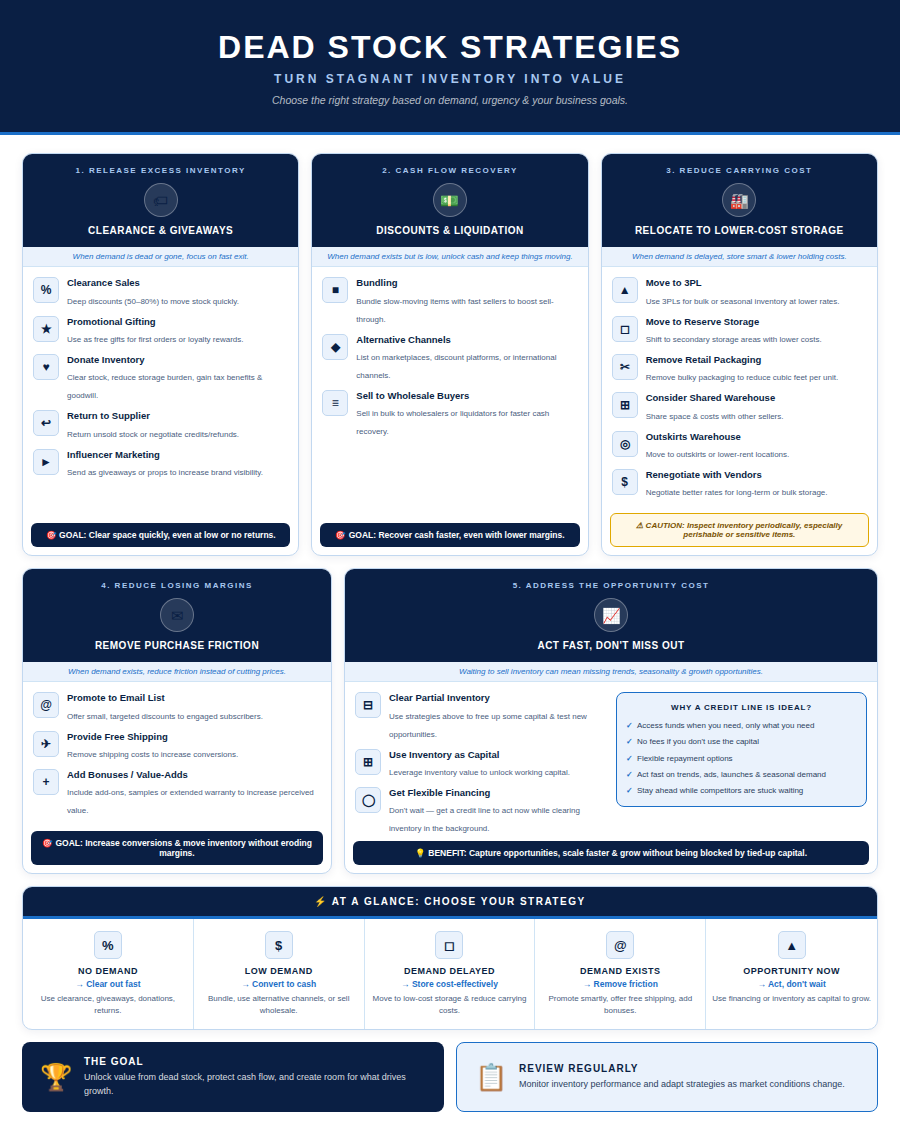
Each impact of dead stock can be traced back to a simple question: What do you need to fix right now?
- If you want to free up space — Release inventory
- If you want to unlock tied-up capital — Recover value with discounts
- If you want to reduce carrying costs — Relocate inventory
- If you want to protect margins — Retarget demand through controlled promotions
- If you want to capture new opportunities — Readjust inventory and capital
The sections below break down each approach in detail, so you can apply the right strategy based on what your business needs most right now.
1. Release excess inventory
When inventory has little to no demand and is unlikely to sell in the future, holding on to it only blocks valuable space. At this stage, the goal is not margin recovery; it is fast exit.
Run clearance sales
Run aggressive discounts to move inventory quickly. This could mean markdowns of 50–80%, depending on how outdated the product is.
Example: Clear out old phone cases for discontinued models at $2–$3 each to empty shelves before stocking newer models.
Leverage promotional gifting
Use dead stock as an incentive rather than trying to sell it directly. Offer it as a free gift on first purchases or as part of loyalty programs.
Example: “Free accessory with your first order” moves stagnant items while improving conversion rates for new customers.
Donate inventory
If selling is no longer viable, donating inventory can help recover some value indirectly through tax benefits and brand goodwill.
Example: Donate unsold apparel to nonprofit organizations, reducing storage burden while supporting community initiatives.
Return to supplier
If supplier agreements allow, return unsold inventory or negotiate partial refunds or credits for future purchases.
Example: Send back unsold seasonal stock to the supplier for credit toward next season’s inventory.
Lean on influencer marketing
Use dead stock in influencer campaigns where the product acts as a prop or giveaway rather than the core offering.
Example: Send excess inventory to micro-influencers for giveaways to clear stock while increasing brand visibility.
2. Recover value through discounts
When demand has dropped but not disappeared entirely, the focus shifts to cash flow management. The goal here is not to maximize margins, but to convert stock into usable capital quickly.
Bundle
Combine slow-moving products with fast-selling ones to improve overall sell-through.
Example: Bundle an older phone case with a popular new model case at a slightly higher price, making the deal more attractive.
Try alternative sales channels
What does not sell on your primary store might still move on marketplaces, discount platforms, or international channels.
Example: List excess inventory on marketplaces like Amazon, eBay, TikTok Shop, or discount-focused platforms where price-sensitive buyers are more active.
Sell to wholesale buyers
Offload inventory in bulk to wholesalers, resellers, or liquidation partners. This ensures faster cash recovery, even if it comes at a reduced per-unit price.
Example: Sell remaining stock to a bulk buyer at a 40% discount, recovering a portion of the investment immediately.

3. Relocate to economical storage
When demand is delayed, not gone, the goal is to hold inventory without letting costs pile up. This typically applies to seasonal or slow-cycling products that will sell later.
Move to reserve storage
Transfer inventory from primary picking shelves to reserve or secondary storage areas where space is cheaper but less accessible.
Example: Instead of occupying fast-access warehouse racks, move excess inventory to back storage, freeing up prime space for high-demand SKUs.
Move to lower-cost locations
Relocate inventory to warehouses in lower-rent areas where storage costs are significantly cheaper than urban or prime locations.
Example: Move from a city-based warehouse to an outskirts facility with lower monthly rates.
Move to a 3PL
Use third-party logistics provider that offers lower storage rates for bulk or long-term holding.
Example: Move off-season winter jackets to a 3PL warehouse with lower monthly storage fees until the next season.
Consider shared warehouse space
Use shared or co-warehousing setups where storage costs are distributed across multiple sellers.
Example: Shift excess inventory to a shared warehouse to reduce fixed storage expenses.
Remove retail packaging
Remove bulky retail packaging for items that will not be sold immediately to reduce storage volume per cubic foot.
Example: Instead of storing each unit in its original box, consolidate products into master cartons or polybags.
Renegotiate with warehouse vendors
Review your storage contracts and negotiate better rates, especially for long-term or bulk storage.
Example: Reduce rates for off-peak storage periods or commit to longer contracts in exchange for lower pricing.
Caution:
Reducing storage costs should not come at the expense of product quality. Inventory, especially perishable or sensitive goods, such as cosmetics or leather products, should be inspected periodically to avoid spoilage, damage, or obsolescence.
4. Retarget existing customers
When the goal is to sell without eroding margins, focus on reducing purchase friction so customers are more likely to convert at a reasonable price.
Promote through your email list
Target existing customers or subscribers who already trust your brand. Offer limited discounts to nudge conversions without undercutting pricing.
Example: Send a “subscriber-only” offer with 10–15% off on slow-moving items to drive sales.
Provide free shipping
Shipping costs are a common drop-off point. Absorbing or bundling shipping into the price can improve conversions without visibly discounting the product.
Example: Offer “Free shipping on all orders above $X” to increase average order value while moving inventory.
Add bonuses
Instead of lowering the product price, increase perceived value through add-ons or extras. This helps maintain pricing while making the offer more attractive.
Example: Include a complementary accessory or extended warranty with purchase to encourage decision-making.
5. Readjust inventory and capital
This is not about clearing stock entirely but creating room to test, launch, or scale products that are more likely to perform.
Clear partial inventory
Instead of liquidating all dead stock, selectively clear a portion using the strategies outlined earlier. This helps you unlock some cash while still holding inventory that may recover value later.
Example: Discount 30% of excess stock to generate immediate cash and use that to test a trending product category.
Use inventory as capital
If selling at a loss is not ideal, inventory financing allows you to borrow against the value of your stock.
Example: Use existing inventory as collateral to secure funds for a new product launch while continuing to sell the old stock gradually.
Use flexible credit
Discounts, bundling, or alternative channels do not always generate immediate liquidity. In fast-moving eCommerce markets, that delay can mean missing demand spikes, seasonal trends, or first-mover advantage.
When the priority is speed and flexibility, explore eCommerce financing options, such as a credit line, which gives access to funds on demand (instead of a fixed lump sum). You use only what you need, when you need it, and avoid paying for unused capital. This bridges the gap between current constraints (dead stock) and future opportunities (new SKUs, demand spikes).
CrediLinq is designed specifically for eCommerce sellers who need fast, flexible access to working capital without operational friction. Registered business in the US, UK or Singapore with $1M in annual revenue and 12 months of sales history get access to credit upto $2M.
- Platform-based underwriting: Connects directly with platforms like Amazon, Shopify, eBay, Walmart, and TikTok Shop to assess real-time sales data, no collateral required.
- Fast approvals with minimal paperwork: Get approved in as fast as one business day without lengthy applications or asset pledging.
- Flexible, multi-purpose credit line: Use funds for restocking, ads, or launching new SKUs, no restrictions on usage.
- Pay only for what you use: A flat monthly fee starting at ~1.5% or a simple fixed annual percentage rate of 18% applies only to the amount drawn. No usage means no cost.
- No lock-ins or hidden costs: No equity dilution, no collateral, no long-term commitments, and transparent pricing throughout.
- Repay on your terms: CrediLinq lets you repay flexibly in 3-6 months in biweekly installments instead of taking a percent of your daily sales.

What Should You Do With Dead Stock?
The right approach depends on demand:
No demand → Release inventory
Low demand → Recover value with discounts
Demand delayed → Relocate inventory to lower-cost storage
Demand exists → Retarget demand through promotions
Opportunity now → Readjust inventory and capital to act quickly |
How to Avoid Dead Stock in the Future
Preventing dead stock is less about one fix and more about consistent control across forecasting, monitoring, and replenishment. The goal is to keep inventory aligned with actual demand and course correct early.
Improve demand forecasting
Base purchasing decisions on actual sales patterns, not assumptions.
- Use historical sales data and seasonality trends
- Factor in promotions, pricing changes, and external demand shifts
- Avoid over-ordering “just in case”
Example: If a product consistently peaks between November and January, plan inventory around that window instead of spreading stock evenly across the year.
Audit inventory regularly
Do not wait for inventory to age before reviewing it.
- Track aging inventory (e.g., 30, 60, 90+ days)
- Identify slow-moving SKUs early
- Segment inventory by performance (fast vs slow movers)
Example: If an SKU has not sold in 30–45 days, flag it. This gives you time to discount or reposition before it becomes dead stock.
Track key inventory KPIs
Visibility into performance helps prevent buildup.
- Inventory turnover ratio — how quickly stock is sold and replaced
- Sell-through rate — percentage of inventory sold in a given period
- Days inventory outstanding (DIO) — how long stock sits before selling
Example: If turnover drops from 6x to 3x annually for a category, it signals overstocking or weakening demand.
Set reorder points
Avoid both overstocking and stockouts with structured controls.
- Set reorder points based on lead time and demand
- Use economic order quantity (EOQ) to determine optimal order size
- Align purchasing cycles with actual sales velocity
Example: If you sell 10 units/day and the supplier lead time is 7 days, your reorder point should cover at least 70 units (plus buffer), instead of ordering large bulk quantities upfront.
Use an inventory management system
Manual tracking leads to delays and errors, especially when dealing with multi-channel inventory management.
- Centralize inventory data across channels
- Automate stock alerts and replenishment triggers
- Maintain real-time visibility into stock levels and movement
Example: Tools integrated with platforms like Shopify or Amazon can automatically flag low stock, highlight slow-moving SKUs, and sync inventory across channels.
Turn Dead Stock Into a Strategic Advantage
Dead stock does not have to be written off. By assessing demand and acting early, you can still recover value, reduce losses, and make room for better-performing products. The key is to match your response to the situation: release, recover, relocate, readjust, or retarget.
But your business cannot afford to wait while inventory clears. Solutions like CrediLinq provide flexible working capital based on real-time sales data, enabling you to fund new products, campaigns, or expansion without waiting for full liquidation. The goal is not just to manage dead stock, but to keep your business moving forward.

Final Takeaways
- Dead stock actively costs you through storage fees, tied-up cash, and products you can’t buy because your money is stuck in the wrong SKUs.
- The right move depends on what’s going on with demand. Exiting fast, recovering cash, or just finding cheaper storage are all valid. Just don’t apply the same fix to every situation.
- The longer you wait, the worse your options get. Catching a slow-mover at 30–45 days still gives you room to maneuver. At 90+ days, you’re usually just cutting losses.
- Most dead stock is avoidable. Better forecasting, tracking the right KPIs, and setting proper reorder points go a long way before things pile up.
- And while you’re waiting for inventory to clear, your business still needs to move. That’s where having access to flexible capital makes the difference, so you’re not stuck waiting on dead stock to fund your next move.
Frequently Asked Questions
What is zombie inventory, and how does it impact inventory health?
Zombie inventory refers to stock that has little to no sales over an extended period. It weakens overall inventory health by tying up working capital, increasing storage costs, and limiting your ability to invest in better-performing products.
What are effective liquidation strategies for zombie inventory?
Common liquidation strategies include clearance sales, bundling, wholesale, and alternative sales channels. These help recover working capital quickly. If immediate liquidity is still a challenge, CrediLinq bridges the gap while inventory is being cleared.
What is the best timing for liquidating zombie inventory?
Acting sooner improves inventory health and frees up working capital for reinvestment into higher-performing SKUs.
What are the tax implications of inventory liquidation?
Liquidating inventory at a loss allows businesses to claim write-downs or deductions, depending on local tax regulations. However, discounted sales still generate taxable revenue.
How often should I review inventory health KPIs?
Inventory health KPIs such as turnover ratio, sell-through rate, and aging inventory should be reviewed weekly or monthly. Frequent monitoring helps identify zombie inventory early and take corrective action before it impacts cash flow and working capital.
What dashboard tools are best for monitoring inventory health?
Inventory management systems and analytics dashboards integrated with platforms like Shopify or Amazon provide real-time visibility into inventory health. These tools track KPIs, highlight slow-moving stock, and support faster decisions.