




Highlights
- A $500K purchase order can return a negative margin because platform fees, freight, marketing, and financing stack after COGS
- Amazon’s fee stack consumes 35 to 50% of revenue because referral, FBA, and storage costs apply before ads
- Financing structure impacts ROI more than interest rate because cost visibility determines how accurately margins can be modeled
- Misreading breakeven traps capital because contribution margins are often overestimated at the planning stage
- A flexible line of credit like CrediLinq improves decision making because financing becomes a known input before capital is committed, while also fueling growth across markets and marketplaces, restocks, ads, and more.
Why This Matters to You
|
Introduction
You run the numbers, place the order, and by the time your inventory sells through, the margin is lower than expected. It’s one of the most expensive planning failures at scale, and one of the most avoidable.
Most ecommerce ROI calculators stop at the cost of goods. They don’t account for what happens between the factory gate and the customer’s door: freight, duties, Fulfillment by Amazon (FBA) fees, pay per click (PPC) spend, payment processing, and the capital you borrowed to fund it all.
For sellers running $500K+ orders, those costs add up fast.
Most sellers don’t lose money due to weak demand. They lose it because their cost model is incomplete when capital is deployed.
Learning how to work through it to price every cost layer in sequence, and knowing whether the order is profitable before the money is spent is key to winning this battle.
Before the purchase order goes out, take a moment to check whether you need financing for this cycle and whether that cost is built in.
The Profitability challenge in scaling Ecommerce Revenue
A $500K order looks different on paper than it does in the bank account.
On Amazon, referral fees (5 to 45% of revenue), FBA fulfillment charges, monthly storage, and inbound placement costs already consume 25 to 35% of your selling price, and that’s before a single ad runs. Most scale stage sellers spend a further 5 to 15% of revenue on Total Advertising Cost of Sales (TACoS).
By the time both layers are counted, more than half of the revenue has left the building before profit is even in the conversation.
Freight and duties make it worse. Tariffs require Harmonised System (HS) code level modeling because category averages aren’t close enough at this order size. A 1% duty miscalculation on a $500K order costs $5,000. That’s not a rounding error.
Most sellers at this scale fund large inventory orders with a line of credit rather than using up their cash reserves. That means the financing fee is a line item in the cost stack, not an afterthought.
Accounting for every cost layer accurately, from freight and duties to platform fees, marketing, and financing, is what separates a reliable ROI model from one that flatters you before the order ships.
Inputs checklist: Landed cost analysis, marketing spend, financing fees
At $500K+ order sizes, profitability is determined before the purchase order is placed, not after sell through. Identify ever cost layer – quantify and source it upfront. Missing even one input can distort the ecommerce ROI calculator enough to turn a profitable looking order into a loss.
The checklist below breaks the model into core cost pillars, outlining exactly what to collect and where to source it from. This ensures your ecommerce ROI calculator is built on actual inputs, not assumptions. Use this as a pre-order validation step before committing capital.
ROI inputs checklist: what to collect before placing a $500K order

Product and landed costs
Product and landed costs cover everything it takes to get inventory from the factory to a fulfillable location. That starts with the purchase order value, but it doesn’t stop there.
Freight typically $1,500–$6,000 per container, import duties often 5–20% of CIF value, customs brokerage $35–$175 per entry, port handling $300–$600 at US ports, cargo insurance 0.3–1% of cargo value, and first-mile delivery $200–$1,500 port-to-warehouse all sit between the supplier invoice and the moment stock is available to sell.
Most sellers model the purchase order value and stop. The duty rate alone, applied at the wrong HS code, can shift the landed figure by thousands of dollars.
Duty rates vary significantly by HS classification, making correct code selection critical for accurate landed cost modeling.
Nothing is concrete until you have an actual freight quote. Model at the unit level; the variance across products and routes is too wide to use a category average.
Marketing
PPC and affiliate spend are the cost of generating the revenue the model assumes, not optional extras. Set your TACoS target before placing the order. Amazon marketplace affiliate commissions scale with sales rather than bids, so they’re easier to estimate but harder to cap.
Marketplace platform fees
Amazon’s fee structure shifts as per product size tier, category, and fulfillment type. Run your ASINs through Amazon’s FBA Revenue Calculator before building the model. Being off by one size tier moves unit economics by $3–$5 per unit. On 5,000 units, that’s a $15,000 to $25,000 modeling error before a single item ships.
Payment gateway
Every time a customer completes a purchase, the platform that processed the payment takes a cut. This fee, charged by providers like Shopify Payments, Stripe, or PayPal, typically runs between 2.4% and 3.5% of the transaction value.
For example, on a $140 sale, a 2.9% gateway fee costs $4.06. Across 5,000 units at full sell through, that adds up to roughly $10,500 on $700K in revenue.
Most sellers plug in a default rate from the platform’s pricing page. The more accurate approach is to use your blended rate, which is the actual average percentage you paid across all payment methods, currencies, and transaction types over the last 60 to 90 days.
This single figure accounts for the real mix of how your customers pay, credit cards, debit cards, international transactions, and digital wallets, all of which carry slightly different fees. Log into your payment dashboard and calculate it from real transaction data. That number goes into the model.
Financing
For most sellers operating at this scale, large inventory orders are rarely funded from cash reserves alone. External financing, typically a line of credit, is a practical reality, and that means the cost of that capital is a line item in your model, not an afterthought.
For professional, omnichannel, and cross-border sellers scaling from seven to nine figures in GMV, financing structure is a planning tool.
Unlike most other cost inputs, financing cost is one of the few you can know with certainty before the purchase order is placed. If you are drawing on a line of credit, the fee is fixed and calculable upfront. It belongs in the model from day one, alongside landed costs, platform fees, and marketing spend.
Sellers running multi-SKU orders at this scale benefit from tracking these cost inputs across inventory cycles, not just at the point of placing a new order.
Once you know the full cost stack, the next question is whether your business qualifies for the working capital to fund it.
Illustration: How does ROI modeling work for $500K Amazon orders
Imagine this: there is a mid-range consumer goods SKU on Amazon FBA, with a $500K purchase order ($475K manufacturing, $25K packaging), 5,000 units, and an average selling price (ASP) of $140.
Step 1: Building the ROI calculation model
Before evaluating profitability, every cost layer must be applied to the same revenue base. This step reconstructs the full unit economics of the order, combining landed costs, platform fees, marketing spend, and financing into a single model.
What looks like a healthy margin at the product level often compresses once these layers are applied sequentially.
Landed cost: The $500K PO plus $25K in freight and duties (5% HS rate on $475K manufacturing value, approximately $24K) totals $525,000, or $105 per unit.
Marketing: 12% TACoS on $700K projected revenue equals $84,000.
Amazon fees: $14 referral plus $14.50 FBA equals $28.50 per unit, or $142,500 on 5,000 units.
Gateway fees: 1.5% of $700K equals $10,500.
Financing: 1.5% per month on $500K for 3 months equals $22,500, a fixed cost you can confirm before signing the purchase order, which means it belongs in the model from the start. With a structured line of credit, this is one of the few cost inputs that can be modeled with certainty before capital is deployed.
Returns: 3% of revenue equals $21,000, based on a conservative category benchmark.
Step 2: Net profit margin formula
Once all cost layers are defined, the next step is to bring them into a single view to calculate true profitability. This means mapping every cost component against gross revenue to understand how margin is eroded across the cycle.
What matters here is not just total cost, but how each layer contributes to margin compression.
The table below consolidates the full cost stack for this $500K order, showing both absolute cost and percentage of revenue to make the impact of each component clear.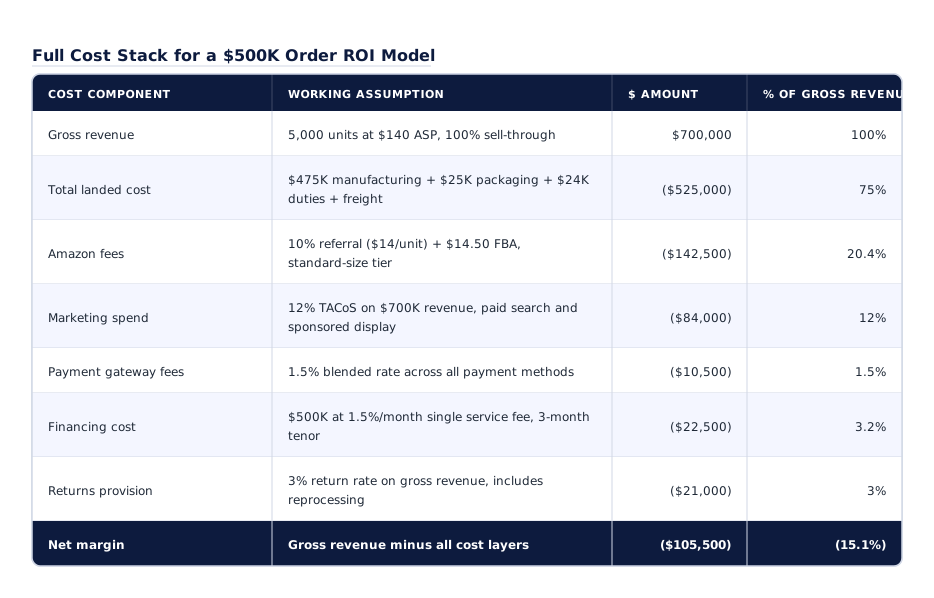
*Note: The negative margin is deliberate. This scenario illustrates what a common over-optimistic model looks like once all cost layers are applied sequentially. The two primary drivers are a 12% TACoS, which is high relative to the contribution margin available after landed costs, and a thin ratio between the average selling price (ASP) and total per-unit fees.
In this scenario, Amazon referral and FBA fees alone account for $28.50 per unit against a $140 ASP, meaning 20.4% of every sale goes to platform fees before marketing, financing, or returns are counted. When ASP is not high enough relative to the fixed per-unit fee load, margin compresses fast and leaves little room for the variable cost layers that follow.
Even with 100% sell-through, the order results in a negative margin. This is not due to a single cost component, but the cumulative effect of multiple layers that are often under modeled or excluded entirely.
Step 3: Sensitivity scenarios
Once the full cost stack is built, the next step is to test the model’s sensitivity to key variables. At this scale, small shifts in marketing efficiency, pricing, or landed cost can materially change the outcome of the entire inventory cycle.
Sensitivity analysis highlights which levers actually move profitability and which ones don’t.
- Moving TACoS from 12% to 8%: This recovers $28,000. That alone won’t flip the cycle to positive, but if you pair it with an ASP of $165+ on this cost structure, the numbers work.
- Duty Rate up by 2% on $475K Manufacturing Value: This would add approximately $9,500 to your landed costs.
- Sell through drops to 85%: revenue falls to $595K while fixed costs remain unchanged. The loss gets worse fast.
Fund your next inventory cycle with a flexible line of credit from CrediLinq, so financing cost is a known input, not a post sale surprise. The upfront, transparent, and flexible pricing allows you to calculate effectively whether the order works on paper. The next question is how cash flows through the cycle and where it gets constrained.
Where cash gets stuck: Understanding the capital stress layer
An ROI model tells you whether an order is profitable. A capital model tells you whether you can survive the time it takes to realize that profit.
These are different problems. Most sellers model the first and underestimate the second.
On a $500K order, the gap between placing a purchase order and receiving a meaningful Amazon payout is typically 60 to 90 days. You are required to pay the supplier before the goods arrive. You pay FBA inbound and logistics costs before inventory is available for sale.
PPC spends come in before conversions recover that cost. Amazon’s bi weekly payout cycle (every ~14 days), combined with post delivery holding periods and bank transfer delays, causes revenue to lag behind sales, often extending the cash conversion cycle to several weeks.
Running multiple order cycles compounds the problem. Funding a second $500K order before the first has fully converted to cash effectively doubles working capital requirements without doubling available liquidity.
Sellers who track both the cash conversion cycle and SKU-level sell through rates make better capital allocation decisions, prioritizing faster-turning inventory and avoiding capital lock up in slow-moving stock.
This is where the financing structure becomes critical. When capital aligns with inventory cycles and payout timelines, the cash gap becomes manageable. When it doesn’t, even profitable orders can create liquidity stress.
Reading the numbers: Net profit, breakeven, ROAS
Once the cash gap is understood, the next step is to interpret what the model is actually telling you. At this stage, three metrics determine whether the order is worth funding: net profit margin, break even sell through, and return on ad spend (ROAS).
Each answers a different question. Profitability, risk, and efficiency.
Net profit margin formula
Net profit margin = (Gross revenue − Total costs) ÷ Gross revenue × 100
In plain terms: subtract every cost layer, landed costs, platform fees, marketing spend, financing, returns, and payment gateway fees, from gross revenue, divide that figure by gross revenue, and multiply by 100 to get your margin as a percentage.
At this order size, many healthy Amazon businesses land in the 12 to 22% net margin range, depending on category; less than 8% usually signals a structural cost issue (e.g., most ecommerce brands target 10 to 20%+ net margins, with thinner margins often seen as weak).
Breakeven sell through
Use contribution margin to calculate the true breakeven point. The table below breaks down fixed costs, variable costs per unit, and the resulting breakeven threshold for this $500K order.
Breakeven analysis for a $500K order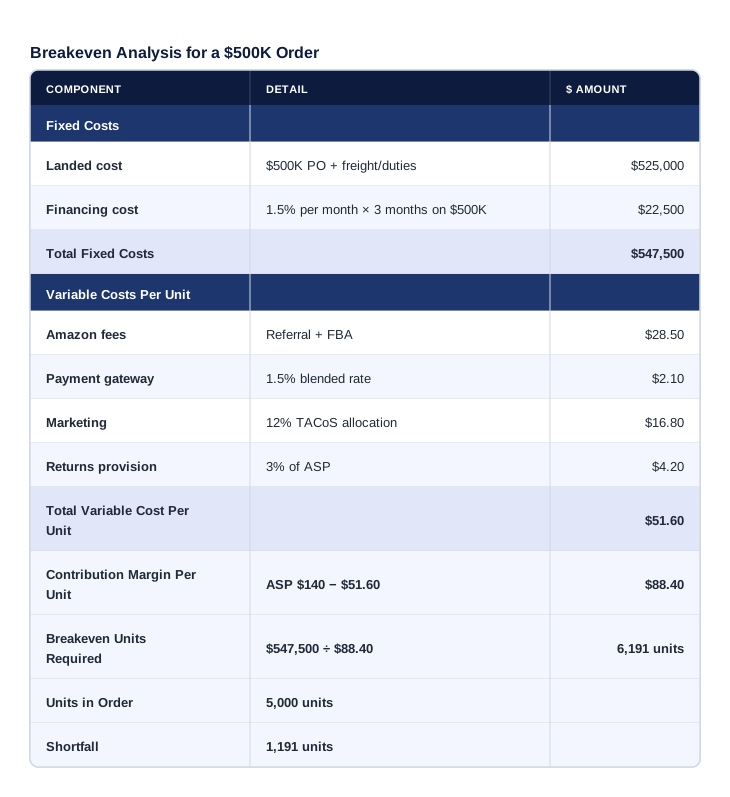
The model shows that this order is structurally unprofitable before a single unit ships. This is not a demand problem. It is a unit economics problem built into the order itself.
Boosting ROI: practical optimization strategies
Once the model demonstrates where margin is lost, the next step is to act on it. At this stage, improving ROI is not about increasing sales. It is about tightening the cost structure across the inventory cycle.
Four levers consistently have the highest impact: supply chain, marketing efficiency, marketplace performance, and financing structure.
Supply chain
Running landed cost analysis at the HS code level rather than using category averages reduces variance and improves accuracy. Even small duty misclassifications can shift total cost meaningfully at this scale.
Bonded warehousing allows sellers to defer duty payment until goods are sold. At a 5 percent duty rate, this can preserve a significant portion of working capital during the sell through period.
Negotiating extended payment terms with suppliers or shifting from Cost, Insurance and Freight (CIF) to Free on Board (FOB) terms reduces the amount of capital tied up before inventory is ready to sell.
Marketing
Marketing spend is one of the few cost levers you can move quickly without renegotiating a supplier contract or switching logistics providers.
In the $500K scenario, advertising was modeled at 12% TACoS on $700K projected revenue, totaling $84,000. Pulling that back to 8% recovers $28,000. That’s more than the full financing cost of the cycle at $22,500, from a single efficiency improvement.
Better listing conversion rates do the same work without touching bids. Stronger keywords and creatives mean more sales per dollar spent, which brings TACoS down without cutting visibility.
Marketplace optimization
Buy Box ownership directly affects margin. Losing the Buy Box on a high-volume ASIN often increases acquisition costs, as sellers are forced to bid more aggressively to recover traffic.
Listing quality also plays a critical role. Accurate dimensions, complete attributes, and strong imagery reduce return rates and improve organic ranking, strengthening unit economics without additional spend.
Financing
The financing structure determines whether capital supports or constrains growth.
With revenue-based financing, repayment scales with sales, which can compress margins during high revenue periods. In contrast, a structured line of credit has a fixed and predictable cost, allowing financing to be modeled upfront as part of the ROI calculation.
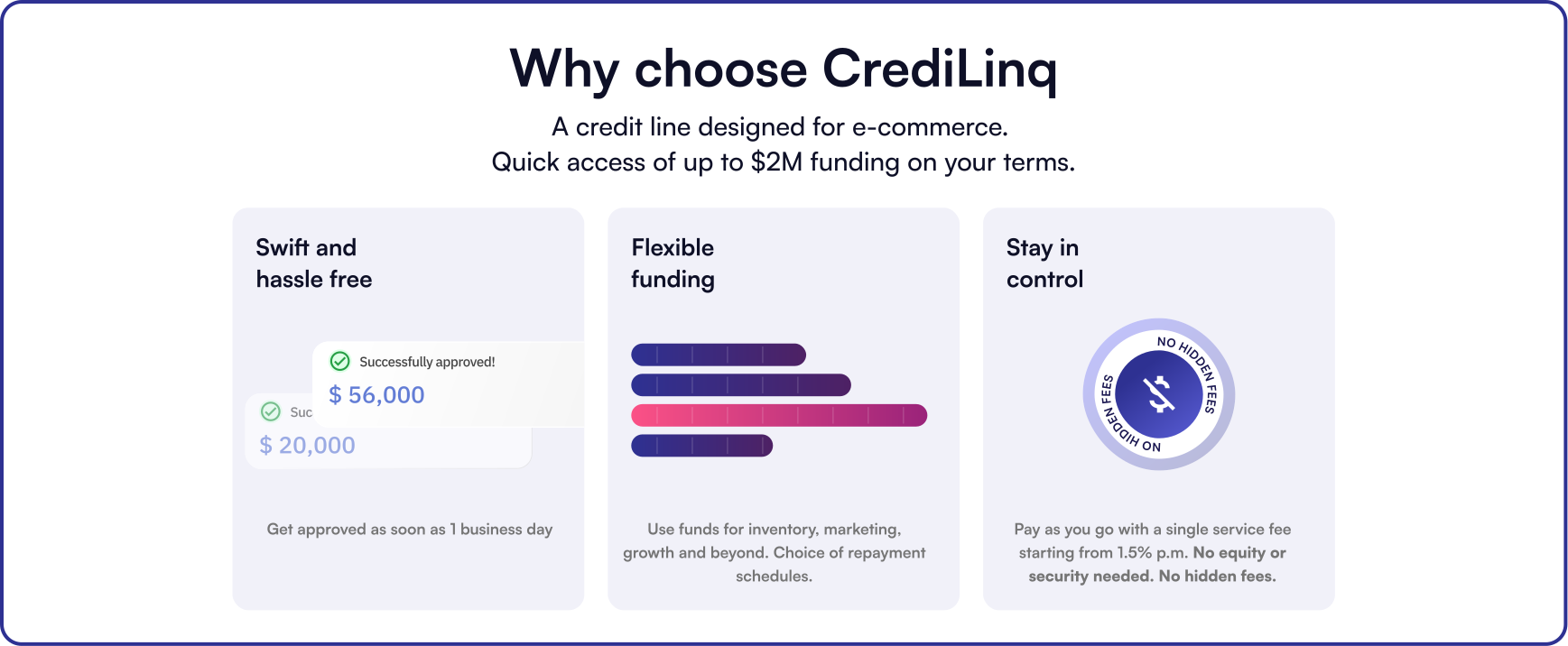
CrediLinq’s line of credit supports ecommerce sellers managing large inventory cycles. CrediLinq is also an Amazon-approved partner in 16 markets. It enables sellers to align capital with inventory timelines and marketplace payouts, while keeping financing costs predictable before the purchase order is placed.
Financing structures and capital efficiency
Once the ROI model is built, the next question is not just whether the order is profitable, but whether the financing structure supports that profitability.
Two loans with similar rates can produce very different outcomes depending on how and when repayment happens. At this scale, capital efficiency is driven less by the cost of capital alone and more by how predictable and modelable that cost is before the purchase order is placed.
The comparison below shows how different financing structures impact ROI visibility, cash flow timing, and overall capital efficiency across an inventory cycle.
Financing options for ecommerce sellers – A quick comparison

Among these structures, a revolving line of credit offers the highest level of control over both cost and timing. As referenced throughout this model, CrediLinq is built specifically for professional, omnichannel, and cross-border sellers scaling from seven to nine figures in GMV. Here is what that means in practice:
- Fixed, upfront cost of capital that can be modeled into ROI before the purchase order is placed
- Repayments structured as fixed bi-weekly instalments over a 3 to 6 month tenor, with no early repayment penalties
- No equity dilution and no revenue sharing
- Pay only for what you draw, with no hidden fees
- Financing that works across Amazon, TikTok Shop, Shopify, eBay, Walmart, and other marketplaces
- Designed for $500K+ inventory cycles, with a single monthly service fee as low as 1.5% or a simple, fixed annual percentage rate of 18% on drawn funds and no hidden charges, so financing cost is a fixed input before the purchase order is placed
When financing is structured this way, the cost is known before the order goes out. Sellers who build that number into the model upfront tend to make better decisions across the whole cycle, on supplier terms, logistics timing, and how aggressively to push marketing spend. Sellers who don’t find out what the order actually cost them once the payout lands.

Model the cycle before you commit the capital
A $500K order is a capital deployment decision, not a bet. For it to be executed profitably, the ecommerce ROI calculator needs to be modeled before the purchase order s signed.
Landed costs, marketplace fees, marketing spend, and financing are all knowable in advance. The framework above brings these inputs into a single model that produces a net margin estimate, a breakeven sell through figure, and a clear view of the cash gap between order placement and first payout. This allows sellers to make decisions based on data rather than assumptions.
Sellers who align capital to SKU-level sell through rates, rather than treating the order as a single number, retain margin that others lose. Building the model first also improves negotiating power across the cycle, from supplier terms to logistics costs to financing structure.
The model is not just a calculation. It is a control system for how capital is deployed and recovered.
When financing is predictable, this control becomes stronger. A structured line of credit allows sellers to incorporate capital cost into the model upfront, rather than discovering its impact after the cycle is complete.
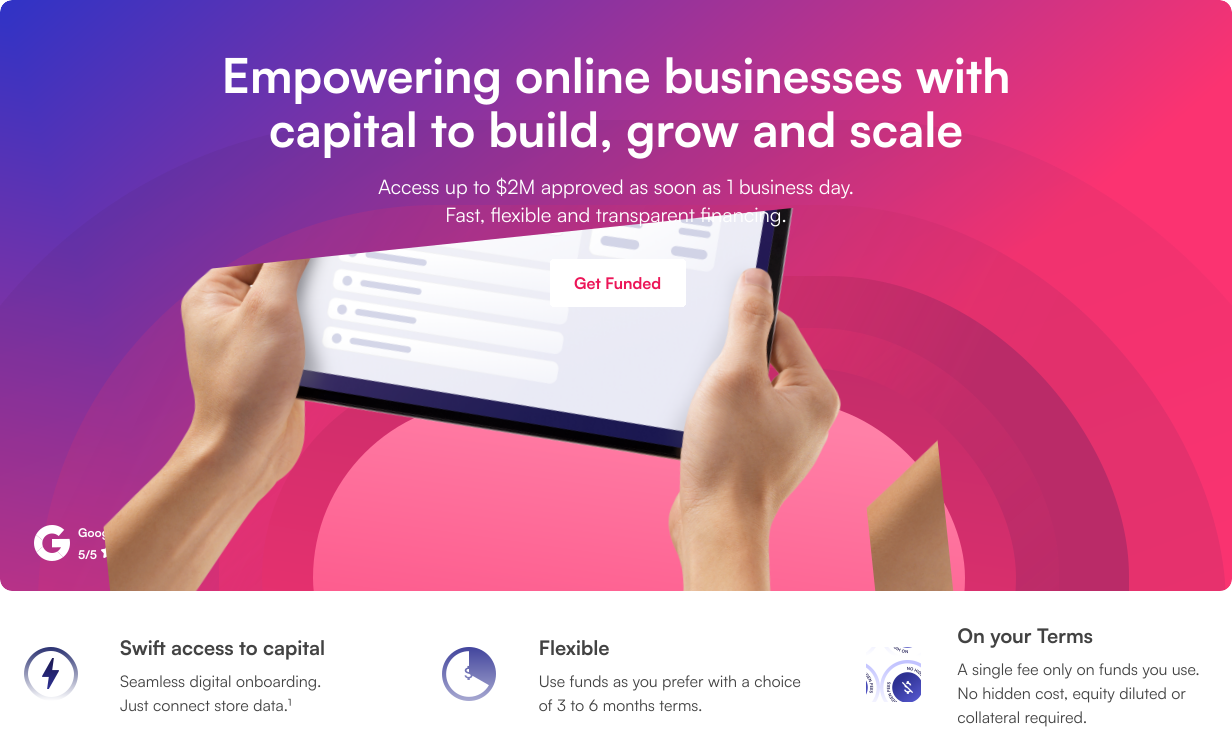
CrediLinq’s line of credit is designed for this approach, with transparent pricing, fixed monthly fees, and a 3 to 6 month tenor. You can also repay early with no penalties.
Timing is everything for Amazon sellers prepping for sales seasons, and CrediLinq provides credit decisions as fast as one business day, accelerating your growth plans.
What this actually gives operators is control. When financing cost is known upfront, margins don’t leak, cycles don’t stall, and growth decisions are based on numbers rather than assumptions.
Key Takeaways
- An incomplete ROI model is the most common reason profitable-looking orders turn into losses
- Contribution margin and breakeven sell through are more granular decision metrics than top-line revenue or ROAS alone
- Small percentage errors in duties, fees, or marketing spend can translate into large absolute losses at scale
- A modelable and predictable cost of capital enables better planning, negotiation, and scaling decisions
- Treating inventory at the SKU level rather than as a single order improves capital allocation and reduces risk
- The strongest operators do not rely on post cycle analysis; they build and validate the model before deploying capital
- Financing structure directly impacts both margin visibility and cash flow stability across the cycle.
FAQs
1. What is the difference between ROI and ROAS in e-commerce?
ROI measures overall profitability once every cost, such as landed cost, platform fees, financing, and marketing, has been deducted from revenue. ROAS measures how much revenue each ad dollar generates. A strong ROAS can still result in a loss at the order level, which is why serious sellers track both. ROAS is used to manage ad efficiency, while ROI determines whether the full inventory cycle is profitable.
2. How do I estimate tariffs and duties for landed cost analysis?
Look up the exact 10 digit HTS code for your product in the US Harmonized Tariff Schedule rather than using a category estimate. Duty rates vary significantly by classification. For goods sourced from China, Section 301 tariffs between 7.5 percent and 25 percent may also apply.
Getting the classification wrong can lead to a material error in total landed cost at this scale.
3. How should I model marketplace platform fees in ROI calculations?
Run your ASINs through the Amazon FBA Revenue Calculator and model fees at the unit level, including referral fee, fulfillment, and storage. Fee structures vary significantly by product category and size tier, and even a small mismatch can shift unit economics meaningfully.
4. How do I account for returns and refunds in Amazon sales ROI?
Start with category-level benchmarks such as 5 to 8 percent for electronics, 15 to 30 percent for apparel, and 3 to 6 percent for health and beauty. Apply the relevant rate to gross revenue and include return processing and write down costs in your model. Returns processing fees in high return categories should be included within platform fees rather than treated separately.
5. How do financing costs affect Amazon sales profitability?
On a $500,000 draw at 1.5 percent per month for 3 months, the fee is $22,500, which is approximately 3.2 percent of $700,000 projected revenue. The length of the inventory cycle is the key variable. Aligning repayment timing with marketplace payout cycles reduces the effective cost of capital over the cycle.
6. How does a line of credit impact Amazon sales ROI calculations?
A line of credit provides a fixed, known cost structure before a purchase order is placed. This allows financing to be treated as a defined input in the ROI model, rather than as a variable that appears only after sales are realized.
Because it is revolving, sellers can draw, repay, and reuse capital across inventory cycles without having to reapply. This improves capital efficiency and supports continuous scaling.
A structured line of credit, such as CrediLinq, also aligns repayment timelines with inventory cycles and marketplace payouts, making the financing cost predictable and easier to model upfront.