




Overview
-
- Prime Day growth can strain liquidity because inventory, freight, and ad spend are funded months before revenue is realized.
- Precise demand forecasting across sourcing, logistics, and marketing determines whether Prime Day becomes scalable profitability or costly overextension.
- The type of financing you choose affects your margins and cash flow. Revenue-based financing models take a cut from every sale, while structured credit lines have fixed repayments that make cash-flow planning easier.
- Planning ahead and starting the stocking and funding process 4-5 months early to accommodate FBA cutoffs prevents stockouts, protects rankings, and preserves sales velocity.
- A structured line of credit like CrediLinq’s helps sellers fund inventory, ads, and logistics ahead of Prime Day with no equity dilution or collateral required.
Why This Matters to You
- If you are a $1M–$20M Amazon seller, Prime Day is a capital stress test.
- The difference between scaling profitably and missing demand often comes down to how well you plan and fund your inventory cycle.
- This guide will help you estimate how much capital you actually need, understand which financing structures protect your margins, align funding with inventory, logistics, and payout cycles, and avoid common liquidity traps during high-growth periods
- If you are planning for Prime Day, evaluating your funding options early can help you secure capital before inventory deadlines tighten.
Amazon Prime Day 2026 is expected to take place in early to mid-July, with current estimates suggesting a window of July 8–11, based on recent event patterns. For sellers, however, preparation begins much earlier, often as early as February or March, when inventory planning, supplier coordination, and logistics timelines are set in motion.
Prime Day is one of the year’s highest-demand sales events, often driving sharp spikes in traffic, conversion rates, and order volumes across categories. In recent years, hundreds of millions of items have been sold globally during the event, highlighting the scale of opportunity for marketplace brands. For established sellers, the challenge is rarely demand generation. It is preparing enough inventory and capital to meet that demand at the right time.
Inventory must be purchased months in advance. Freight lead times and Fulfillment by Amazon (FBA) intake deadlines force sellers to commit capital well before revenue materializes. Marketing spend spikes before revenue arrives, and payouts lag behind reinvestment needs.
That is why Amazon Prime Day inventory funding has become a strategic priority for professional e-commerce sellers generating $1M–$20M annually. It is essential to secure the right type of capital without sacrificing ownership or revenue share or compressing long term margins.
Many scaling sellers address this by using structured working capital solutions such as CrediLinq’s line of credit, which allows them to fund inventory, advertising, and logistics in advance while repaying predictably as sales convert into cash. This reduces reliance on equity or sales-linked repayment structures and enables more controlled scaling during high-demand events like Prime Day.
This guide breaks down the full Prime Day inventory funding playbook for 2026, from sales forecasting and supply chain planning to non-dilutive, non-revenue sharing financing structures.
Why Capital Planning Matters for Amazon Prime Day Inventory Funding
Many Amazon sellers see a dramatic spike in demand during Prime Day. In 2025, Amazon expanded the event to four days (July 8-11) and reported it as the company’s biggest Prime Day ever, with record estimated sales of $24.1B and an estimated 375+ million items sold globally, surpassing any previous four-day period that included a Prime Day event.
During the event, customers saved billions across more than 35 product categories, indicating both high purchase intent and aggressive promotional activity.
For sellers, this combination creates a unique dynamic:
- Demand surges significantly within a compressed time window
- Pricing pressure increases due to discounts and competition
- Inventory must be available in full before the event begins
This means Prime Day is not just a sales opportunity. It is a pre-funded event, where the ability to capture demand depends on how much inventory and marketing spend can be deployed in advance.
Independent sellers, most of which are small and medium-sized businesses, achieved record sales and sold a record number of items during Prime Day 2025. In 2024 (which is the last official data available), these sellers sold over 200 million items globally, highlighting the massive scale of opportunity for third-party brands on Amazon. For many businesses, Prime Day can drive 2x–3x increases in sales compared to a typical week, fueled by spikes in traffic and promotional activity.
While the surge creates a major revenue opportunity, it also compresses the inventory cycle. Sellers must order and ship stock months in advance to ensure it arrives at Amazon’s fulfilment centres before FBA cut-off deadlines for Prime Day.
For Prime Day 2026, Amazon recommends making sure your inventory arrives at their facilities by May 27 for AWD shipments and minimal shipment splits, and by June 5 for Amazon-optimized splits, which means your shipping timelines begin at least 2 weeks ahead of May 27, by the second week of May.
Without sufficient working capital to fund large inventory purchases in advance, even high-performing brands risk stockouts, lose Buy Box visibility, and see product rankings decline during one of the year’s highest-traffic events.
For professional sellers operating at scale, the inventory requirement can be substantial. A brand generating $3M–$5M in annual Amazon GMV may need to deploy $400K–$700K in inventory to support Prime Day demand alone, depending on category margins and turnover rates. Larger brands often commit even more capital to ensure sufficient depth across their best-selling SKUs.
The timing of these investments creates a significant cash-flow gap. Inventory orders are typically placed 90–120 days before Prime Day to account for manufacturing lead time, freight, customs clearance, and FBA check-in time. Yet Amazon seller payouts are released on a 14-day cycle after sales occur. This means capital can remain tied up for four to five months before fully returning to the business.
For example, a seller placing a $500,000 inventory order in April may not fully recover that capital until late July or August, once Prime Day sales settle and Amazon payouts are completed.
Note: How We Arrive at the $400K–$700K Prime Day Inventory Range
For a mid‑sized Amazon brand generating $3M to $5M in annual GMV, Prime Day inventory needs are typically modeled using a demand‑multiplier + safety‑stock framework.
Many sellers and agencies estimate event‑period inventory by applying a category‑specific multiplier to normal daily sales over the event window, then adding a meaningful buffer to avoid stockouts. (Source)
A $3M–$5M seller averages roughly $8K to $14K in daily sales, and Prime Day guidance often advises planning for 5–10x demand (for 4 days) plus 25 to 50% safety stock, which can translate to $200K to $800K+ in event‑period sales velocity.
When converted into committed inventory value (accounting for cost, margin, and stock‑up strategies), this feeds into the $400K to $700K ballpark for top SKUs. (Source)
Additionally, many Prime Day playbooks recommend increasing FBA stock on hero products by 25 to 35% above baseline, and mid‑sized sellers are often advised to maintain 60 to 90 days of supply on leading ASINs that is well above Amazon’s 28‑day minimum, to win the Buy Box and protect rankings.
These heuristics, combined with standard inventory‑planning tools and real‑world data, underpin the given range. (Source) |
This is why early capital planning and access to inventory funding are critical to helping sellers fully capture Prime Day demand.
That upside requires upfront investment across multiple layers, including:
- Inventory purchases
- Manufacturing deposits
- Freight and customs
- FBA prep and storage
- Advertising and promotions
- Returns buffers
- VAT and tariffs
The most common constraint is liquidity.
The real cost of stockouts during peak demand.
Running out of inventory during Prime Day creates cascading consequences, including:
Lost sales velocity, which weakens listing momentum during the event. Amazon’s ranking algorithm heavily weighs recent sales performance, meaning that even short interruptions in sales velocity can reduce product visibility in search results.
BSR (Best Sellers Rank) drops, making it harder for your product to appear in high-intent search results. Because BSR updates frequently based on sales activity, a temporary stockout during high-traffic periods can quickly push listings down category rankings.
Buy Box loss, which allows competing sellers or similar products to capture demand. Inventory availability is one of the key Buy Box eligibility factors in Amazon’s algorithm. Losing the Buy Box can wipe out months’ worth of sales velocity, requiring months more to recover.
PPC inefficiency, where you continue your marketing spend, but your conversions fall to zero due to stockouts and suppressed listings.
Competitor displacement occurs when your rival listings gain visibility and reviews while your product is unavailable, which further affects your BSR.
Recovery costs: After the event, you must spend more to rebuild your customer base and ranking with higher ad spends and steeper discounts.
For high-velocity SKUs, even a short stockout during Prime Day can undo months of ranking optimization and advertising investment, making it harder to regain BSR position and Buy Box share once the event ends.
Amazon Prime Day Tips For Forecasting Inventory Demand And Financing Needs
Accurate forecasting is the foundation of responsible Prime Day strategy decisions. Overestimating demand traps cash in unsold stock. Underestimating demand creates missed revenue.
Since Prime Day compresses months of demand into a short 4-day event window, sellers need to forecast inventory across several sales uplift scenarios and then translate those projections into a concrete sourcing strategy.
1. Model sales uplift scenarios
To begin with, sellers must model your sales uplift scenarios so that you don’t leave revenue on the table or burn cash inefficiently during Prime Day. A structured forecasting model typically begins with baseline performance.
For example, consider a seller averaging $415K in monthly revenue (roughly $5M annually). That baseline provides the starting point for Prime Day demand modeling.
Here are three suggested forecasting models:
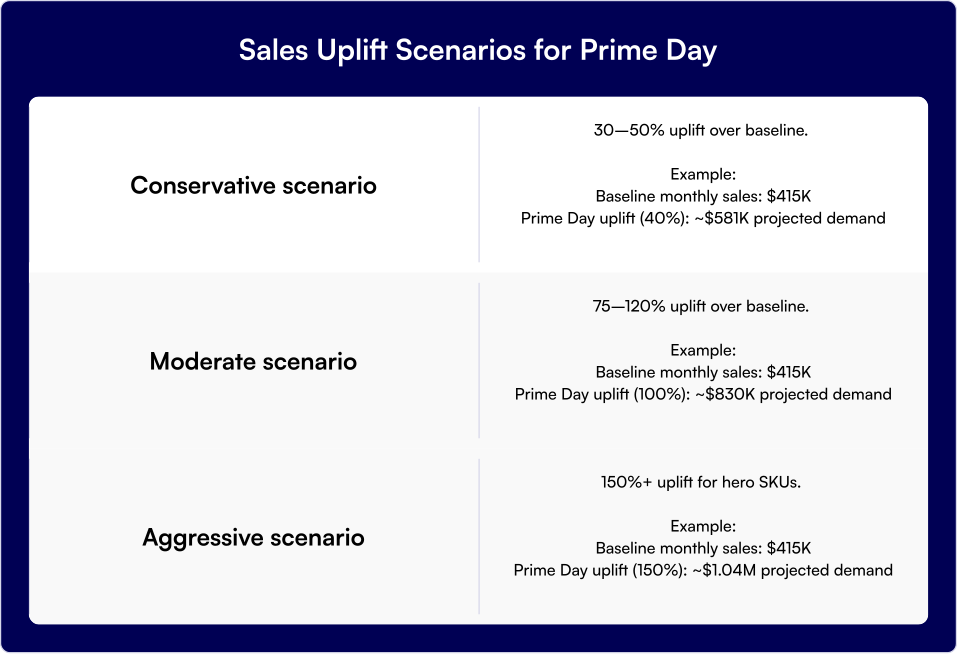
Conservative scenario (30–50% uplift)
Plan for a modest spike—this is your low-risk baseline to avoid overcommitting inventory and cash.
Best suited if you’re testing Prime Day or have limited ad budgets and supply flexibility.
Moderate scenario (75–120% uplift)
This is the most realistic planning benchmark for most sellers during Prime Day.
Align inventory, ads, and pricing here to balance growth with profitability.
Aggressive scenario (150%+ uplift)
Use this for hero SKUs or top performers that can fully capitalize on peak demand.
Ensure deep inventory, strong ads, and competitive pricing to maximise ranking and market share gains.
This scenario modelling helps you prepare for different demand spikes—from a cautious 30% lift to a 150%+ surge—so you’re not caught understocked or overexposed. The smart move is to plan inventory and budgets around the moderate case, while keeping flexibility to scale toward the aggressive upside for high-performing SKUs.
Stress testing multiple scenarios helps determine the funding range needed.
2. Build A Data-driven Reorder Plan
Once you’ve modelled your sales uplift, the next step is translating that demand into a clear, executable reorder plan.
Start with your supplier lead times, especially if you’re manufacturing overseas. Production alone can take anywhere from 30 to 60 days, and that’s before your goods even leave the factory. Layer on production capacity constraints – your supplier may not be able to instantly scale to 2–3x your usual order volume, particularly during peak global demand cycles.
Next, factor in freight timelines. Ocean shipping from Asia to the US and EU typically takes 20 to 40 days, and that’s assuming no port congestion or delays. This makes backward planning critical: you need to place orders months in advance to hit Prime Day windows.
Equally important are FBA inbound deadlines. As noted earlier, Amazon has strict cut-offs for inventory to be received and made available in fulfilment centres before Prime Day. Missing these deadlines can mean your stock simply isn’t eligible for Prime Day sales, regardless of demand.
To ground your planning in reality, use your historical sell-through rates. Look at how quickly your products have sold during past promotions or high-traffic periods—this gives you a more accurate view of how fast inventory will move under pressure.
Finally, build in safety stock buffers, typically in the range of 25–50%. These buffers protect you against unexpected spikes in demand, shipping delays, or forecasting errors—common risks during events like Prime Day.
In short, a strong reorder plan connects your demand forecast to operational execution—ensuring you’re not just predicting growth, but actually equipped to capture it.
3. Align Inventory Demand Forecasting with Marketing Strategy
According to data from Acadia, ad spend directly influenced performance during Prime Day, with sales patterns closely mirroring how budgets were allocated and paced. In fact, their analysis suggests that dips in performance weren’t necessarily due to falling demand, but because campaign budgets were exhausted mid-event.
This has a direct implication for inventory planning: your demand forecast must be tightly linked to your marketing intensity.
As you scale:
- PPC budgets increase
- Coupons and discounts accelerate conversions
- Influencer and affiliate campaigns drive incremental traffic
- External channels amplify visibility beyond Amazon
Each of these levers can significantly increase sell-through—often faster than expected.
The takeaway is simple:
Marketing without sufficient inventory wastes demand and ad spend. Inventory without marketing leaves growth on the table.
The goal is to synchronize both, so when visibility spikes, your inventory is ready to convert it into revenue.
This is why Prime Day forecasting is ultimately a capital allocation exercise: inventory purchases, advertising spends, and logistics costs must be financed simultaneously several months before the event.
The Capital Stress Layer in Amazon Prime Day Inventory Funding: Where Cash Gets Stuck
As sales velocity spikes, so does the need for upfront capital. Inventory has to be ordered weeks in advance, ad budgets need to be scaled aggressively, and discounts compress margins—all before the bulk of revenue is realised. Add to this Amazon’s payout cycles, and you’re often operating in a window where cash is going out faster than it’s coming in.
This is where liquidity gets trapped: in inventory sitting in transit, in fulfilment centres, or moving rapidly but not yet converted into usable cash.
Prime Day, therefore, exposes structural liquidity pressure points that aren’t always visible during steady-state operations. Strategic sellers address this by aligning funding with inventory velocity, rather than relying solely on retained earnings—ensuring they can sustain momentum without choking growth at the peak.
Top Non-Dilutive Funding Options For Amazon Sellers and Prime Day Financing
For scaling Amazon sellers, the primary objective is securing cost-efficient growth capital that supports inventory expansion without weakening long term profitability.
One key criterion is non-dilutive funding, meaning capital that does not require founders to give up equity ownership or control of the business. Instead, repayment occurs through structured credit agreements tied to revenue performance, purchase orders, or scheduled repayments.
Several financing models have emerged specifically for e-commerce sellers managing inventory cycles around events like Prime Day.
Line Of Credit
An inventory line of credit provides revolving capital that sellers can draw from as needed, similar to a credit facility.
Advantages
- Pay only for what you use, rather than paying interest on the full credit limit
- Flexible use of funds, including inventory purchases, advertising, freight, or supplier deposits
- No percentage of daily sales is deducted, which protects margins during high-volume sales events
- Reusable capital, allowing sellers to draw, repay, and reuse funds across multiple inventory cycles, such as Prime Day and holiday demand
- Predictable repayment structure, making cash flow planning easier compared with revenue based financing models
Limitations
- Interest can add up with frequent usage
- Easy access can lead to over-borrowing if not managed properly
- Lenders can reduce or revoke your credit limit at any time, even without warning
- Some lenders may charge maintenance fees, drawdown fees, or inactivity charges
- Better suited for short-term working capital, not large fixed investments
Best For
- Sellers looking to expand operations across marketplaces and regions ($1M+ revenue scaling to multi-platform)
- Sellers expanding products/SKUs (new listings, category diversification)
- Businesses with fluctuating cash flow
- Retailers, e-commerce brands, and seasonal businesses
- Inventory and working capital requirements
- Stocking up before peak seasons or managing supply chains
- Growth-focused SMBs
- Businesses looking to scale marketing or expand product lines
- E-commerce sellers and digital-first brands
Less Ideal For
- Long term capital investments
- Large one-time funding needs
- Businesses with unpredictable or weak repayment capacity
- Those lacking financial discipline
- Early stage businesses with no revenue track record
For sellers preparing for Prime Day, access to flexible working capital can determine whether inventory orders are scaled up or constrained by cash flow. CrediLinq’s inventory line of credit is built to enable professional e-commerce businesses to draw capital for multiple uses, including expansion, inventory purchases, advertising campaigns, freight payments, or supplier deposits, as needed.
Since funds can be drawn and repaid in line with marketplace payout cycles, sellers can finance large inventory orders ahead of Prime Day without committing to a fixed percentage of daily sales or giving up equity. This helps founders plan inventory purchases more confidently while maintaining predictable repayment schedules as sales convert back into cash.
Revenue Based Financing
Revenue based financing (RBF) lets businesses access capital and repay it as a share of their revenue. Repayments continue until a pre-agreed cap is reached. Wayflyer, Outfund, and Onramp Funds are all providers who offer revenue-based financing.
Advantages
- Repayments adjust with sales performance
- Flexible during low revenue periods
- Fast approvals (2–7 days)
- Accessible for businesses with limited credit history
Limitations
- Higher overall cost of capital (can reach approximately 40% APR)
- Can reduce margins during high sales periods
- Less predictable cash flow due to variable repayments
Best For
- Early stage sellers
- Businesses with volatile or seasonal revenue
- Sellers who cannot qualify for traditional credit
Less Ideal For
- High margin optimization focused businesses
- Companies with stable, predictable cash flow
- Businesses seeking low cost financing
- Long term capital needs or large fixed investments
Purchase Order Financing
This model funds confirmed wholesale or retail Purchase orders (PO). It enables sellers to pay suppliers upfront to fulfil large orders without straining working capital.
Funding is typically repaid once the end buyer pays, effectively bridging the gap between production and revenue realization.
Advantages
- Enables fulfillment of large orders without upfront capital
- Improves cash flow by covering supplier payments
- Scales with order volume
- Does not require traditional collateral (secured against PO)
- Useful for rapid growth and bulk order cycles
Limitations
- Higher cost than traditional financing (e.g. effective APR of 20-60%)
- Limited to specific transactions (not flexible like a credit line)
- Lender control over supplier payments
- Requires confirmed purchase orders from credible buyers
- Not suitable for service based businesses
Best For
- Businesses with large confirmed purchase orders
- Importers, wholesalers, and distributors
- E-commerce brands dealing with bulk inventory orders
- Companies facing supplier upfront payment requirements
Less Ideal For
- Businesses without confirmed purchase orders
- Service based or digital only businesses
- Companies needing ongoing working capital flexibility
- Small or low margin orders where fees impact profitability
Bank Loans
Bank loans are traditional financing options offered by banks, typically involving fixed amounts, longer tenures, and stricter eligibility criteria.
Advantages
- Lower interest rates (~8%–15% APR)
- High loan amounts available (typically $100K–$5M)
- Trusted and regulated financing source
- Suitable for long term funding needs
Limitations
- Lengthy approval and disbursement timelines
- Heavy documentation requirements
- Collateral or personal guarantees are often required
- Strict eligibility criteria
Best For
- Established businesses with strong credit history
- Companies with stable financials
- Long term capital investments
- Businesses comfortable with collateral backed funding
Less Ideal For
- Early stage or digital first businesses
- E-commerce sellers with fluctuating revenue
- Businesses needing fast, flexible capital
- Companies without collateral
Term Loans
Term loans provide a lump sum of capital that is repaid over a fixed period with scheduled installments and defined terms.
Advantages
- Fixed repayment schedule for predictability
- Structured financing for specific needs
- Can support medium to large funding requirements
- Clear loan tenure and closure timeline
Limitations
- Rigid repayments regardless of revenue fluctuations
- May require collateral or guarantees
- Limited flexibility once the loan is disbursed
- Slower approval compared to fintech options
Best For
- Businesses with predictable cash flow
- Planned investments (expansion, equipment, hiring)
- Companies that prefer structured repayment timelines
- Established SMEs
Less Ideal For
- Businesses with volatile or seasonal revenue
- Companies needing ongoing or reusable capital
- E-commerce sellers managing dynamic inventory cycles
- Businesses requiring quick access to funds
Funding Comparison Snapshot
Amazon sellers evaluating Prime Day inventory financing compare options across cost, fees, repayment structure, speed, and eligibility. Each funding model suits different growth stages and cash-flow needs.
However, the provider also plays a critical role. The same funding type can vary significantly in flexibility, access, and overall cost depending on the lender.
The sections below compare both funding structures and leading providers to give a complete view of available options.
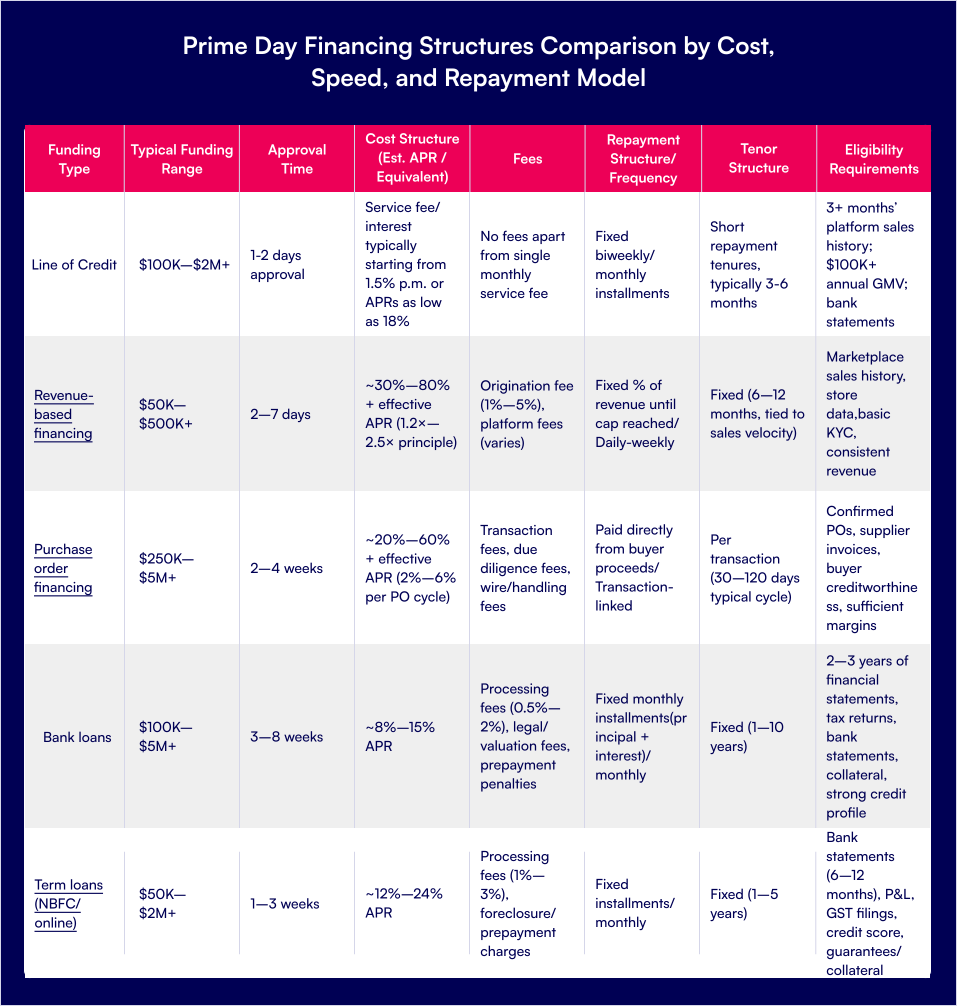
While each funding model serves a different purpose, not all providers deliver the same level of speed, flexibility, or accessibility.
The comparison below highlights how leading providers stack up, and where modern, data-driven solutions like CrediLinq stand out.

*Customized loan tenors up to 12 months are available on a case-by-case basis from CrediLinq.
Each option comes with trade-offs across cost, control, and flexibility. The key is choosing a solution that supports your growth without constraining cash flow.
Prime Day Financing Timeline: Aligning Capital With FBA Inbound Windows
Prime Day inventory planning typically begins 3–5 months in advance, covering procurement, production, international shipping, and Amazon inbound deadlines. Financing needs to be aligned across this entire cycle, not just at the last minute

Begin your Prime Day funding process early to secure capital before inventory deadlines tighten.

Managing Cash Flow After Prime Day Sales and Financing Repayments
Securing inventory and capital for Prime Day is only one part of the equation. What happens after Prime Day is equally critical, as sellers must balance incoming revenue with repayments, returns, and reinvestment needs.
Strong post-event cash flow management ensures that Prime Day gains translate into sustained growth rather than short-term spikes.
1. Amazon payout cycles and settlement delays
Amazon typically disburses payments on a bi-weekly cycle, which means there can be a lag between sales and actual cash inflow. Sellers need to plan for this gap, especially if repayments or supplier balances are due immediately after Prime Day.
2. Returns, refunds, and revenue adjustments
Post-Prime Day periods often see elevated return rates, which can impact net realized revenue. Factoring in return windows and refund processing timelines is essential for accurate cash flow forecasting.
3. Financing repayments and cash flow pressure
Depending on the funding structure, repayments may begin immediately after disbursement or scale with sales.
- Fixed repayments (term loans) can strain liquidity post-event
- Revenue-linked repayments (RBF) adjust with performance but reduce top-line cash flow
- Credit lines offer more flexibility but still require disciplined utilization
4. Restocking for Q4 demand (BFCM and holiday season)
Prime Day is often a precursor to back-to-school and holiday demand cycles. Sellers need to quickly reinvest in inventory to avoid stockouts during BFCM (Black Friday Cyber Monday) and Christmas, creating another capital requirement shortly after Prime Day.
5. Advertising reinvestment and momentum scaling
Post-event periods present opportunities to scale high-performing SKUs. Allocating capital toward retargeting, sponsored ads, and promotions can extend the sales momentum generated during Prime Day.
6. Working capital buffer and operational resilience
Maintaining a liquidity buffer helps absorb unexpected costs such as higher return rates, delayed shipments, or ad spend overruns. This is particularly important for fast-growing e-commerce businesses. CrediLinq provides:
- A flexible credit line (up to $2M) with approvals as fast as 1 day
- Flexible 3–6 month repayment tenors,
- Fees only on what you draw (as low as 1.5% per month or a simple fixed annual percentage rate (APR) of 18%)
- Collateral-free, non-dilutive funding
CrediLinq makes it easy to manage cash flow in between peak sales periods.
Strategic Takeaway
Smart operators treat Prime Day not as a one-off sales event but as part of a continuous capital cycle that spans inventory procurement, peak sales, and reinvestment in upcoming demand periods such as back-to-school and the holiday season.
Aligning financing with this broader cycle helps maintain liquidity, reduce risk, and support sustained growth beyond a single sales window.
What High-Growth Amazon Sellers Should Prioritize For Prime Day Financing
Prime Day success is not just about selling more units. It requires synchronizing several operational levers:
- Inventory production and inbound timing
- Capital availability for supplier deposits and freight
- Marketing investment ahead of the event
- Logistics execution and FBA processing windows
- Cash flow recovery after sales convert to payouts
Non-dilutive capital allows sellers to capture upside without giving up equity or sacrificing revenue through sales-based repayment structures.
The most experienced operators treat financing as infrastructure for predictable growth, not as emergency funding during inventory shortages.
For Amazon sellers preparing for Prime Day, having flexible working capital available before production deadlines can determine whether inventory scales with demand or becomes the bottleneck.
CrediLinq’s inventory line of credit is designed specifically for high-growth e-commerce sellers, allowing businesses to access working capital for inventory purchases, advertising, and logistics without giving up equity or committing to revenue-share repayment structures.
With flexible drawdowns, predictable pricing, and capital aligned to sales cycles, it helps sellers fund inventory early and scale for peak events like Prime Day.
CrediLinq charges a single service fee starting from just 1.5% per month, or a simple, fixed annual percentage rate as low as 18% on the funds drawn. Without any hidden fees, revenue share, collateral, or equity dilution, repayments can stretch from 3–6 months, with no prepayment penalties, giving sellers clear, predictable cash-flow control.
FAQs
1. What is the minimum credit score required for Prime Day funding?
Requirements vary by lender, but many e-commerce-focused financing providers prioritize business performance and revenue history over personal credit scores.
2. How quickly can Amazon sellers secure Prime Day inventory funding?
Many alternative e-commerce lenders can approve and fund applications within a few days, especially when sellers provide marketplace sales data for underwriting. However, most Prime Day sellers start exploring financing several months in advance to align funding with supplier deposits, production timelines, and Amazon FBA inbound deadlines. Starting early improves approval odds and terms.
3. Do non-dilutive funding options require inventory collateral?
Not always. Many alternative e-commerce lenders underwrite financing based on sales data, marketplace performance, and cash flow, meaning traditional collateral may not be required. Requirements vary by provider and funding structure.
4. What are typical funding limits for Prime Day inventory purchases?
Established sellers can often access $100K–$2M+, depending on revenue, margins, and historical performance.
5. Does accepting external funding affect Amazon account health?
No. Financing arrangements are independent of marketplace account status, provided sellers meet operational and policy requirements.
6. What is the difference between a line of credit and revenue-based financing?
An inventory line of credit typically has fixed repayment schedules and defined APR ranges, while revenue-based financing deducts a share of revenue, which can extend repayment periods if sales slow.
Revenue-based financing (RBF) effective APRs often range from ~30% to 80%+, depending on the factor fee and repayment speed, whereas credit facilities generally follow more predictable repayment structures.
7. Is equity funding ever necessary for Prime Day preparation?
Equity is rarely required for seasonal inventory needs. Most established sellers prefer debt or credit-based funding to preserve ownership.