


Highlights
Why This Matters to You
|
TikTok Shop’s creator economy has outpaced most brand operations. The platform’s creator ecosystem reached 15.3 million creators in H1 2025, with 851,000 actively selling products through videos or livestreams.
TikTok influencers alone drove $5.4 billion in United States GMV in 2024, representing 60% of total US platform transactions. For example, Tarte Cosmetics generated over $40 million in TikTok Shop revenue last year, with 88% of that coming from affiliate creators, not brand ads.
When creator programs work at this level, they scale fast. A product goes viral, sign-up requests surge, and what began as a managed program of 50 creators becomes 500 applications in a week.
The typical manual stack, using spreadsheet-tracked applications, manual KYC checks, manually reconciled payout files, and DM-based community management, breaks at scale in predictable ways.
At 1,000+ creators, payout reconciliation alone, matching TikTok Shop settlement data to individual creator commission rates across return windows, tier adjustments, and SKU-level attribution, can consume the entire finance team days before a single transfer goes out.
So it is important to automate the operations layer between the brand and the creator program. That is where AI agents are now beginning to show value.
What is a Social Media AI Agent?
A social media AI agent perceives data from social platforms, reasons about what action to take, and executes it without step-by-step human direction.
They are different from AI bots and chatbots, which follow a scripted workflow. Agents, on the other hand, can adapt across different workflows.
The defining characteristic is goal-directed reasoning. If you give an agent a high-level objective such as “onboard all approved creator applications from this week”, it figures out the steps required across multiple systems, executes them, and escalates edge cases for human review.
These autonomy levels separate current AI tools:
- AI-assisted, where the human drives every decision
- Autonomous with guardrails, where the agent acts within defined boundaries
- Fully autonomous, where the agent runs all tasks end-to-end.
In 2026, most production-grade ecommerce AI tools operate at level two.
What separates a genuine agent from a basic TikTok Shop API integration is cross-system reasoning.
A standard API pulls data from one endpoint on a fixed schedule. An agent connects TikTok Shop settlement data, a creator CRM, a contract management system, and a payment rail, and decides which actions to take across all of them based on conditions.
That capacity for multi-step, conditional decision-making is what makes agents viable for managing creator programs at scale.
How AI Agents manage TikTok Shop creator programs at scale
AI Agent Workflows for Fast Creator Onboarding
An application surge from a viral campaign creates a waitlist, which in turn creates a delay. Delayed creators lose interest or sign with a competitor. The speed of onboarding is directly tied to creator program retention.
AI agent workflows can hasten the onboarding process for creators in the following ways:
1. Identity verification and brand-fit checks
When a creator applies, the agent cross-references their TikTok handle against public data like follower count, engagement rate, audience demographics, and recent brand mentions.
It runs fraud-detection signals, including engagement authenticity (the ratio of comments to likes, follower growth patterns and bot-indicative engagement spikes) and flags any prior brand safety violations. For a human reviewer to do this per creator manually takes minutes. For an agent processing a queue of 200 creator applications, the total time is the same.
2. Smart contract and brief delivery
Once a creator clears the verification stage, the agent can auto-generate a campaign brief and a contract, populated with dynamic fields for the creator’s name, commission tier, product SKUs, content requirements, posting windows, and usage rights.
Critically, a human approval loop is in place before anything is sent. The agent stages the document, and a team member reviews and confirms. The contract goes out within minutes of approval rather than days of manual drafting.
Campaigns with platform-specific briefs that specify TikTok-native requirements such as vertical video, shoppable tags and first-three-second hooks perform 43% better than generic cross-platform briefs.
Agents can apply these specifications to every brief by default, at no incremental labor cost per creator. A brand receiving 500 applications in a week can process, verify, brief, and contract the qualified subset in hours rather than days, consistently, without version-control errors or missing fields.
Automating Daily Creator Management with Social Media AI Agents
Things like content reminders, performance check-ins, brand guideline reinforcement, and so on all require consistent attention across a program of hundreds or thousands of creators.
Here is how AI agents handle this:
1. Content reminders and deadline management
Agents monitor posting schedules against contracted deliverable windows and send automated reminders via the creator’s preferred communication channel at defined intervals leading up to the deadline. Late posting rates drop significantly when reminders are systematic rather than dependent on a community manager’s availability.
2. Performance alerts
Agents continuously pull creator-level performance data on views, click-through rate, GMV generated and conversion rate per link. This way, they can automatically flag high performers for bonus-tier review and underperformers for intervention or offboarding.
A human manager who checks performance weekly misses real-time signals. A continuously monitoring agent can surface a creator whose content is trending within hours of the spike, enabling the brand to amplify with paid Spark Ads. At the same time, the organic momentum is still alive.
3. Sentiment monitoring and brand risk escalation
Agents scan creator content and comment sections for brand-safety signals, such as negative-sentiment spikes, competitor mentions, off-brief content, or policy-violating claims.
When a signal crosses a defined threshold, the case is escalated to human review with a summary of the flagged content and a recommended action. The agent does not make the brand safety call. It surfaces the case so a human can make it quickly and with context.
Streamlining TikTok Shop Payouts and Performance Reporting at Scale
Payout reconciliation is the most operationally intensive step in creator program management.
The complexity comes from TikTok Shop’s settlement mechanics. TikTok’s April 2025 policy change means creator affiliate commissions are paid 15 days post-delivery, and only after the seller’s own settlement has cleared. Reserve funds are held for 30 days to cover potential returns.
In a realistic scenario, 100 orders, $100 AOV, 10% return rate, 15% affiliate commission on 80% of orders, the actual bank deposit equals approximately 67.3% of reported GMV after all deductions. This gap between dashboard GMV and actual settled cash is where most manual reconciliation errors start.
AI agents address this by ingesting TikTok Shop settlement reports at the order level, cross-referencing each order’s SKU, delivery status, return window, and creator attribution, and generating a payout file that reflects the actual settled amounts.
The agent automatically accounts for returns, commission tier adjustments, and refund windows, rather than requiring a finance team member to apply those calculations manually across thousands of line items.
The output is a clean, auditable payout file ready for payment rail execution. Agents can also generate creator-level dashboards showing GMV generated per creator, conversion rate, return rate, average order value, and commissions earned.
This gives community managers the data they need to make retention and tier promotion decisions in real time rather than waiting for a monthly report.
Selecting the Best eCommerce AI Tools for TikTok Programs
Choosing tools for a TikTok creator program requires evaluating against four criteria:
- TikTok API compliance
- Multi-agent or multi-workflow orchestration capability
- Payout infrastructure
- Human oversight architecture.
Some of the best purpose-built AI tools for managing TikTok’s creator programs include:
|
Tool |
TikTok-Specific Capability |
Payout Infrastructure |
Best For |
|
GRIN (Gia) |
Creator roster building, outreach automation and onboarding workflows |
Affiliate commission management, Shopify-integrated |
Brands building programs from scratch with AI-led sourcing |
|
Modash |
350M+ TikTok/IG/YouTube profiles, AI discovery, content tracking |
Bulk payout in 180+ countries, single invoice |
Multi-platform programs needing unified payout |
|
Euka AI |
TikTok-specific outreach automation, sample approval, follow-up |
Performance-linked tracking |
Brands scaling organically without paid acquisition |
|
Cruva |
3M verified TikTok affiliates, 7,000+ DMs/day pipeline |
Affiliate tracking dashboard |
High-volume TikTok affiliate outreach at speed |
|
Upfluence |
Creator discovery, affiliate automation, sales attribution |
E-commerce-integrated payout management |
Brands needing post-to-purchase attribution |
1. GRIN (Gia)
Grin’s Gia AI affiliate influencer marketing agent
GRIN is a creator management platform supporting TikTok, Instagram, and YouTube, with TikTok integration covering recruitment, communication, campaign management, agreements, payments, and analytics.
Its AI agent, Gia, builds creator rosters matched to brand-defined personas, automating outreach and onboarding. The platform handles affiliate commission management, content tracking, and creator payments within a single, connected workflow.
2. Modash
Modash’s creator data API for influencer management on TikTok
Modash is an influencer marketing platform covering 350 million creator profiles across TikTok, Instagram, and YouTube.
It has an AI-powered semantic search that filters creators by audience demographics, engagement rate, location, niche, and fake-follower signals, without requiring creators to opt in.
Modash integrates with Shopify for post-to-purchase performance tracking but does not have native integration with the TikTok Shop affiliate program. It is a discovery, CRM, and payment tool for TikTok creators, not a TikTok Shop-native platform
3. Euka AI
Euka AI TikTok Shop creator affiliate management tool
Euka AI is built exclusively for TikTok Shop affiliate management. It is an official app on the TikTok Shop App Store and is designed specifically around TikTok Shop’s affiliate infrastructure.
Its AI creator search covers 3.5 million TikTok Shop affiliates, filtering by GMV, category, and performance metrics, with automated TikTok DMs, collaboration invites, and email campaigns. It can also send up to 1,000 messages and 2,500 targeted invites per day.
The platform also includes an automated spark code collection for GMV MAX campaigns, AI-powered content moderation, and competitive intelligence on rival sellers’ creator performance.
4. Cruva (formerly UpTk)
Cruva’s TikTok Shop affiliate outreach AI bots
Cruva is an AI-powered creator commerce platform originally built specifically for TikTok Shop affiliate programs.
Its core capabilities are AI-driven creator discovery using natural language search across 3 million+ verified TikTok affiliates.
Users can use the platform to push automated outreach via DMs and email. CRM automations on Cruv can be triggered by sample shipments, GMV milestones and real-time affiliate GMV reporting.
5. Upfluence
Upfluence creator’s marketplace campaign tool
Upfluence is an enterprise influencer and affiliate marketing platform that enables brands to activate creator campaigns that drive in-app TikTok Shop purchases. It also integrates with Shopify, BigCommerce, WooCommerce, Amazon, Klaviyo, and Zapier.
Its AI agent, Jaice, automates workflows across product gifting, outreach, shipment approvals, and creator payments from a single platform. The platform can also identify brand-fit creators from a brand’s own customer database by syncing with ecommerce integrations and analyzing social mentions.
Financing Options for Large Creator Payout Cycles
Creator payout cycle halts cash flow
AI agents can identify when creator payouts are due, calculate the correct amounts, and generate the payout files.
What they cannot do is fund the gap between when those payouts are due and when TikTok Shop’s settlement cycle releases the underlying revenue.
These financing options can help you address this gap:
TikTok’s early settlement program
TikTok allows eligible sellers to access 80–90% of the order value the day after shipment through Storfund, TikTok’s embedded advance partner. The facility’s cap limits how much can be advanced in any given period, which can become a bottleneck during rapid scaling or viral spikes.
Revenue-based advances
For TikTok Shop sellers who need capital fast, revenue-based advances from providers like Onramp Funds can offer a genuine short-term solution. Repayment runs as a percentage of daily sales, which can feel flexible during periods of stable revenue.
The structural problem, however, is that these deductions run on the provider’s schedule rather than TikTok’s settlement cycle. This means remittances are pulled from the account during the exact window when funds are tied up in platform holds and creator commissions come due simultaneously.
For sellers managing large affiliate payouts alongside settlement delays, RBF can compress working capital at the worst possible moment, making it a useful emergency option but a rough fit as a recurring capital structure for creator program management at scale.
Revolving lines of credit
Creator payout obligations are predictable. They follow TikTok’s settlement calendar, run on defined commission tiers, and recur with every campaign cycle. That predictability is exactly what a revolving line of credit is built for.
You can draw capital to cover the payout obligation when it falls due, repay on a fixed schedule as settlement proceeds clear, and the facility resets for the next cycle without a new flat fee or a new application.
Unlike revenue-based advances, the repayment schedule does not accelerate when sales spike or compress when they dip; it runs on a timeline the seller controls, independent of what TikTok has disbursed that week.
How CrediLinq’s Working Capital Line Supports Payout Scalability
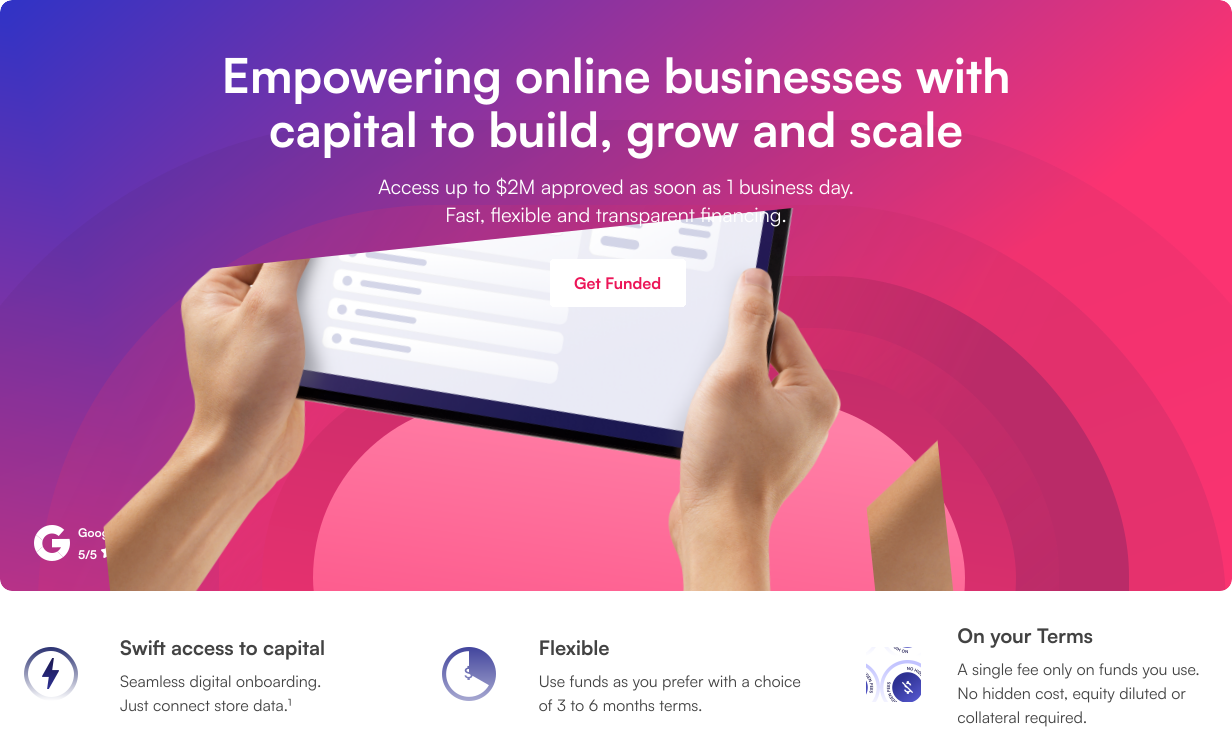
CrediLinq provides working capital for TikTok Shop sellers via an unsecured revolving line of credit, underwritten on marketplace sales performance across Amazon, TikTok Shop, Shopify, eBay, Lazada, and Shopee.
It requires no collateral or personal guarantees. For TikTok Shop sellers managing large creator programs, this matters because payout spikes do not announce themselves, and it’s important to pay creators on time.
If you are short on cash, you can use CrediLinq to draw what is needed to pay creators on schedule, and repay from the settlement proceeds as they clear.
The monthly service fee starts at 1.5% on drawn funds only, with no fee on undrawn balances. Repayments are made biweekly over 3 to 6 months. You can draw amounts from $50,000 to $250,000 with lines of up to $2M for qualified sellers.
The honest limitation is that an eligibility threshold of 12 months of operating history and $30,000 or more in monthly revenue is required. Newer TikTok Shop sellers may not yet be able to access the facility.
You cannot predict how explosively viral your product will be on TikTok Shop. To keep a handle on things, invest in AI agents to automate your creator marketing processes and have a contingency plan for steady cash flow when the moment arrives.
Get funded with CrediLinq today.
Find out if your TikTok Shop sales qualify for a CrediLinq credit line.
Final Takeaways
TikTok Shop’s creator affiliate model is already the dominant driver of platform GMV. About 60% of US transactions in 2024 were creator-attributed. That number will not decrease as TikTok Shop approaches its projected $112 billion in global GMV in 2026.
The brands that capture a disproportionate share of that growth are the ones that can run large-scale creator programs with the operational consistency of a small one. AI agents make that possible. Not by replacing the judgment that makes creator relationships work, but by handling the operational volume that consumes too much time and attention.
Onboarding, brief delivery, performance monitoring and payout reconciliation are all solvable at scale with current tools. The cash flow gap between TikTok’s settlement cycle and creator payout obligations is not. That gap requires a capital solution that moves on the seller’s timeline and not the platform’s.
Frequently Asked Questions
How do AI agents differ from basic TikTok Shop APIs?
APIs pull or push data on a fixed schedule from a single endpoint. AI agents connect multiple systems, reason across them, and make conditional decisions autonomously. They act on outcomes rather than just executing preset instructions.
Can agents handle multilingual creator communication?
Yes. Most production-grade platforms include translation models for outreach, briefs, and reminders across major languages. Nuanced relationship conversations and brand voice decisions should still undergo human review before being sent.
What data feeds are needed to automate payouts accurately?
Four inputs: TikTok Shop settlement reports at the order level, SKU-level creator attribution data, each creator’s commission tier configuration, and banking rails API access. The April 2025 commission policy change also requires confirming seller settlement has cleared before triggering creator payments.
Is creator data safe when using third-party AI tools?
Require SOC-2 Type II certification, a signed data processing agreement, and confirmation that the vendor does not train shared AI models on your creator data. Most enterprise-grade platforms meet this standard. Newer tools may not. Always ask for documentation before connecting.
What minimum sales volume qualifies for CrediLinq financing?
At least 12 months of operating history and $30,000 or more in monthly revenue across connected marketplace platforms. Qualification is based on sales performance data, not credit scores or collateral. Approvals are typically within one business day.
Will AI replace human influencer managers?
No. Agents handle high-frequency tasks like applications, briefs, reminders and reconciliation. Humans handle what matters most: the top creator relationships, strategic decisions, and brand judgment calls. The outcome is reallocation and not replacement.
Citation References
- https://insights.ttsvibes.com/tiktok-shop-statistics/
- https://www.shortformnation.com/blog/tiktok-shop-affiliate-marketing-the-complete-2026-guide
- https://thecirqle.com/blog-post/your-2025-guide-to-onboarding-creators-for-performance-driven-influencer-marketing
- https://seller-us.tiktok.com/university/essay?knowledge_id=2336057241700098&default_language=en
- https://www.dashboardly.io/post/tiktok-shop-payout-explained-when-how-tiktok-pays-sellers
- https://seller-us.tiktok.com/university/essay?knowledge_id=3995852763531009&lang=en