


Overview
- Onramp Funds gives fast capital to eCommerce sellers, repaid as a share of sales, which may be better suited for short-term cash needs, but costs can rise if repayment takes longer.
- CrediLinq’s credit line provides flexible access to capital with one simple fee, fixed repayment windows, and supports sellers across global markets and multiple marketplaces.
Why this matters to you
- You want to understand the real cost of Onramp’s Funding offers and how the effective rate changes with faster or slower repayment.
- Perhaps you need a credible alternative and want to explore other funding options beyond Onramp’s revenue-based financing.
Revenue-based financing (RBF) links your repayments to the rhythm of your sales, with automatic deductions from your daily or weekly revenue.
But why is this model attractive to sellers?
It is pretty simple. It feels operationally lightweight as you don’t have to worry about calculating loan repayments—just focus on your revenue from sales. Somehow, the loan “repays itself.”
Onramp Funds uses this same model to give eCommerce sellers instant working capital, repaid as a share of each sale. This review explains how Onramp’s pricing and repayment terms work and when a transparent credit line like CrediLinq may be a better fit for predictable cash planning.
What is Onramp Funds?

Onramp’s funding for eCommerce brands (Source: Onramp)
Onramp Funds is a financing provider that offers revenue-based working capital exclusively to eCommerce merchants in the United States. It is purpose-built for marketplace sellers who need fast cash for inventory and marketing, and it leans on store performance rather than your personal credit file.
Onramp product offers and repayment
Onramp’s revenue-based financing model provides two repayment structures for sellers:
1. Variable repayment structure: You receive a lump sum now and repay a fixed total (advance and a flat fee) by remitting a percentage of your daily or weekly sales until the balance is cleared.
The flat-fee ranges from 2% to 8%, and remittance can be as low as 1% of daily sales, with no monthly minimums or fixed payment requirements.
2. Fixed repayment structure: You still repay the funded amount plus a flat fee (same 2% to 8%), but instead of a sales percentage, you make equal, scheduled installments that “freeze your APR” and simplify cash planning. This behaves like a short-term loan with a fixed fee rather than metered daily remittances.
For Amazon sellers specifically, fees range from 0.5% to 4% of sales, with an estimated APR of 11.9% to 19.9% and a 90-day payoff window.
Onramp Funds provides sellers with up to USD 2M, depending on your store’s revenue performance and platform data.
Quick comparison of Onramp’s repayment structures

How you can access Onramp offers
You can go straight to Onramp’s website and start an application. Here’s what to expect:
- Enter a few quick details to receive an estimate of how much funding you might qualify for
- Connect your e-commerce store and/or payment processor so Onramp can review your sales history and business performance. You may also need to provide bank statements up to the last 6 months.
- You will receive a tailored offer of an advance amount with fees and repayment information
- Once approved, funds can be available in as little as 24 hours to your business bank account
Eligibility requirements for Onramp
To qualify for funding from Onramp Funds, your business must:
- Operate as a United States-based business entity, typically an LLC, S-Corp, or C-Corp with a valid EIN and business bank account.
- Generate at least USD 3,000 in monthly sales to be considered, although higher revenue may increase approval odds and offer size.
*There is no minimum period range of trading history required to qualify for Onramp funding, although more time in business may increase your chances.
Pros of Onramp for eCommerce sellers
- Does not evaluate your personal credit, and no personal guarantee or collateral is required.
- Clear total payback disclosed upfront under a flat-fee model
- Quick access to capital, as funding can arrive within 24 hours after approval
Cons of Onramp for eCommerce sellers
- Daily and weekly remittances tighten cash flow during slow periods
- Only supports United States-based business entities today
- Effective cost can be high when annualized over longer windows
Other Alternatives to Onramp
CrediLinq

CrediLinq offers a revolving line of credit to multi-market sellers (including Amazon, Shopify, eBay, TikTok Shop, Lazada, Shopee, and more) across the Western and Eastern parts of the world.
You can have instant access to up to USD 2 million in working capital without being locked into a revenue-share model or giving up profits or equity.
You receive a custom funding limit based on your overall sales performance. From there, you can draw any amount as needed, at any stage of your business cycle.
Pricing is simple and transparent with a single monthly service fee charge as low as 1.5% or a simple fixed annual percentage rate (APR) of 18%, applied only to funds you actually draw. There’s no compounding interest, no revenue share, and no hidden mark-ups.
Uncapped

Capital loan funding by Uncapped (Source: Uncapped)
Uncapped provides fast-working capital to established eCommerce businesses in the United States, the United Kingdom, and select European Union markets. It offers flexible financing up to USD 10 million, built around flat fees rather than compounding interest.
With Uncapped, you can choose between:
- Fixed-term working capital (fixed fee of 0.7% to 1.5% monthly)
- Line of credit (fixed APR starting around 10.99%)
The company does not require personal guarantees or equity dilution, allowing sellers to retain control while scaling their business operations.
Their term products are usually short-to-mid duration, with tenors ranging from 3 to 24 months for eCommerce sellers, depending on the frequency of revenue inflow and repayment preference.
|
Suggested read: Uncapped Review for eCommerce Sellers |
Let us see how these alternatives compare to Onramp.
Comparison Table: CrediLinq vs Onramp Funds vs Uncapped
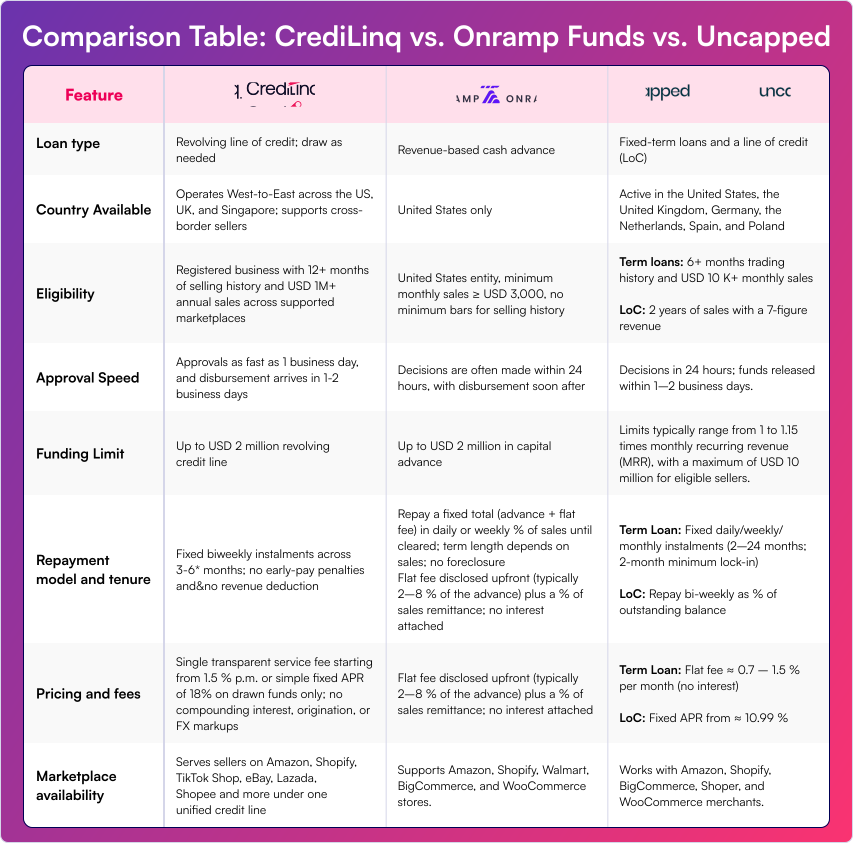
*Customized solutions are available upon request. Loan tenors can extend up to 12 months on a case-by-case basis.
How Onramp’s Revenue-based Financing Compares to CrediLinq’s Credit Line
Imagine you are getting ready for a 90 day push and you estimated you need about USD 50,000 to cover this cycle.
You have two ways to fund it:
- Take an advance from Onramp, repay a pre-agreed total through a slice of every sale.
- Draw 50,000 United States dollars from a CrediLinq credit line, repay it over a fixed window with a simple monthly service fee.
On paper, both models avoid compounding interest, but in practice, the way cost behaves over time and how much control you have over it is very different.
Onramp Funds (flat fee locked in, time and APR driven by sales)
Onramp works with a flat fee on the amount advanced and then collects repayment as a percentage of your daily or weekly sales until the balance is cleared.
For illustration, assume:
- Advance amount: USD 50,000
- Flat fee: 6% percent (within the 2–8%)
- Total to repay: USD 53,000
The fee of USD 3,000 does not change once you accept the offer. What changes is how long it takes you to clear the total amount to be repaid, because repayment is tied to your sales pace.
A simple way to approximate the effective annualised cost is:
APR (approx.) ≈ flat fee percentage ÷ (repayment months ÷ 12)
Now look at three possible outcomes:
- Very strong cycle (paid back in 3 months): APR ≈ 6% ÷ (3 ÷ 12) = 6% ÷ 0.25 = 24%
- Steady cycle (paid back in 5 months): APR ≈ 6% ÷ (5 ÷ 12) ≈ 6% ÷ 0.41… ≈ 14.4%
- Soft cycle (paid back in 6 months): APR ≈ 6% ÷ (6 ÷ 12) = 6% ÷ 0.5 = 12%
A few important observations for a seller:
- The fee is fixed at USD 3,000, whether you clear the advance in 3 months or 6 months.
- If your original plan assumed a longer payback window but sales spike and you repay much faster, the realised APR can jump into the high 20s, even though the nominal fee looks small.
- If sales slow and repayment stretches, the dollar fee does not shrink. You are still giving up a percentage of every sale for longer, and the share of your annual sales that goes to repaying this one advance can stay high relative to your profit margin.
CrediLinq: monthly service fee on a fixed schedule
Now consider the same USD 50,000, but this time you draw it from a CrediLinq line of credit with a 90 day (3 month) term and a monthly service fee as low as 1.5%.
A key difference is that your CrediLinq limit may be much higher (for example, up to USD 2 million), but in this scenario you only drew USD 50,000 for this cycle. The service fee is applied only to the drawn balance while it is outstanding.
Month 1
- Opening balance: USD 50,000
- Service fee at 1.5%: USD 750
- Principal repaid: USD 16,667
Month 2
- Opening balance: USD 33,333
- Service fee at 1.5%: USD 500
- Principal repaid: USD 16,667
Month 3
- Opening balance: USD 16,667
- Service fee at 1.5%: USD 250
- Principal repaid: USD 16,667
Total service fee over three months is roughly 1,500 United States dollars.
- Total fee percentage ≈ 1,500 ÷ 50,000 = 3%
- APR (approx.) ≈ 3% ÷ (3 ÷ 12) = 3% ÷ 0.25 = 12%
Key differences versus the Onramp example:
- The fee scales with time used. If you choose a 90 day term instead of 120 days, or repay early, you only pay for the months you actually use, and the total fee falls further.
- Repayment happens through fixed instalments, not a moving percentage of daily sales. You know your cash outflows in advance and can align them with payout dates and supplier terms.
Because CrediLinq is a line of credit, you also have the option to draw less than your limit or draw in stages.
If you only needed USD 30,000 for a cycle instead of USD 50,000, every calculation above would be based on USD 30,000, and your fee would be lower accordingly.
Why CrediLinq May Be a Better Alternative for Many eCommerce Sellers
CrediLinq is built for how modern eCommerce actually operates, which involves multiple channels, currencies, and uneven sales cycles.
Where most lenders push rigid loans or revenue-share models, CrediLinq gives sellers control: one revolving line of credit, predictable costs, and zero deductions from your daily sales.
Traditional advances and daily revenue skims can squeeze cash flow when you need it most. With CrediLinq’s revolving line, you can draw exactly when you need cash for any purpose and repay in biweekly installments typically over 3-6 months.
Customized solutions are also available upon request with loan tenors up to 12 months on a case-by-case basis.
With CrediLinq, you get transparent pricing and repayment clarity.
You are charged only one simple monthly service fee, starting from 1.5% on the draw, or a simple fixed annual percentage rate (APR) of 18%, no equity or revenue shares. This makes it easy for you to correctly calculate landed costs and decide when a cycle is truly profitable.
The credit line adapts to the way you actually operate, for example:
- New product launches: You can draw twice, or as needed, to cover a deposit on a purchase order, pay the balance based on payouts from existing products.
- Rolling replenishment: You can use staggered draws without resetting a new loan each time.
- Cross-border operations: CrediLinq supports sellers across the West and the East, including the United States, the United Kingdom, and Singapore.
You can fund suppliers in Asia while campaigns run in the U.S., U.K., or Singapore, all from one account. Funds arrive directly in your working or preferred currency — USD, GBP, SGD — so you avoid unnecessary FX conversions and delays.
Managing multiple channels
CrediLinq connects directly to your Amazon, Shopify, eBay, TikTok Shop, Lazada, or Shopee accounts, and you can fund operations across all channels from one revolving credit line.
You can apply in minutes:
- Sign up with your business email and verify ownership.
- Provide basic information, like business name and registration number
- Connect your marketplace accounts to sync live data, allowing your sales performance to be accurately assessed.
- Complete KYC (business registration, tax ID, director ID).
Approvals are typically received within one business day, with a limit of USD 2 million.
Get stable cash flow, stronger control, and better reach with CrediLinq
CrediLinq gives sellers what revenue-based models can not, which is stability, scalability, and control over how and when capital flows. This is critical for global eCommerce operators managing multiple marketplaces and variable sales cycles.
While Onramp’s revenue-share model helps sellers repay flexibly through daily or weekly deductions, it also takes a percentage of every sale, even during slower weeks.
This can strain cash flow just when sellers need liquidity for restocking inventory, marketing, or paying freight bills.
Onramp supports only U.S.-based sellers. That works if you sell locally, but not if your growth is global.
CrediLinq gives you cross-border reach. You can fund operations across the United States, United Kingdom, or Singapore in multiple currencies (USD, GBP, SGD).
CrediLinq is built for eCommerce that moves between West and East — so you can source, sell, and scale your business anywhere without limits. |
Choose: Onramp or CrediLinq
Both options are great for eCommerce sellers, but they differ in their operations. If you want fast, short-cycle capital and are comfortable with daily or weekly deductions from your revenue, then Onramp can help.
It’s essential to note that while this model may be convenient during busy seasons, it can significantly slow down and tighten your cash flow when sales are low. Also, the effective cost may increase if repayment takes longer during this period.
But that is precisely what eCommerce selling is. There are highs and lows and general “unevenness” with revenue stability.
CrediLinq offers some semblance of stability by ensuring you are always liquid to fund your store’s operations.
Instead of taking a percentage of your sales, CrediLinq offers a revolving line of credit, allowing you to decide when to draw funds and repay on fixed terms of 3-6 months. You pay a single transparent service fee only on the amount used.
This way, you can more accurately predict your cash flow volume and plan margins at your own pace.
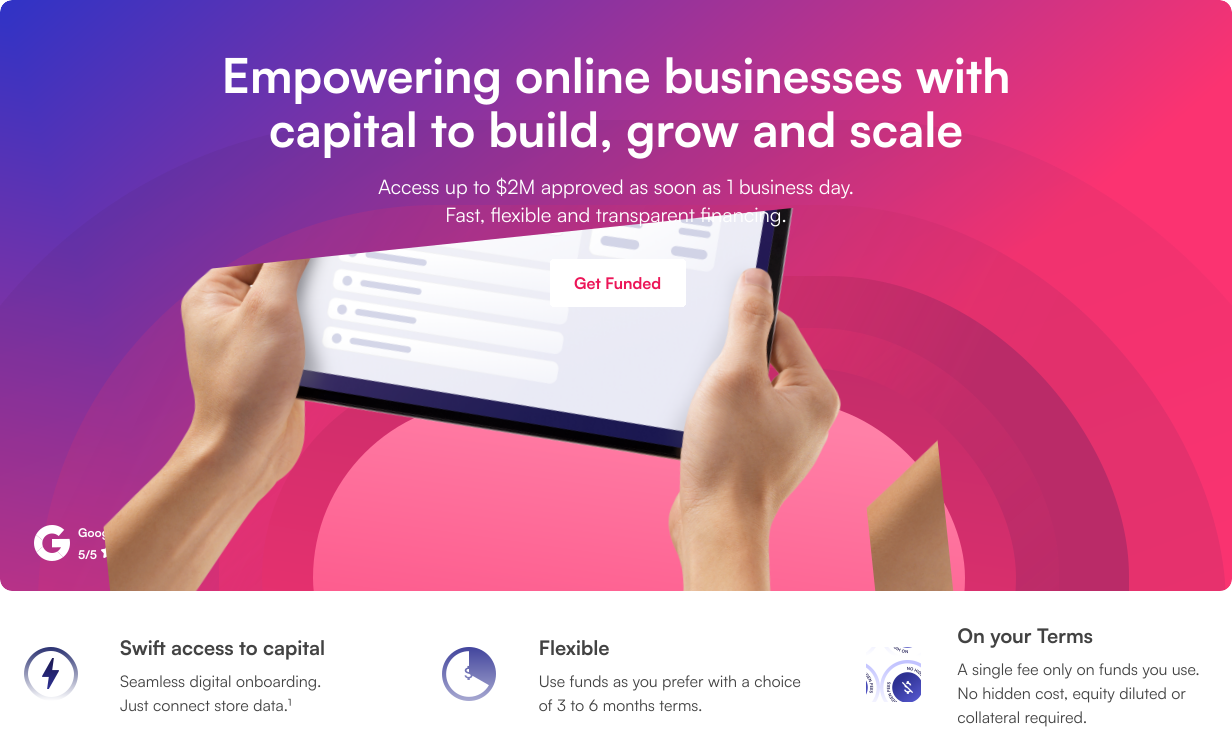
Get funded today with CrediLinq and discover a smarter way to finance your business.
Final Takeaways
- Every seller needs working capital, but not every model fits your rhythm.
- Onramp’s daily remittance commitments when sales are steady; CrediLinq’s fixed, predictable credit line works when they are not.
- CrediLinq’s funding gives you breathing room to manage your repayment without committing to daily deductions on your sales revenue.
- Its transparent single-fee structure and flexible repayment windows make it a practical option for sellers who may not benefit from a revenue-based funding model.
- With CrediLinq, funding is not restricted to one zone, as it covers Western and Eastern markets, including the United States, the United Kingdom, Australia, Singapore, and Hong Kong.
Frequently Asked Questions (FAQs)
How fast can I get funding from Onramp?
Onramp disburses funding in as little as 24 hours after approval. Speed may vary by risk reviews and bank rails.
What are the requirements to qualify for Onramp Funds?
Your business must be a United States-based registered entity and have recorded at least USD 3,000 a month as a simple baseline to be considered. There are no minimum trading history periods required. Exact offers still depend on your sales performance.
Does Onramp take a % of my Amazon sales every day?
Yes. Onramp remits a percentage of your sales, often daily or weekly, until the total amount is repaid. Remittances can be as low as 1% of daily sales.
How expensive is Onramp compared to a bank loan or Amazon Lending?
Onramp uses a flat-fee model (about 2–8%) plus a percentage of sales for repayment. This is usually costlier than bank lines when annualized, but faster and less paperwork-heavy. Amazon Lending can be cheaper for those invited, but access is limited.
Are there alternatives if I do not qualify or the offer is too expensive?
Yes. Consider CrediLinq’s revolving credit line with a single monthly service fee starting from 1.5% on drawn funds and predictable biweekly installments of 3-6 months; or Uncapped if you prefer fixed-term base-fee loans or qualify for their line of credit offer.