



Overview
|
|
Why This Matters
|
Global eCommerce revenue for 2026 is on track to be $3.88T, yet a significant share of online sellers still cannot access the working capital they need through traditional banks.
A standard business term loan can take 45 to 90 days from application to funding, while an inventory restock window closes in two weeks.
This disconnect has given rise to alternative lenders that underwrite based on real-time platform/marketplace data rather than historical tax returns or personal credit scores. They pull sales history directly from marketplaces like Amazon, Shopify, TikTok Shop, eBay, or Walmart to underwrite loans.
Approvals that once took months are now delivered in days, sometimes hours.
So, in this article, we’ll explore why conventional credit models fall short for online sellers, how purpose-built solutions like CrediLinq are reshaping eCommerce business loans, and what other financing options exist, so you can fund growth without slowing down.
Why Traditional Lending Is Not Built for eCommerce
Traditional financial institutions rely on credit assessment frameworks designed for brick-and-mortar enterprises. When an online seller walks through that process, several mismatches appear.
1. Eligibility criteria ignore marketplace performance data
Banks prioritize personal credit scores (often demanding a FICO score of 680 or above), debt-service coverage ratios of 1.25x or higher, and tangible assets. They do not value a 24-month Amazon Seller Central history, a consistent 30-day Shopify GMV trend, or TikTok Shop sales velocity.
The metrics that define an online brand’s health are invisible to legacy underwriting models.
2. Collateral requirements exclude most eCommerce businesses
SBA 7(a) loans, for example, require collateral for loans above $50K, typically a lien on real estate, equipment, or other physical assets.
eCommerce businesses often hold their value in inventory, brand equity, and customer lists. The result is a dead end for asset-light operators.
3. Approval timelines are too slow
A typical bank term loan, including SBA-backed products, requires 45 to 90 days of processing. Loan officers review two to three years of filed tax returns, audited financial statements, and a formal business plan.
In eCommerce, a supplier discount for bulk inventory or a limited-time advertising opportunity vanishes long before financing is approved.
4. Fixed repayment schedules clash with variable revenue cycles
Term loans demand consistent monthly payments over one to five years. That structure assumes stable cash flow.
An eCommerce business may generate 40% of its annual revenue in November and December, then drop sharply in January. Marketplace payout cycles, Amazon disbursing every 14 days, for instance, further create liquidity strain.
This leads many online sellers either to self-fund growth (leaving margin on the table) or to resort to high-cost business credit for eCommerce.
eCommerce Financing Designed for Fast-Growing Businesses
The new generation of eCommerce lenders has rewritten the underwriting process. Rather than combing through tax returns and fixed asset schedules, they connect directly to your storefronts and make decisions based on live performance data.
A few characteristics defining what a good eCommerce business loan looks like are the following:
1. Marketplace-based underwriting
Instead of a stack of paperwork, lenders read sales history, order volumes, return rates, and customer reviews directly from platforms like Amazon, Shopify, eBay, TikTok Shop, Walmart, Lazada, and Shopee. CrediLinq, for instance, evaluates a business’s 12 months of selling history across these platforms to provide credit up to $2M.
2. Fast decisions
Because the underwriting runs on live data, approvals happen in as little as one business day. You connect your store (or upload sales reports and bank statements for platforms without direct integration), the system processes the numbers, and you get approved, often the same day you apply.
3. No collateral or equity
Since the lender can see your transaction history, they don’t need to secure the loan against your personal assets. The funding is pure working capital. CrediLinq’s credit lines go up to $2M, backed by platform data alone.
4. Flexibility to draw only what you need
The most effective eCommerce financing works as a reusable credit line, unlike a traditional loan that comes with a one-time disbursement. You’re approved for a total limit, draw only what the moment requires, and pay a fee solely on the amount actually used. The remaining capacity stays available for the next inventory build, ad campaign, or marketplace launch. Draw nothing, owe nothing.
5. Transparent pricing
Traditional loans often come with origination fees, processing fees, late fees, and prepayment penalties. The new eCommerce lenders keep it simple. CrediLinq, for instance, charges a flat monthly service fee, as low as 1.5% p.m., on the drawn amount. No hidden charges, no early repayment penalties.
You can easily access such business credit for eCommerce needs if you meet the following criteria:
- At least 12 months of selling history on supported platforms (Amazon, Shopify, eBay, TikTok Shop, Walmart, Temu, Lazada, Shopee)
- A minimum of $30K in combined monthly revenue across those platforms
- A registered business entity (private limited company, LLC, or equivalent)

Comparing eCommerce Business Loans Options
The following table compares four common eCommerce financing routes sellers consider.
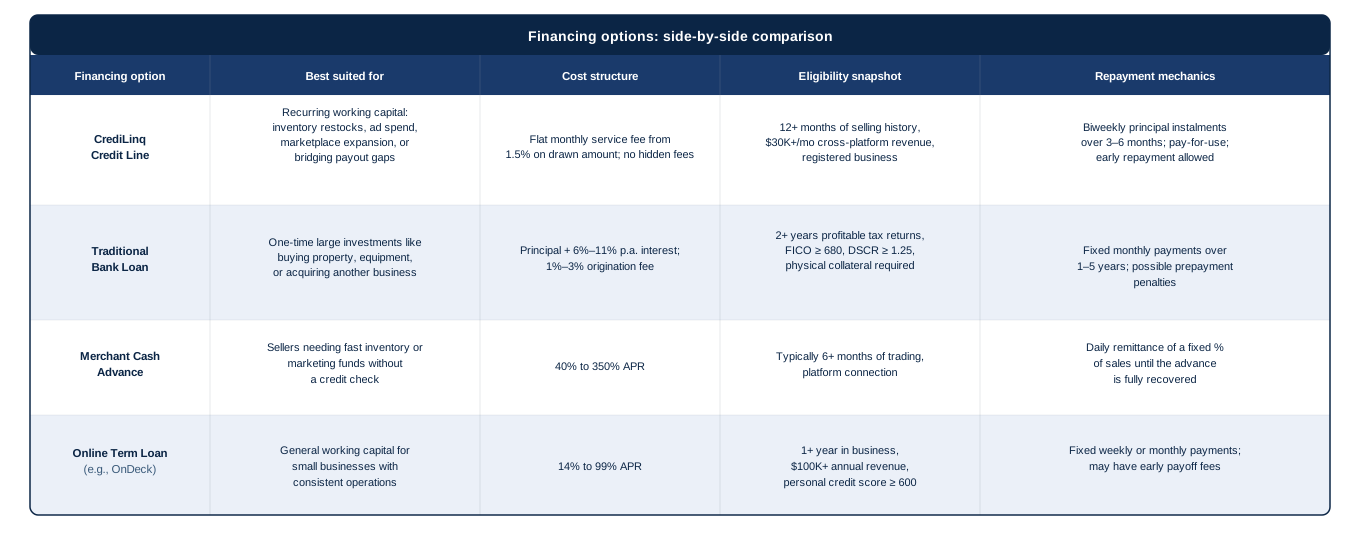
Bank loans are cheap but slow and require collateral. Online term loans and cash advances are fast but expensive. CrediLinq’s credit line gives you the flexibility of paying only for what you use, with transparent pricing and no daily sales deductions, a middle ground that works for growing eCommerce businesses.
eCommerce Financing That Finally Fits How You Sell
eCommerce runs on tight timelines. A restock window, a viral product trend, a campaign that needs budget now. The right funding tool lets you act when the moment arrives, not weeks later.
A revolving credit line built around your store data does exactly that: it gives you a pre-approved limit, charges only when you draw, and lets you repay on a schedule that matches your sales.
CrediLinq brings these pieces together. It connects to your platforms, reads your performance history, and delivers a decision within a business day. No collateral, no equity dilution, and one transparent fee, stripping away the usual trade-off between a slow bank loan and a costly cash advance.
Key Takeaways
|
Frequently Asked Questions
How fast can I get funding with eCommerce Business Loans?
Funding timelines vary by lender. Traditional eCommerce business loans take several weeks, while marketplace-based lenders approve applications much faster. With CrediLinq, eligible businesses can receive a funding decision in as little as one business day by connecting their marketplace sales data.
Will Applying for an eCommerce Business Loan Impact My Credit Score?
It depends on the lender and the underwriting process. Some eCommerce business loan providers perform hard credit checks, which may affect your credit score. CrediLinq primarily evaluates marketplace performance and business data, helping online sellers access business credit for eCommerce without relying solely on personal credit history.
What is the Typical Cost Range for eCommerce Business Financing?
Traditional loans offer lower annual rates, while merchant cash advances can be significantly more expensive. CrediLinq offers transparent pricing, with service fees starting as low as 1.5% per month on the amount drawn.
Can I Qualify for eCommerce Loans if I Sell on Multiple Marketplaces?
Yes. Many modern eCommerce lenders consider sales across multiple channels when assessing eligibility. CrediLinq supports sellers operating on Amazon, Shopify, Walmart, TikTok Shop, Lazada, Shopee, and eBay, allowing businesses to qualify using their combined marketplace performance.
What Are the Typical Loan Amount Caps for eCommerce Sellers?
Loan amounts depend on factors such as revenue, business history, and lender requirements. Some eCommerce business loans offer smaller working capital limits, while others provide larger facilities for established sellers. CrediLinq offers business credit for eCommerce of up to $2M for eligible businesses.
Can I Use eCommerce Business Loan Funds Specifically for Marketing and Advertising?
Yes. Many sellers use eCommerce business loans and business credit for eCommerce to fund advertising campaigns, customer acquisition, inventory purchases, and expansion initiatives. A flexible credit line from CrediLinq can be used for marketing spend on channels such as Meta, Google, and TikTok Ads.