



Highlights
Why This Matters to You
|
TikTok Shop is a global rocket. The effect of social media on eCommerce has been an immeasurable success as a result of “content virality”. A product can move from normal sales paces to breakout demand in just a couple of hours or days.
TikTok Shop exceeded USD 500 million in US sales during the 2025 Black Friday to Cyber Monday (BFCM) period, recording nearly 50% more shoppers than the previous campaign period. The opportunities are massive, but the issue with virality is that it can be random and instant. If you are unprepared, you could lose out on trend momentum before you can make the best of the situation.
According to Colorful Socks, TikTok trend lifespans can be short-lived, with modern micro-trends lasting 3 to 5 days, and older trend cycles may max out at 10 days.
For items in fashion or tech gadgets, you may not have more than 3 weeks before the hype dies down and the algorithm moves on. Also, before the viral moment, the inventory is sometimes already spoken for and understocked compared to newly generated demand.
To restock, you could come short because of delays in getting cash, as TikTok may not settle your earnings for 8 to 31 days, depending on your Shop Performance Score.
Having on-demand financing during this period is important to beat the high-stakes gap between when the demand signal appears and when you can fund the inventory to capture it.
Why TikTok Shop Seller Financing Matters During Viral Spikes
The problem with viral spikes is that increased sales frequency and usable cash do not move together. While the virality does promise revenue explosion, operationally, you may walk into a liquidity trap.
You must know that:
1. Settlement speed is not the same as cash availability
TikTok Shop’s settlement system operates on a tiered structure tied directly to your Shop Performance Score.
Standard sellers wait 8 days post-delivery for funds to clear. Accelerated sellers wait 5 days. Only elite-tier shops with consistently high SPS qualify for Express, which settles in 1 day.
If you add the mandatory 30-day reserve holdback, a percentage of earnings held as collateral against potential returns, the actual cash available is already reduced.
Add in 1 to 3 business days for bank processing, and the real cash conversion window for most sellers extends well beyond the settlement tier on paper.
2. Viral demand compresses revenue while expanding risk exposure
When a product spikes on TikTok, delivery volume, customer messages, cancellations and refund requests all rise. This activates the platform’s risk profile flagging automatically, including even for well-run shops.
After-sales requests must be fully resolved before any payout is released, meaning a wave of post-viral returns can freeze settlements entirely at the exact moment you need to restock.
Now, for a seller with about a 10% return rate and 15% in affiliate commissions, the realistic net payout, based on available data, is approximately 67.3% of reported GMV. This means nearly a third of gross revenue never reaches the bank account in the first cycle.
3. Inventory distortion on TikTok shop is not balanced
The combined impact of stockouts and overstock costs retailers about USD 1.73 trillion globally in 2025, according to research from the IHL Group.
In fact, inventory distortion still eats up roughly 6.5% of global retail sales. Even after recent declines, that loss is comparable to South Korea’s entire GDP.
Now on TikTok Shop, the distortion is almost always a stockout. A viral video can sell through every unit, including safety stock, within hours.
Jimmy Hadden, a social commerce executive at Wyze, described it directly:
“During viral peaks, having Seller Shipping as a fallback has been crucial. We are fortunate enough to be able to cover most of our baseline demand with FBT. During a viral spike, we are going to be out of stock and miss realizing the peak significantly more often.”
Predicting Viral Volatility Before it Peaks on TikTok Shop
Leading indicators to watch across TikTok Shop’s native analytics:
- Hashtag velocity: A hashtag growing from 10 million to 80 million views within 48 to 72 hours is a demand signal. Cross-reference with TikTok Creative Center’s trending products module to confirm category alignment.
- Cart-add spikes: A sudden increase in cart additions without a corresponding increase in completed purchases signals hesitation, usually on price or availability. That gap represents capturable demand if you can restock and run a targeted promotion within the window.
- Influencer repost patterns: When mid-tier creators (100k–500k followers) begin organically reposting content featuring your SKU without an affiliate arrangement, you are already inside the spike and not approaching it. About 50% of TikTok Shop purchases are tied to influencer content. When that layer turns organic, velocity accelerates without proportional ad cost.
- Early engagement-to-conversion ratio: When a video shows 10x normal engagement in the first 6 hours, that is the operational trigger to place emergency inventory orders.
How Much Inventory to Order Once the Product Gets Viral on TikTok Shop
The right inventory number comes from two inputs working together:
- A demand forecast built on real signals, and
- A cash flow model that tells you what you can actually fund before the window closes.
On the demand side, the leading indicators from the previous section give you the raw material.
On the cash flow side, you need to know how many units you can fund given your supplier deposit terms, your existing working capital, your current settlement balance on the platform, and the time before revenue clears.
These two numbers, demand ceiling and fundable ceiling, determine your actual order quantity.
Let’s take an example:
|
Lisa’s TikTok shop carries a beauty device she bought at $28 per unit, and she sells it on TikTok Shop for $79. From each sale, she pays a 15% affiliate commission, about $11.85 per unit, to the creators driving the purchase. Leaving a gross margin of $39 per unit before platform fees. She averages about 800 units in weekly sales. A macro-creator posts a paid review, and within 6 hours, the cart experiences a 900% spike. First, the seller builds their three scenarios across a 14-day virality window:
Lisa then chooses to plan for the base case and hold the aggressive scenario as a restock trigger. At 4,000 units per week over a projected 2-week viral window, the order quantity is 8,000 units. At a $28 unit cost, the total cost of the goods is $224,000. If the supplier requires a 50% deposit at purchase order placement, $112,000 is due immediately. The remaining supplier balance due on delivery is $112,000. Total pre-sales capital exposure: $224,000 committed before the first new units ship.
Settlements are still clearing in partial amounts, and roughly 30% of earned revenue remains held in TikTok’s reserve system. The account is generating revenue but is not yet liquid enough to cover what is coming. This is the quiet phase that catches sellers off guard.
The pinch point runs from Day 1 through Day 22. At the base case, Lisa has committed $224,000 in supplier payments while receivables are frozen in TikTok’s settlement and reserve system. This is not caused by a bad product, a poor margin, or weak demand. It is caused by the structural mismatch between when suppliers need to be paid and when TikTok releases funds. That gap is exactly what the right financing instrument needs to bridge. |
Available TikTok Shop Seller Financing Options
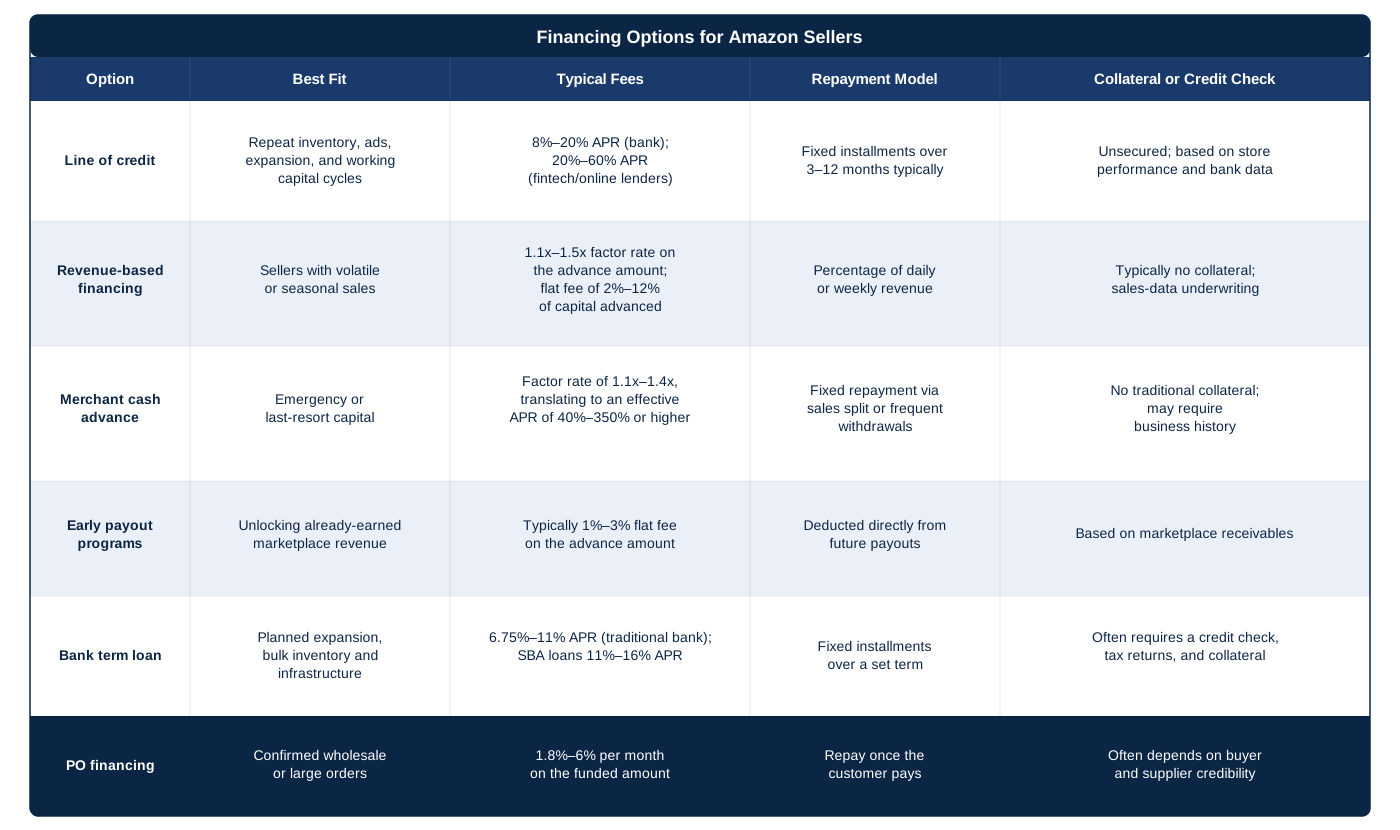
For social commerce funding, you need a model with a cost structure, approval speed, and repayment behavior that interacts properly with TikTok’s inventory and payout volatility.
Some options include:
1. Line of Credit
A revolving line of credit allows a seller to draw as needed and repay on schedule. Approval timelines for specialist ecommerce lenders like CrediLinq can be as fast as 1 business day.
CrediLinq offers draw limits for established sellers ranging from $50,000, with facilities available for up to $2 million. Interest accrues only on the drawn amount, not on the full facility. CrediLinq charges a single fixed service fee starting as low as 1.5% per month on drawn amounts.
2. Revenue-based financing
Revenue-based financing provides upfront capital that is repaid from a percentage of sales. It can fit sellers with fluctuating revenue, but the drawback is that repayment can accelerate during the exact period when the seller needs cash for reorders.
Unlike revenue-based financing, line of credit facilities like CrediLinq’s do not require repayment as a percentage of daily sales. With CrediLinq, repayments are made through scheduled biweekly installments over 3 to 6 months.
|
Important note: Revenue-based financing uses factor rates rather than traditional interest rates. Factor rates typically run 1.1x to 1.5x the advance amount. Given this, on a $100,000 advance at a 1.2 factor rate, total repayment is $120,000. When converted to effective APR, which depends on “how fast repayment occurs,” it may be beyond 20%. Always calculate the fee-inclusive effective APR at your expected revenue level before signing, not at the factor rate alone. |
3. Merchant cash advance
MCAs are technically not loans. They purchase future receivables, which allows providers to sidestep usury laws. It is a good solution for urgent, defined, short-duration needs, but may perform poorly as a primary financing structure for growth-stage sellers.
Bankrate, which has covered personal and business finance for decades, categorizes MCAs as a last resort. They also recommend that any business that uses one have an exit strategy in place before signing.
A large part of this is due to the high cost of maintaining MCAs, as you can be charged anywhere from 1.1-1.4X the advance amount, which can significantly increase the APR.
4. Dynamic settlement and early payout programs
TikTok Shop has a Daily Advance feature through Storfund, a third-party receivable purchase program providing up to 80% of the shipment amount the day after shipment.
It may solve the payout lag problem to a degree, but it does not address the upstream supplier deposit requirement that precedes sales.
You can think of it as a downstream fix. One that is useful for accelerating payout once the product is moving, but not a substitute for the upfront capital needed to place the purchase order in the first place.
5. Bank loans and term loans
Traditional bank term loans carry average interest rates of 6.8% to 11% according to the Federal Reserve Bank of Kansas City, with SBA 7(a) fixed rates ranging from 9.75% to 14.75%.
The rate advantage over alternative financing is real and significant. The timeline is not. The SBA loan process can take up to 60 to 90 days from application to funding under standard conditions. A viral window does not survive a 60-day underwriting process.
6. Purchase order financing
PO financing funds supplier costs tied to a confirmed purchase order. Fees often range from 1.5% to 6% per month, depending on risk and deal structure. It can work for large B2B orders, but many viral TikTok Shop spikes are forecast-driven and not backed by signed customer POs.
Choosing the Right Social Commerce Funding Partner for Your TikTok Shop
Decision checklist for TikTok sellers:
- Does repayment take a percentage of daily sales? If yes, model the cash impact during a peak revenue window, when sweeps are largest, against the capital you need available for your next restock.
- Does the lender understand marketplace payout cycles? A lender whose repayment structure ignores the 8-to-31-day settlement gap will build in a mismatch that shows up as a cash squeeze.
- Is the facility revolving or lump-sum? Viral inventory needs often come in waves: an initial deposit, then a balance payment on delivery, then a second run if the trend holds. A revolving structure handles that rhythm. A lump sum does not.
- Is approval tied to collateral or sales performance? Most TikTok sellers do not hold significant fixed assets. Underwriting based on marketplace sales data, revenue history, and platform track record reflects the actual asset.
- Are there hidden fees, prepayment penalties, or confession of judgment clauses? Require full disclosure before signing. MCAs, in particular, are known to carry non-transparent fee structures.
Regardless of the financing option, preparation shortens approval time. For marketplace-based lenders, bear the following in mind before applying:
- You will need to connect your marketplace account/upload your store data (Seller Central, TikTok Shop Seller Center, Shopify) to the provider’s portal.
- At least 3 to 6 months of bank statements and sales history for the past 12 months
- Gather your outstanding payouts, reserve balances, and holdback amounts by platform
- Active purchase orders or supplier quotes if financing a specific inventory event
- Business registration documents and operating history
With CrediLinq, underwriting is based on marketplace/platform sales performance and bank statements and not credit scores or collateral.
Sellers with at least 12 months of selling history and consistent monthly revenue of $30,000 or more across supported platforms, including TikTok Shop, Amazon, Shopify, eBay, Shopee, and Lazada, can pre-qualify without impacting their personal credit.
CrediLinq Interest/Service Fee and Repayment Terms
CrediLinq provides flexible credit lines to eligible ecommerce sellers at rates starting from 1.5% p.m. or a simple fixed annual percentage rate of 18%. No hidden fees or surprise charges.
Sellers can repay in 3-6* months in bi-weekly instalments without putting a strain on their cashflow.
*Tenors can be extended to 12 months for eligible sellers on a case-by-case basis.
Why Choose CrediLinq as Your Financing Partner for Your TikTok Shop
In reference to the example above, Lisa committed $112,000 in supplier deposits on Day 1 before a single settlement cleared, while TikTok’s reserve holdbacks are still active on existing sales.
With a CrediLinq revolving line already in place, Lisa draws $112,000 on Day 1 to cover the deposit immediately, and the new
inventory arrives on Day 18 to 22.
When the remaining supplier balance of $112,000 is due on delivery, Lisa draws again against the same facility. The two draws together total $224,000; the full base-case goods cost held for approximately 30 to 45 days before incoming TikTok settlements cover repayment.
Because the repayment structure is scheduled for biweekly installments rather than a percentage of daily sales, the seller’s incoming settlement revenue is not being swept simultaneously. It arrives intact and can go toward the next restock cycle, advertising, or the repayment schedule, all on Lisa’s terms.
CrediLinq provides a revolving line of credit with predictable repayment terms and no equity dilution or revenue-based repayments.
While you are waiting for settlements to clear, a better-funded competitor is already restocking. Get a CrediLinq line in place before the next spike so you are the one who stays in stock.
Key Takeaways
|
Frequently Asked Questions
How fast can I get funding to catch a viral spike?
Some fintech lines of credit, revenue-based financing providers, and merchant cash advance providers can move in 1–3 days, while some MCA offers may be faster. With CrediLinq, sellers can access up to $2 million with approval as soon as one business day.
Does TikTok Shop seller financing require collateral?
Not always. Many e-commerce-focused lenders use sales data, store performance, and bank data instead of hard collateral.
Will applying affect my personal credit score?
It depends on the lender. Some providers use soft pulls during pre-approval, while banks and credit card providers may use hard credit checks.
You should ask whether the application includes a soft pull, a hard pull, a personal guarantee, or a business-only assessment before applying.
What is the typical cost range for revenue-based financing?
Revenue-based financing costs vary by provider, risk, and repayment speed. You can expect pricing to range from 1.1 to 1.5x of the funded amount.
How do TikTok Shop payout delays impact repayment schedules?
Payout delays can create a mismatch between repayment due dates and available cash. TikTok Shop settlement can be affected by performance tier, reserves, delivery timing, and bank processing. Fixed repayments should be scheduled after expected payout clearance, where possible.
Can I combine early-payout programs with a credit line?
Yes, but model the combined cost. An early payout can release earned revenue faster, while a credit line can fund pre-sales needs such as supplier deposits and freight. The risk is stacking fees across multiple products without tracking the total cost per unit sold.