


Overview
- Alibaba.com is built for international trade, with tools like trade assurance and the verified supplier program.
- 1688.com is a domestic Chinese wholesale marketplace that often lists sharper prices but may limit you to operating inside China’s systems (language, payment rails, and logistics).
- Sellers are drawn to 1688 because of better margins, but consistent cash flow is needed to take advantage of these opportunities, as demand and competition to clear stocks out are high.
- CrediLinq offers you quick and consistent cash flow to fund your sourcing cycle for your eCommerce store without requiring you to give up equity or lock into long-term loan debts.
Why this matters to you
- 1688 can feel like a secret door to manufacturer-level pricing, and you want to know what the advantages are.
- Alibaba can feel like a safety net for cross-border trade, but you feel you could get better pricing for the same goods elsewhere.
- You want to take advantage of domestic Chinese prices but need funding flexibility to place bigger orders or secure factory slots before competitors do.
Sourcing products is one of the most decisive steps in building a profitable eCommerce business. 1688.com and Alibaba.com both connect you to China’s vast manufacturing network, but they serve different buyers.
1688.com is a Chinese-language wholesale marketplace locals use. Alibaba.com serves as the international sourcing hub for the rest of the world. Prices on 1688.com often look lower for identical or similar listings.
However, lower list prices do not automatically translate to lower landed costs, especially when considering additional factors such as international payments, agents, inspections, and freight.
For sellers sourcing from overseas, cost is only part of the story. Managing payments, freight, and restocks requires liquidity as much as it does strategy. Platforms like CrediLinq help here by giving eCommerce sellers flexible working capital to act fast on opportunities found on 1688 while keeping cash flow balanced across marketplaces.
1688 vs Alibaba: A Comparison

Marketplace Overview: 1688 vs Alibaba
What is 1688.com
1688.com is a Chinese business-to-business marketplace under the Alibaba Group. It connects buyers with local manufacturers and wholesalers, offering:
- Lower Prices: Domestic wholesale pricing, often 10–30% cheaper than Alibaba.
- Flexible MOQs: Ideal for small orders or product testing.
- Challenges: Chinese-only interface, local payment methods, and limited export support.
Because it is domestic, listings are in Chinese, prices are usually in Chinese Yuan, and sellers are set up for local payment and logistics.
This is why you often see lower price points and flexible order quantities, but fewer native cross-border services.

Source: 1688.com website
What is Alibaba.com
Alibaba.com is an international wholesale marketplace. It is designed for exporters and overseas buyers.
The platform offers cross-border infrastructure to protect buyers and check sellers, including:
- Trade Assurance (Alibaba’s free buyer protection program that holds payments in escrow and guarantees refunds if a supplier fails to meet order terms)
- Verified supplier audits
- Multi-language workflows and integrated export logistics
All of this is so that non-Chinese businesses can source goods with clearer protections and payment options. The website navigation is also available in English and other languages.

Source: Alibaba.com website
The United States is China’s largest single importer; in 2024 alone, over $400 billion in goods were imported from China. Electrical and electronic equipment alone accounted for roughly US$127 billion of these imports.
Both 1688 and Alibaba.com have become key sourcing hubs from China for the United States’ eCommerce market. But the type of products buyers target on each platform differs slightly.
On 1688, buyers typically go after low-cost, high-turnover items within categories like:
- Home and comfort goods (organisers, textiles, décor items)
- Consumer electronics and accessories (USB chargers, LED lamps, humidifiers, phone holders)
- Clothing (basic T-shirts, tote bags)
These products appeal to resellers because of their lower domestic pricing and flexible minimum order quantities.
On Alibaba, United States-based Amazon and DTC sellers focus on export-ready, higher-margin goods that are easier to ship and brand like:
- Smart home devices
- Fitness accessories (yoga mats, portable gym equipment, gym wearables)
- Kitchen tools (wheat straw plates, reusable food storage, silicone baking mats)
- Pet supplies (pet grooming kits, pet toys, scratch posts)
- Clothing accessories (custom-branded clothes, seasonal dresses, sunglasses)
Key differences between Alibaba and 1688 for sellers
For these platforms, sellers are mainly concerned with:
1. Pricing and minimum order quantities (MOQs)
1688
Prices often run lower because the marketplace targets the domestic Chinese wholesale price tier. Minimum order quantities are frequently flexible. Also, the low price advantage may narrow once you include international payment fees, third-party inspections, and freight forwarding.
Alibaba
Pricing is still wholesale, but generally higher than 1688 for similar listings because suppliers quote for export and not domestic resale. Minimum order quantities vary by supplier, but exporters often standardize around export packs and cartons.
For example, a seller sourcing 500 units of a phone case from 1688 could save 25% on unit costs but might spend 15% more on logistics compared to Alibaba’s streamlined shipping.
2. Supplier verification and product authenticity
1688
Suppliers display domestic membership and credibility badges such as Chengxintong (诚信通) and “powerful merchant” tiers.
These indicate fee-based membership and some degree of platform vetting, but they are not the same as third-party factory audits. You must validate capabilities, production scope, and compliance independently.
Alibaba
Trade assurance can hold payments and support refunds for late shipment or quality non-conformance. It has an audit called a verified supplier, a third-party inspection program that inspects a company’s profile and production capability. These do not replace your own inspection, but they reduce screening friction.
Advantages of using 1688
Some benefits you could enjoy picking 1688 over Alibaba include:
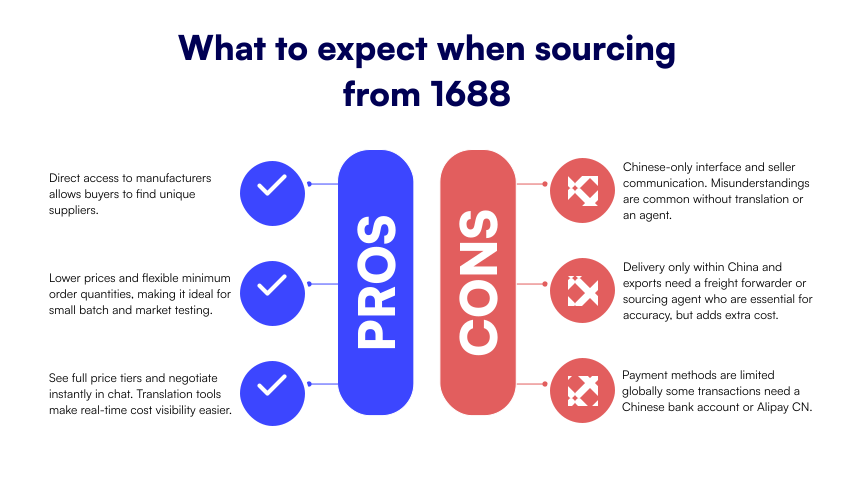
1. Direct access to manufacturers
1688 aggregates domestic Chinese sellers, including factories that may not list on Alibaba at all. This can expose you to product lines and price points that exporters do not advertise to overseas buyers.
2. Lower prices and flexible order quantities
Because 1688 targets domestic trade, you will often see materially lower unit prices and smaller starting quantities. For test orders or trying to quickly test on product-market fit, this can be a powerful lever.
3. Transparent pricing and product information
1688 product pages often display all domestic price breaks and options upfront, in Chinese, with live messaging for negotiation. With their latest AI translation workflow, you can now get multi-language translations and real-time currency conversion to gain faster visibility into the lowest possible cost for a product.
Challenges with using 1688
1. Language barriers and platform navigation
1688 uses a Chinese-only interface, and most sellers have to communicate in Chinese. This raises the risk of specification misunderstanding unless you or your agent manages translation tightly.
2. Limited international shipping options
Most 1688 sellers are optimized for domestic delivery. There is no native international shipping layer like you may find via consolidated services on export-oriented platforms like Alibaba. You will usually need a freight forwarder, a third-party logistics provider, or a 1688-focused sourcing agent to move goods out of China.
3. Payments and account setup
International payment support is limited. Historically most sellers accepted Chinese bank transfers, Alipay or WeChat Pay tied to a local bank card in China.
For overseas buyers, newer solutions now allow:
- Alipay “cross-border pay” (跨境宝) business accounts which permit certain registered foreign companies to pay in RMB.
- Partner services such as WorldFirst / “World Pay” which lets you link an offshore account, convert your currency and pay suppliers on 1688 without needing a mainland-China bank account.
Nonetheless, many overseas buyers still engage local sourcing agents to bridge the payment gap. This is because direct credit-card, PayPal or USD bank transfer options remain rare for 1688 suppliers.
4. Needing sourcing agents
If you do not have team members who can communicate fluently in Chinese or local logistics directly, working with a reputable 1688 sourcing agent is essential.
A good agent manages supplier verification, sample coordination, payments, quality inspections, and export logistics under one service. This does include a fee, but it is essential to reduce reworking risks.
How to use 1688 for sourcing to the USA
The following steps will guide you to source the right way on 1688. Treat every step as a workflow. Set up correctly, verify once, and reuse the same process for every new supplier.
Step 1 – Create your 1688 account
The setup guide automatically walks you through the steps. Expect the interface to appear in Chinese. If needed, use browser translation extensions such as Google Translate or 1688 AIBUY’s built-in translation and AI chat support to make navigation easier.
Step 2 – Search smart
Use precise Chinese keywords for better results. If you do not speak Chinese, translate your product terms carefully to include material, size, and standard codes. For example, instead of searching “stainless steel water bottle,” use “不锈钢水杯 500 ml” to include both the material and volume.
Similarly, if you are sourcing cotton tote bags, search “纯棉手提袋 35×40 cm” to capture fabric type and dimensions. You can maintain a concise bilingual glossary of keywords to reuse across all searches.
Step 3 – Filter by badges and tenure
Shortlist suppliers that have been active for several years and display credibility badges. This shows that the seller has verified company information and paid membership fees. Check their transaction history and ratings to confirm activity.
Step 4 – Validate manufacturer status
Check whether the seller is a factory or a trading company. Factory listings often include photos of production lines, tooling machines, or product molds.
However, you must know that having production line photos does not guarantee they own the factory (some trading companies show partner factories).
In fact, fraud and mis-representation are widespread among overseas buyers sourcing via Chinese B2B marketplaces.
For example, many “manufacturers” are really shell trading companies, business licences are forged or overstated, and genuine export-capable factories vanish once advanced payments are made.
Here is a checklist for verifying manufacturers and suppliers:
- Ask for the supplier’s official Chinese business licence: Verify the registration number, business scope (look for words like “生产 / 制造 / 加工” — manufacture, processing) and legal name via the official Chinese government system, like the National Enterprise Credit Information Publicity System.
- Confirm the registered address matches the address on the licence: Check Google Maps, Chinese map services, or request a video/factory tour showing production lines, tooling machines, or molds. Suppliers claiming to be factories without visuals are a higher risk.
- Product range and catalog consistency: A true manufacturer will tend to specialize in a narrower product range (its core category), rather than a very broad catalogue of unrelated goods. If the supplier lists many categories, it may be a trading company.
- Certifications and production capacity evidence: Verify that the supplier holds relevant industry certifications, provides photos of production equipment, and has sufficient staff and factory capacity. This indicates manufacturing capability rather than simply a reselling front.
- Legal and credit status check: Use the official Chinese company registration databases such as the National Enterprise Credit Information Publicity System (NECIPS) to search a supplier’s registration number, unified social credit code, business scope, and record of lawsuits or regulatory non-compliance.
You can also review whether the company appears in wider regulatory frameworks like China’s Corporate Social Credit System.
Moreover, check for how long the company has been in operation. A more extended history and clean legal record can increase trust.
- Request samples with a clear specifications sheet: Prepare a bilingual specification sheet that outlines materials, finishes, dimensions, compliance standards, labeling, and packaging requirements. Send it with your sample request. Confirm in writing that the approved sample will serve as the production reference.
- Plan payments and logistics early: If you do not have a Chinese business entity or bank account, arrange a sourcing agent or freight forwarder before placing your order. They will handle payments to suppliers, local pickup, export customs, and international shipping. Doing this upfront prevents delays later in the process.
Risk controls you should not skip for both marketplaces
- Documented specification and sample sign-off before production: Always prepare one clear product specification with photos, materials, dimensions, and packaging details. Obtain the supplier’s approval and have them sign a “golden sample” to serve as the exact production standard.
- Purchase contract with clear delivery window and remedies: Draft a concise agreement outlining delivery dates, product standards, and the consequences of late shipment or quality failure. Even a simple signed document helps you claim refunds or replacements later.
- Carry out independent quality inspection for each shipment: Use a third-party inspection company to check goods before they leave the factory. It costs a little extra but saves you from shipping defects or wrong items across the ocean.
- Clear post-shipment claim window and evidence requirements: Agree in writing how many days you have to report a problem after receiving the goods and what proof you need (photos, videos, or inspection reports). This keeps both sides aligned if something goes wrong.
- Supplier diversification across two factories, once volume justifies it: When your sales grow, do not rely on one supplier. Work with at least two factories for the same product to ensure continued sales even if one experiences delays or price changes.
Funding your sourcing cycle on 1688 with CrediLinq

Sourcing from 1688 can unlock better prices, but it also means paying suppliers upfront, covering freight, and managing long cash gaps before your next marketplace payout. Many sellers miss these opportunities because cash flow is tight.
CrediLinq helps free up your liquidity. It offers flexible credit lines built specifically for eCommerce sellers, giving you quick access to working capital when you need it so you can:
- onnect your sales data from Amazon, TikTok Shop, Shopify, eBay, Shopee, Lazada, and more to qualify for funding based on your real marketplace performance.
Once approved, you can use those funds for procurement on 1688, to place larger orders, negotiate better factory prices and secure early-season stock without dipping into your operational cash flow.
- Worry less over repayment, as you only have to deal with a flat monthly service fee starting from 1.5% per month on funds that you actually use (or as low as simple fixed APR of 18%) , with no early repayment penalties.
- Choose repayment periods of three to six months. This short-cycle structure keeps your credit line turning faster. This way, you can fund a batch, sell through inventory, repay, and draw again without committing to a long-term debt build-up. Alternatively, customized solutions are also available upon request. Loan tenors can extend up to 12 months on a case-by-case basis.
- Scale bigger with access of up to USD 2 million in available credit, approved in 1 business day without lengthy paperwork.
- Choose to receive funds in USD, GBP, or SGD, depending on where your suppliers or logistics partners are based. This means you may be able to pay Chinese or Southeast Asian suppliers directly in their preferred currencies even if you are based in the United States
Which Platform to Source Goods from

Is 1688 a better sourcing alternative to Alibaba?
The better platform depends on what you sell and your level of preparedness.
Choose 1688 for lower local prices, and have an agent or local team assist with language, payments, and shipping. It is ideal for testing new products, small orders, and building direct factory relationships.
Choose Alibaba for an easier, ready-to-export setup with built-in buyer protection, verified suppliers, and English support. You will pay a bit more, but it saves time and reduces mistakes.
For sellers who must balance international sourcing with fast sales cycles, liquidity is key to maintaining steady growth.
CrediLinq turns that liquidity into a significant advantage, enabling you to buy smarter, scale faster, and maintain momentum without worrying about short-term cash gaps.
Learn how CrediLinq can help finance your 1688 sourcing needs.
Final Takeaways
- 1688 gives you direct access to factories and domestic pricing power, but it demands stronger systems in translation, payment handling, and quality checks.
- Alibaba offers an easier international path with trade assurance, verified suppliers, and ready-made export support, though often at a slightly higher landed cost.
- Whichever platform you use, your growth will still depend on liquidity and your ability to fund orders quickly, bridge payout gaps, and move at the pace of demand.
Frequently Asked Questions (FAQs)
What is the difference between 1688 and Alibaba?
1688 is a domestic Chinese wholesale platform, designed for Chinese buyers and local trade.
Alibaba.com is built for international buyers and exporters, offering multilingual support and global logistics.
1688 often means lower local factory pricing but more complexity for overseas buyers (language, payment, export).
Alibaba offers easier international buying, although it often comes at a higher cost.
Can international buyers use 1688?
Yes, of course, although not directly in most cases. 1688 is built for domestic Chinese trade. Overseas buyers typically require a freight forwarder, a third-party logistics provider, or an agent to facilitate international export and delivery.
Is 1688 cheaper than Alibaba?
Often, yes, at the listing level, because 1688 targets domestic price tiers. The real question is landed cost after you include international payments, agent fees, quality control, and freight. Always compare the full landed cost.