



How Capital Efficiency Changes When You Move from Start-up to Professional Seller

Highlights
- Crossing $1M in e-commerce revenue triggers a structural shift: The business scaling roadmap that got you here actively limits the next phase
- A gross margin above 60% and an LTV/CAC ratio of 3:1+ are non-negotiable before scaling paid acquisition
- Working capital shortages stall most brands between $1M and $10M
- Each revenue band ($1M–$3M, $3M–$5M, $5M–$10M) demands a different capital structure, operational priority, and hiring model
- Strategic growth capital, when structured correctly, is a growth enabler, not a last resort
- Credilinq’s line of credit for equity-free and collateral-free financing lets brands fund inventory cycles and scale marketing without diluting ownership or pledging assets
Why this matters to you
- Cash flow gaps can quietly kill growth — inventory reorders, rising ad costs, and delayed marketplace payouts strain your business even when demand is strong
- Scaling from $2M to $10M hinges on understanding your unit economics, building financial systems early, and aligning your capital structure with how you actually operate
- Selling across Amazon, TikTok Shop, Shopify, or similar platforms adds complexity that makes financial blind spots more costly
- Supplier deposits due now vs. marketplace payouts arriving in two weeks is a timing mismatch that catches growing brands off guard
- Proactive financial planning separates sellers who plateau from those who break through
Introduction
After ecommerce sellers hit $1M+ in revenue, their ad costs begin to climb significantly. Cash gets tied up in inventory and other essential spends, and marketplace payout delays restrict what’s available to spend on growth and expansion to other SKUs and markets. The founder-does-everything model that powered early growth starts creating bottlenecks at every decision.
The gap between $1M and $10M is a daunting capital and systems problem. Brands that cross this barrier successfully deploy capital more precisely, build operational infrastructure, and secure the right financing at the right stage.
This guide maps that journey stage by stage, with the financial frameworks and operational levers most scaling guides never mention.
Why Most E-commerce Businesses Stall After $1M
Early e-commerce growth runs on three engines: founder hustle, one or two winning stock-keeping units (SKUs), and paid ads that scale on strong returns on ad spend (ROAS). These work until they create their own constraints.
Working capital shortages emerge as inventory becomes the largest operational expense. A bad month at $500k in revenue is painful. The same inventory misjudgment at $2M can halt an entire production cycle and trigger a stock-out that costs marketplace ranking, on top of revenue.
Customer acquisition cost (CAC) inflation erodes unit economics. According to Triple Whale’s 2025 benchmark report, cost per mille (CPMs) on Meta rose more than 20% year-over-year, with every single e-commerce category seeing an increase. Without a corresponding lift in Lifetime Value (LTV), ad scaling becomes margin destruction rather than growth.
Payout delays from Amazon (typically 14 days), TikTok Shop, and Net 60–90 retailer terms mean cash is chronically lagging behind commitments, even when the business is technically profitable.
Operational complexity multiplies across channels, SKUs, and suppliers faster than any founder-led system can absorb. What worked at 500 monthly orders might break at 5,000.
As a result, brands invest more into ads, watch margins compress, and wonder why revenue growth feels so expensive. The answer is almost always capital misalignment: spending at the wrong stage without building systems to sustain it.
The Capital Efficiency Mindset: What Changes After $1M Revenue
Capital efficiency means extracting maximum revenue and margin from every dollar deployed, without over-funding structurally immature growth. Many brands fail to scale not because demand is lacking, but because they chase revenue growth while ignoring the financial structure beneath it.
Four metrics that define whether a brand is capital efficient are:
Gross margin (GM): A GM of 60% or more makes a brand capital efficient. Below this threshold, paid acquisition scaling is unsustainable as ad costs consume the margin before contribution is possible.
LTV/CAC ratio: A 3:1 or higher LTV/CAC ratio is a healthy indicator. A brand spending $50 to acquire a customer who generates $100 in lifetime value is unsustainable.
Inventory turnover: Inventory turnover measures how quickly you sell and replace your stock in a year. How many times does your inventory sell and replenish in a year? Low turnover means capital is locked in slow-moving stock. High turnover with strong margins signals operational health.
Cash Conversion Cycle (CCC): The time between paying suppliers and collecting customer revenue is measured as the CCC. Every extra day in this cycle is capital that earns nothing.
CCC formula: Days Inventory Outstanding + Days Sales Outstanding − Days Payable Outstanding
Illustration: Impact of reducing CCC on working capital
Annual revenue of an ecommerce brand: $3M
CCC: 90-days
Operational capital deployed: ($3M ÷ 365 × 90)= $740K
If CCC can be reduced by 15 days to 75 days through faster inventory turns or better supplier payment terms
Operational capital deployed: ($3M ÷ 365 × 75)= $124K
Additional capital available for inventory, ads, or a reserve buffer = $740K – $616K = $124K
|
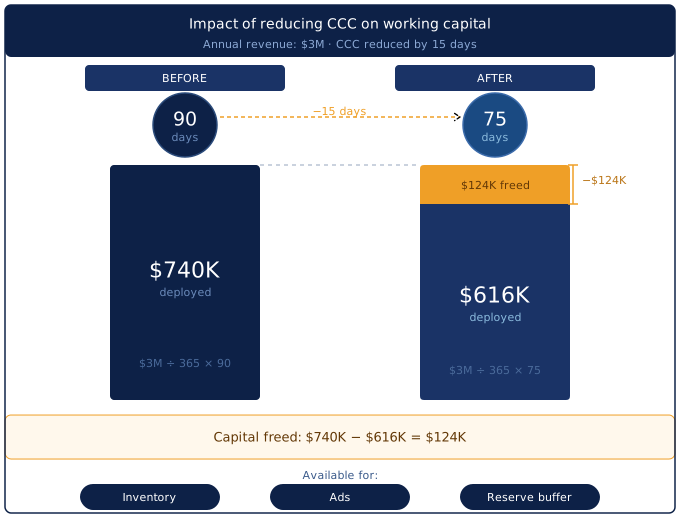
A brand can grow revenue strongly and still run out of cash if inventory builds faster than sales collection. This is the trap most brands with $1M–$3M in revenue fall into, and it explains why capital efficiency, not revenue growth, is the defining skill between $1M and $10M.
The $1M–$10M E-commerce Scaling Roadmap
Each revenue band carries different capital requirements, operational priorities, and risk profiles. What works at $1M actively constrains you at $5M.
The table below maps each priority, system, and capital decision across the three growth stages. You can use it to identify where your business stands today and what to build next.
$1M–$10M E-commerce Scaling Roadmap

With the full picture mapped out, here is what each stage demands in practice.
Stage 1: $1M–$3M — Fixing the Financial Foundations
At this stage, most brands are still founder-led, inventory planning is reactive, and paid acquisition on one or two channels drives almost all revenue. The priority is building the foundation that makes aggressive growth sustainable.
Strengthen unit economics first: Before scaling inorganic marketing ad spend, research your audience to understand their buying psychology and get the numbers right.
A DTC wellness brand scaling on Amazon introduced solution-focused bundles (example: mom hydration kits, containing their popular electrolyte drink with a postpartum wellness guide) and saw their Average Order Value (AOV) lift 20%, using that margin improvement to self-fund its next inventory build instead of relying on personal credit.
Subscriptions improve LTV without additional acquisition cost. For instance, a 5-15% subscribe-and-save discount could convert one-time buyers into predictable recurring revenue, meaningfully improving the LTV without touching acquisition spend.
Tighten inventory and cash cycles: Inventory is the largest working capital constraint at this stage. Map your full CCC: when you pay suppliers, when inventory arrives, when it sells, when cash lands.
Negotiating even 15–30 extra days of supplier payment terms, combined with faster inventory turnover, can free up significant working capital.
Build basic financial visibility: You cannot manage what you can’t see. At a minimum, build:
- SKU-level profitability tracking (which products actually make money after Cost of Goods Sold (COGS), ads, and returns)
- Weekly contribution margin dashboards by channel
- A 12-month rolling cash flow model to surface shortfalls 60–90 days before they become crises
Stage 2: $3M–$5M — Systemizing Growth Engines
At $3M+ revenue, operational complexity increases very fast. The founder-does-everything model breaks, and every decision still running through the founder becomes a growth bottleneck.
Diversify customer acquisition: Single-channel dependence for your ads and marketing is a structural risk. Brands that reached $3M on Meta alone are exposed to CPM spikes, algorithm changes, and policy shifts.
Leading brands at this stage expand into email and SMS marketing (the lowest blended CAC, the highest LTV), creator and influencer partnerships (critical for TikTok Shop, where beauty and personal care accounts for 22% of platform GMV), and Amazon marketplace or Shopify DTC diversification.
Each new channel lowers blended CAC and reduces platform concentration risk, directly improving capital efficiency across acquisition spend.
Build repeatable operational systems: Standard Operating Procedures (SOPs) for every repeatable function, such as inventory planning, order fulfillment, customer service, and marketing campaign workflows, can transform a founder-dependent business into a system-led operation.
Brands consistently pacing 1,000–1,500 orders per month can significantly reduce fulfillment cost and complexity by transitioning to a third-party logistics (3PL) provider, freeing up founder bandwidth for growth decisions.
For brands already selling on Amazon, TikTok Shop, or Walmart, the native fulfillment networks — FBA, FBT, and WFS, respectively — offer an additional layer of infrastructure worth activating. Each program handles storage, packing, and last-mile delivery within its own ecosystem, and products fulfilled through these networks typically receive preferential placement and eligibility for platform-level shipping guarantees such as Prime, which directly influences conversion rates.
Introduce strategic growth capital: Scaling beyond $3M almost always requires external capital. Most e-commerce CFO strategies involve seeking capital when cash flow is already stressed, and accepting expensive, inflexible terms as a result.
Not all working capital solutions are built for this stage. Revenue based Financing and Merchant cash advances offer speed but come with high effective costs: APRs can exceed 60%, making them difficult to sustain across multiple inventory cycles. Equity financing provides runway but permanently dilutes ownership in exchange for what is often a temporary, predictable capital need.
A smarter alternative is equity-free, collateral-free working capital evaluated on e-commerce cash flow. CrediLinq structures working capital for exactly this stage, allowing brands to fund inventory expansion, scale marketing campaigns, and bridge payout cycles on a 3–6 month tenor with fixed bi-weekly installments. Repayments are on a fixed schedule, giving brands predictable payment obligations they can plan around.
Stage 3: $5M–$10M — Building Defensible Competitive Advantages
When sellers reach $5M+ in annual revenue, the challenges look different. Their focus shifts from scaling to sustaining. They need to build something that can’t be easily replicated by their competitors.
Develop proprietary products and brand IP: Commodity products compete on price. Proprietary products compete on identity. Private label innovation, formula differentiation, and brand storytelling create switching costs that protect margins and reduce price competition. A brand with a loyal community earns organic distribution that paid-only brands cannot replicate, no matter the ad budget.
Expand into multi-channel distribution: True resilience means that no single channel accounts for more than 40–50% of revenue. By $7M–$10M, best-in-class sellers operate across Amazon, TikTok Shop, Walmart, Shopify, and even early retail partnerships, each channel serving a different acquisition and retention function while building negotiating leverage with suppliers, 3PLs, and retail buyers.
Build specialized leadership: The generalist team that scaled to $3M cannot scale to $10M. This stage requires dedicated marketing leadership (owning the LTV/CAC strategy), a supply chain lead (managing vendor relationships and freight), and financial leadership, whether fractional or full-time, who builds the infrastructure for the next growth phase.
Financial Tools Professional E-commerce Sellers Use to Ensure Capital Efficiency
As your business scales, the next step is building an analytics infrastructure that supports consistent, data-driven growth.
The table below showcases the key analytical tools scaling brands need, what each does, and when to build it.

A 12-month cash flow model template can be downloaded for free online. It is an important tool that makes shortfalls visible while you still have options. The practical reserve target must be 2–3 months of COGS plus ad spend in accessible cash or a standby line of credit that you can draw and use as you need flexibly.
Strategic Use of Growth Capital
Strategic use of growth capital means deploying funds against specific, measurable milestones: a large Q4 inventory build, a new channel launch before revenue materializes, or bridging a Net 60–90 payment cycle.
CrediLinq’s collateral-free financing supports these use cases, evaluating businesses on their sales and transaction data from the past 12+ months rather than on hard assets.Here’s what CrediLinq’s line of credit offers to scaling e-commerce brands:
No equity dilution: you retain 100% ownership of your business without giving up equity. CrediLinq keeps the cap table clean by providing access to the capital you need to fund inventory or bridge a payout gap without handing over a share of the business you have built.
No revenue sharing: Repayments are fixed bi-weekly installments rather than a daily percentage of sales that penalize your best months. A single fixed service fee repaid in fixed bi-weekly installments removes that variability entirely. This predictability enables founders to build reliable cash flow models and make growth decisions based on data.
No collateral required: CrediLinq does not require you to pledge inventory, equipment, or real estate. Most e-commerce brands at this scaling-up stage do not own the assets traditional lenders want as security. CrediLinq evaluates businesses for credit lines based on their e-commerce cash flow and revenue performance.
Cross-platform financing: CrediLinq works across Amazon, TikTok Shop, Shopify, Walmart, eBay, and more. Platform-specific financing creates a ceiling the moment you diversify. CrediLinq removes that ceiling by funding inventory, marketing, and fulfillment with the same line of credit. Whether your revenue is concentrated in one marketplace or spread across five, multi-channel sellers have a single, flexible capital source that grows with their distribution strategy.
Transparent, predictable pricing: fixed monthly fees with no hidden charges. Hidden fees erode margin and cause long-term damage. CrediLinq charges fixed monthly fees starting at 1.5% per month or a simple fixed annual percentage rate (APR) of 18%.
On-demand access: Draw capital for specific milestones, repay flexibly in 3-6 months on a defined schedule (biweekly instalments).On-demand access lets you draw precisely when each stage requires it: the supplier deposit on Day 0, the balance on Day 30, duties on arrival, etc.
3–6 month tenor: CrediLinq’s repayment cycle is 3-6 months, and can be extended to 12 months* on a case by case basis, giving growing ecommerce sellers the chance to match their inventory and payout cycles effectively.
Eligibility criteria: To qualify for CrediLinq’s financing, you must have 12+ months of selling history on one or more platforms and should be making $30,000 in combined monthly revenue. CrediLinq also connects to your Plaid account or asks for your bank statements to evaluate your eligibility in real time, as soon as 1 business day. Once approved, you can draw down from your approved credit line any time for 1 year without having to reapply for financing multiple times.
Operational Levers That Protect Profit at Scale
Now that you have a roadmap to scale e-commerce business, you must understand that operational efficiency becomes critical at higher revenue levels. Here’s a list of operational factors that you should optimize while scaling:
Inventory and supply chain optimization: Reactive inventory management is one of the most common sources of margin leakage in scaling e-commerce. The fix is disciplined forecasting:
- Reorder points tied to sell-through velocity, not historical averages
- Dual sourcing on top SKUs to remove single-supplier risk
- Forward freight agreements locked in before peak season
Technology and automation: Every manual process that works well at $500k in revenue becomes a bottleneck at $5M. Automating your processes, including streamlining your 3PL, either through FBA, FBT, WFS, or 3rd party companies is recommended to ensure that peak season bottlenecks and other obstacles don’t come in the way of scaling.
Strategic hiring and outsourcing: Not every function needs to sit in-house. Agencies for paid acquisition, 3PL providers for fulfillment, and fractional specialists for finance and operations can deliver $10M-level capability without the fixed-cost burden of full-time headcount at every role.
Lean, specialized teams improve capital efficiency at every growth stage, and they give the business the flexibility to scale spending up or down as revenue fluctuates.
Artificial intelligence is increasingly embedded across all three of these levers. Demand forecasting tools powered by machine learning now reduce forecast errors by 30–50% compared to historical averaging, directly cutting stockout and overstock events. On the operational side, AI-driven repricing engines deliver 2-5% revenue increases and 5–10% margin improvements.
Automated customer service workflows reduce cost-per-interaction by up to 30%. Together, these tools add operational capacity at scale without adding proportional headcount, the defining characteristic of a capital-efficient operation.
Common Scaling Pitfalls E-commerce Brands Must Avoid
- Scaling ad spend before fixing margins: Scaling CAC before the LTV/CAC ratio hits 3:1 is how brands reach $3M in revenue and $0 in profit. Fix the unit economics first.
- Expanding the product line too early: New SKUs consume working capital, fragment marketing focus, and complicate inventory management. Add SKUs when existing products are operationally and financially mature.
- Poor inventory forecasting: Stockouts cost marketplace ranking and revenue simultaneously. Overstock ties up cash and forces margin-eroding markdowns. Both are largely preventable with basic demand forecasting systems.
- Over-hiring before revenue stabilizes: Headcount is a fixed cost in a variable revenue environment. Actively hire for systemized functions rather than the ones you’re still figuring out.
- Seeking capital too late: E-commerce CFO strategy of approaching lenders during a cash flow crisis ensures that you receive worse terms, less flexibility, and slower approvals. Undercapitalization during growth phases forces stockouts, missed demand windows, and reactive decisions that compound the problem.
Equity-free, collateral-free working capital is a safeguard against this trap if secured before the crisis arrives.

Key Takeaways
- The $1M plateau that ecommerce sellers inevitably hit requires a systems change, not just a strategy change
- Each revenue stage demands a different capital structure, operational model, and resourcing approach
- Capital efficiency, not revenue growth alone, is an important metric that underscores the growth beyond $1M and into $10M revenue
- Financial infrastructure (cash flow models, KPI dashboards, SKU-level profitability) is a growth tool, not a finance team luxury
- Flexible financing beats revenue-based repayment structures when you face multiple requirements at each planning stage
- Apply for a line of credit before you need it. Demand windows and lender timelines don’t align unless you plan financing in advance.
The brands that reach $10M build the capital strategy and operational infrastructure to sustain growth at every stage.
Frequently Asked Questions (FAQs)
1. How do you scale e-commerce businesses from $1M to $10M?
You can scale e-commerce businesses by fixing unit economics at $1M–$3M, systemizing acquisition and operations at $3M–$5M, and building multi-channel moats at $5M–$10M.
2. What are the biggest challenges when scaling e-commerce businesses?
The biggest challenges when scaling e-commerce businesses are working capital shortages, rising CAC without matching LTV improvement, marketplace payout delays, and operational complexity that outpaces financial systems.
3. What financial metrics should e-commerce founders track when scaling?
The key financial metrics to track while scaling are gross margin (60%+), LTV/CAC ratio (3:1+), inventory turnover, cash conversion cycle, and contribution margin by SKU and channel.
4. How much capital do e-commerce businesses need to scale?
A $3M brand typically needs $200k–$500k in accessible working capital headroom, with 2–3 months of COGS plus ad spend reserved.
5. What funding options are available for scaling e-commerce businesses?
Various funding options available for scaling e-commerce businesses include a line of credit, inventory financing, and purchase order (PO) financing. CrediLinq offers equity-free, collateral-free line of credit options that are best suited for brands without hard assets or multi-year financials.