



A Comprehensive Review of 8fig Funding for eCommerce Sellers

Overview
Why this matters to you
|
At scale, the supply chain is the business, and financing is either a stabilizer or a new source of drag.
Scheduled remittances are attractive because they turn repayment into a predictable operating flow. The catch is that the flow is only “predictable” if your inputs stay predictable.
In the sections that follow, we explain how 8fig uses a plan-linked remittance schedule, where the pressure points appear, and how alternatives like CrediLinq may better fit different operating realities.
What is 8fig
 8fig capital funding platform (Source: 8fig)
8fig is a funding and planning platform for eCommerce sellers. It supports sellers on marketplaces and storefront platforms, including Amazon, Shopify, eBay, Bigcommerce, WooCommerce, and Wix.
Funding from 8fig is available to businesses that are based in the United States and Canada.
How 8fig Works
1. Connect store and financial data
Once you link your store and bank account, 8fig reviews your sales trends, inventory commitments, and outgoing payments.
Using this data, it sets up a repayment schedule that aligns with when your revenue comes in and allows you to adjust timing or payment amounts if business conditions change.
2. Build a growth plan
You define the level of capital you want to deploy and the outcomes you are targeting. This typically includes forward-looking revenue expectations and how funding supports your store’s inventory depth, supply chain timing, and growth initiatives.
This plan is reviewed against how your business is already performing and where it is headed next. There is no preset cap on how much you can request, but it may be determined by whether the numbers you present support your desire to scale.
3. Deploy funding
Capital is released according to the timing laid out in your plan.
Here’s how it works:
8fig’s remittance schedule
Once your funding plan is approved and activated, your remittance schedule outlines when funds are deposited and when repayments are deducted.
The schedule is tied directly to your submitted plan and reflects staged funding rather than a single lump-sum disbursement.
The schedule shows:
- The timing of each deposit tied to your plan
- When remittances begin for each funded portion
- How much you receive net after participation and remittance offsets
The schedule is customizable after activation. You can request changes to funding amounts, dates, or individual line items through a formal change request.
How funding and remittances are structured on 8fig
The structure is designed around phased funding and scheduled repayments, rather than a one-time payout followed by a single fixed repayment date.
Instead of moving money back and forth, amounts are calculated and settled within the schedule itself. Any offsets, such as your participation or scheduled remittances, are accounted for upfront, so the amount deposited reflects the net funds you actually receive.
|
Is 8fig more of a revenue-based financing model or something else? No, 8fig is not a revenue-based financing platform. Its structure simply schedules repayments around your operating plan.
If your projections are accurate, scheduled remittances can feel predictable and manageable.
If your projections miss (seasonality hits harder than expected, advertising performance dips, or stock arrives late), you can feel the pressure because the plan still expects remittances on a timeline.
This is different from revenue-based financing, where payments automatically adjust with sales. A scheduled plan can be predictable, but it assumes you are correct about your future cash position.
8fig tries to bridge this by allowing change requests.
While you can do this, the real consideration should be how frequently these adjustments are needed and how much operational effort each change introduces. |
Eligibility requirements for 8fig funding
Eligibility depends on recent operating history and revenue performance. Requirements include having:
- At least six valid months in operation (a valid month means one with revenue of USD 8,000+).
- Over USD 100,000 in annual revenue
- Maintained an average monthly revenue of at least USD 12,000 over the past 3 months.
Note: Additional factors may be reviewed as part of an individual plan assessment. Also, certain business models are not supported, including dropshipping businesses and sole proprietorships. The application process does not include a credit check to assess eligibility.
8fig Lending Fees and Costs (with a simple fixed annualized view)
Costs are commonly expressed as a flat amount per USD 100,000 included in a Growth funding plan.
Typical ranges fall between USD 6,000 and USD 10,000 per USD 100,000 deployed. implies a flat cost range of:
- Low-end: USD 6,000 total cost (6% flat)
- High-end: USD 10,000 total cost (10% flat)
This cost is fixed upfront and does not change once the plan is set.
A flat fee may become more expensive per year when the plan duration is shorter. To compare costs consistently, you can convert the flat fee into a simple fixed annualized percentage rate using this formula:
Simple fixed annualized percentage rate = (flat fee percentage ÷ plan length in months) × 12
Simple Fixed APR (%) = Flat fee (%) ÷ Tenor (months) × 12
For a USD 100,000 plan:
- If the cost is 6% and the plan is 6 months: (6 ÷ 6) × 12 = 12% APR
- If the cost is 10% and the plan is 6 months: (10 ÷ 6) × 12 = 20% APR
- If the cost is 6% and the plan is 3 months: (6 ÷ 3) × 12 = 24% APR
- If the cost is 10% and the plan is 3 months: (10 ÷ 3) × 12 = 40% APR
|
Note: The cost is stated per USD 100,000 included in the growth plan. This may imply that the fee is based on the amount structured into the plan, not just on what is deployed exactly as expected.
If you are comparing options, you should read your offer carefully and confirm:
|
Features of 8fig Beyond Funding
The platform includes tools that help manage how money moves through the business after funding.
1. Freight coordination and payment integration
Instead of sourcing quotes externally and managing separate payments, freight requests can be initiated directly within the same operational system used for funding.
Shipment details are submitted, quotes are generated, and freight costs can be covered as part of the broader funding structure rather than paid separately.
2. Planning and forecasting tools
The platform includes tools focused on cash flow management.
Key components include:
- Cash flow visibility: Daily cash balances are projected forward based on connected bank transactions, giving a clear view of how much cash is available at different points in the month.

8fig’s cash-balance projection tool (Source: 8fig)
- Automated transaction categorization: The system automatically categorizes the majority of transactions.

8fig’s auto-categorization tool (Source: 8fig)
- Scenario planning: Operators can model different outcomes, such as splitting payments, adding funding, or shifting expense timing, to see how decisions affect future cash balances before committing.

8fig scenario planning tool (Source: 8fig)
- Multi-account views and filtering: Multiple bank accounts can be viewed together, with cash flow analyzed across different timeframes and filtered by income, expenses, or categories.
Benefits and Drawbacks of Using 8fig as an eCommerce Funding Partner
For high-revenue eCommerce business owners, 8fig’s financing model matters as much as the capital itself.
This model ties funding to an operating plan, which can create discipline and predictability at scale but also shifts more responsibility onto the operator to forecast accurately and manage timing.
It assumes a level of forecast accuracy that is difficult in volatile markets. And, you could say by default, eCommerce cash flow is structurally volatile even at scale.
The tradeoff is that the upside rewards eCommerce brand sellers who run their businesses with financial precision, but it can feel restrictive for those still reacting to cash flow in real time.
Pros
- Offers can be issued very quickly, sometimes immediately and typically within 1 to 2 business days after setup
- Eligibility is assessed without running a credit check, and your credit score is not affected
- Repayments follow a predefined schedule based on your operating plan, rather than fluctuating automatically with daily sales
- If sales or cash flow change meaningfully, you can request updates to the repayment schedule
Cons
- Building and maintaining a detailed plan takes work; If you are not comfortable forecasting cash flow, this can feel demanding and high-stakes
- Scheduled repayments work best when projections are accurate, but when reality diverges, the structure can create short-term cash strain
- Does not support dropshipping businesses or sole proprietors
Other Alternatives to 8fig
Credilinq
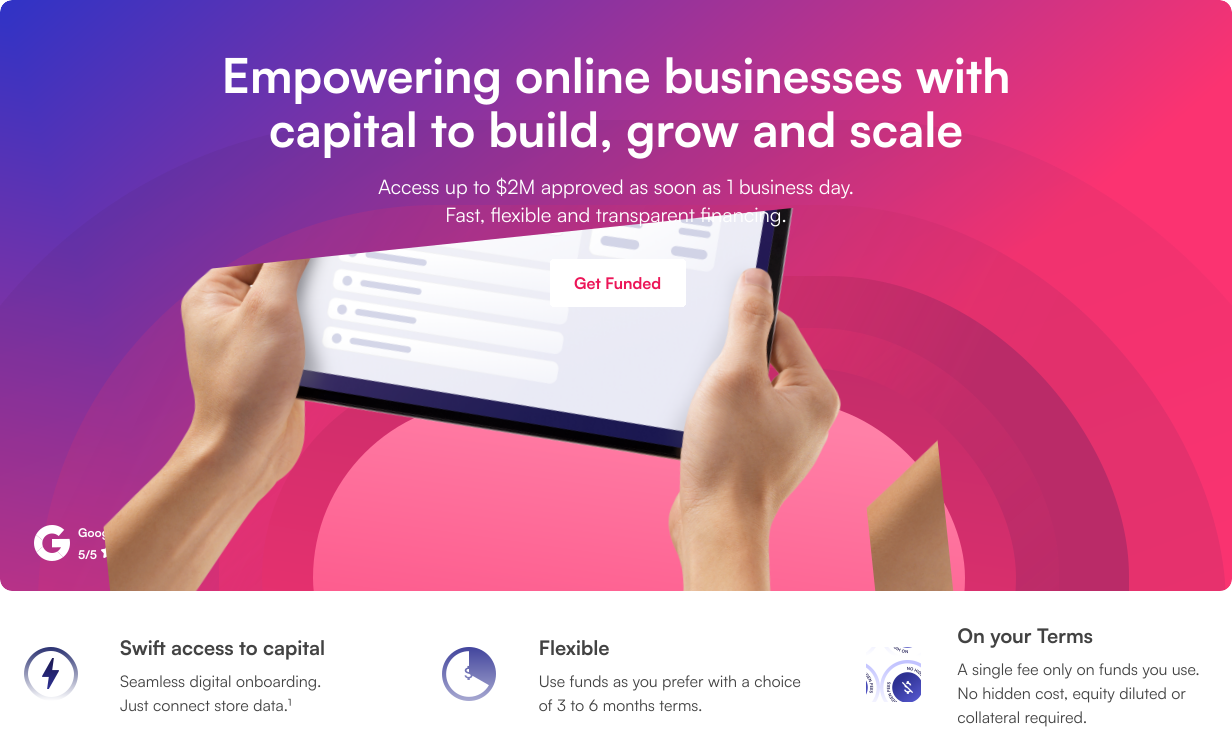
An approved Amazon lending partner in 16 markets that provides short to medium-term, multi-purpose revolving line of credit for inventory, growth, and working capital.  Get Funded!
CrediLinq offers funding to established multi-market sellers in the United States, United Kingdom, and Singapore on platforms like Amazon, Shopify, eBay, TikTok Shop, Lazada, Shopee and more.
Sellers can access up to USD 2 million in funding with approvals as fast as 1 business day, and disbursements made within 1 to 3 business days.
You can draw funds as needed within their approved limit and repay through bi-weekly installments, with no penalties for early repayment.
Funding is structured with typical drawdowns ranging from USD 50,000 up to USD 2 million with repayment periods spanning 3 to 6 months.
Customized solutions are available upon request. Loan tenors can extend up to 12 months on a case-by-case basis.
Pricing is charged as a flat monthly service fee starting at 1.5% and is applied only to the amount you draw.
At the low end, this equates to a simple fixed APR of approximately 18%, with no compounding, revenue sharing, or equity involvement.
CrediLinq’s eligibility requirements
Eligibility is limited to registered businesses with:
- Approximately 12 months of operating history
- Up to USD 1 million or more in combined annual revenue
Pros
- Simple monthly pricing produces a fixed, knowable APR upfront, making cost modeling straightforward
- Revolving credit allows partial draws and early repayment without any penalties
- Multi-purpose capital for inventory replenishment, marketing spend, new launches, and multi-channel growth
Cons
- Made for growth stage sellers given the high eligibility criteria
- A registered business entity is required, so individuals or sole proprietors are not eligible
Best for
High-revenue, multi-market sellers who want predictable repayments and flexible access to capital.
Onramp funds
 Onramp’s funding for eCommerce brands (Source: Onramp)
Onramp Funds provides revenue-based working capital exclusively to eCommerce merchants operating in the United States.
Funding is provided as a lump-sum advance, with offer sizes scaling up to USD 2 million based on platform data and sales history. Decisions are often made within 24hours.
Sellers repay the advance plus a fixed flat fee, typically ranging from 2% to 8%. For Amazon sellers specifically, pricing is typically lower.
Fees for Amazon range from 0.5% to 4% of sales and an estimated APR between 11.9% and 19.9%, based on a typical 90-day repayment window.
Onramp’s eligibility requirements
Eligibility is limited to:
- Registered U.S.-based businesses operating as an LLC, S-Corp, or C-Corp with a valid EIN and business bank account
- Generating at least USD 3,000 in monthly revenue to be considered
Pros
- Variable remittances automatically flex with sales volume, reducing payment pressure during slow periods
- Fast approvals and lump-sum advances suit short-term inventory or marketing needs
- No fixed repayment schedule under the variable model simplifies cash flow during volatility
Cons
- Daily or weekly revenue skims can quietly constrain reinvestment when sales are strong
- Effective fees can be high depending on the repayment timeline
Best for
Sellers who want repayments to flex with sales volume or prefer short-term advances.
|
Suggested read: Onramp Fund Review: Interest Rates and Alternatives for 2026 |
ClearCo
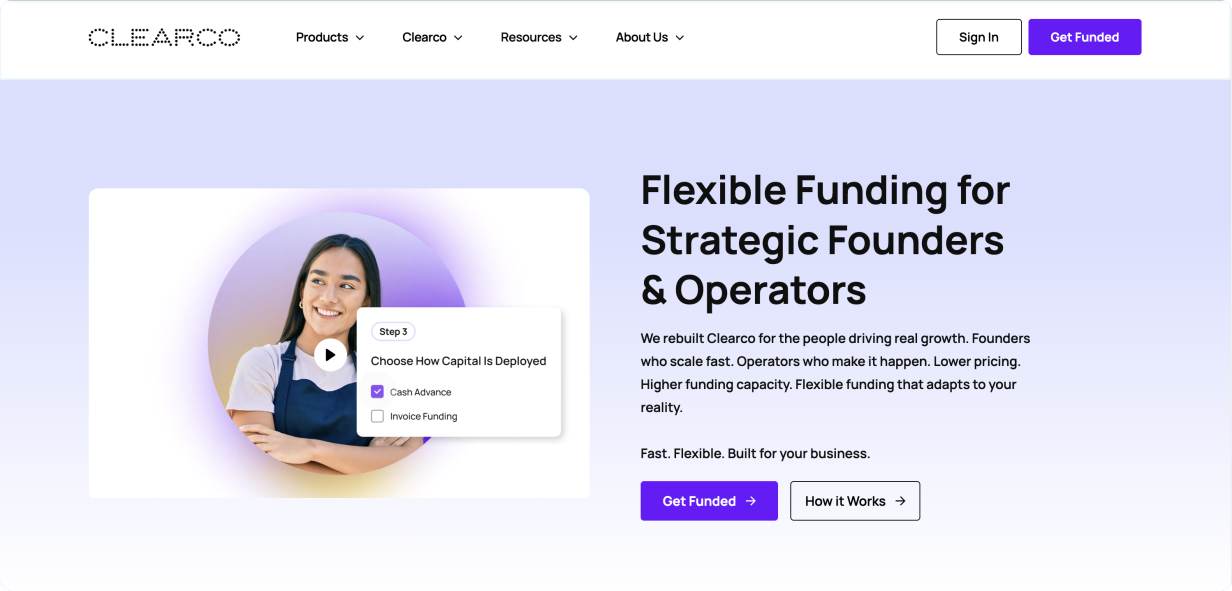
ClearCo funding for business owners (Source: ClearCo)
ClearCo provides capital advances to eCommerce businesses, including Amazon sellers, through flexible funding options such as invoice and receipt funding to cover operating expenses.
Funding is available to businesses operating in the United States, Canada, the United Kingdom, Ireland, the Netherlands, Australia, and Germany.
Approved brands may access funding capacity of up to USD 4 million, subject to review.
Applications are typically evaluated within 1 to 2 business days, and approved funds are usually delivered within 3 business days.
Repayments follow weekly or scheduled pay-as-you-go structures, with fixed-fee repayment plans commonly extending over 4 to 6 months.
Costs vary based on revenue profile and repayment structure. Fees typically fall within a range of approximately 3.63% to 12.5% of the amount advanced, depending on the length and type of funding plan selected.
|
Note: The implied simple fixed APR for ClearCo spans a wide band depending on both fee level, repayment duration and type of funding. Using this formula:
|
ClearCo’s eligibility requirements
Clearco supports incorporated businesses with:
- At least 12 months of revenue history and monthly revenue above USD 100,000
- Registered entity status, such as an LLC or corporation, with access to a United States bank account.
Pros
- High funding capacity supports larger inventory and marketing cycles
- Vendor payment and reimbursement options simplify operational cash flow
- Predictable weekly payments and no collateral or personal guarantees
Cons
- Eligibility excludes earlier-stage or lower-volume sellers
- Weekly repayments tied to revenue can still tighten cash flow during slower months
Best for
Brands that want fast capital plus vendor payments.
Comparison: 8fig vs Onramp vs ClearCo
 *Customized solutions are available upon request. Loan tenors can extend up to 12 months on a case-by-case basis.
eCommerce Financing APR: How to Calculate the True Cost of Capital (8Fig vs CrediLinq)
Assume a high-revenue seller generating USD 1.5 million in annual revenue wants to finance USD 500,000 to support inventory and growth.
What happens if the seller partners with 8figWith 8fig, the seller would have to structure financing around a forward operating plan and pay a flat, upfront cost tied to the amount included in that plan.
The total flat cost to the seller based on the plan would be:
To compare this consistently, let’s annualize the flat cost using the same approach:
Annualized view of the same USD 500,000 plan: If the plan runs for 6 months:
If the plan runs for 3 months:
|
While this total dollar cost is known at the start, the simple fixed APR cannot be determined upfront because it depends on how long the plan actually runs.
The same flat fee produces very different annualized outcomes depending on whether the plan executes over 3 months, 6 months, or longer.
Since the plan duration and timing of remittances can change through change requests or operational shifts, the effective APR is only observable after the plan completes.
What happens when a seller partners with CrediLinqIf partnered with CrediLinq, the seller draws capital from a revolving line of credit and pays a flat monthly service fee of 1.5% with a 3-6 month term.
This translates to a simple fixed APR of 18% if the capital is outstanding for a full year. How?
Given:
The total flat cost over the tenor the seller chooses would be:
Converting the flat cost to simple fixed APR:
Using the formula below, the simple fixed APR is 18% regardless of whether the tenor is 3 months or 6 months.
So, assuming the seller draws USD 500,000 for a 3-month tenor at 1.5% monthly service fee, their simple fixed cost would be:
|
This is different from 8fig’s flat-fee model, where shorter tenors materially increase the annualized rate. With a monthly pricing model like CrediLinq’s, the annualized rate stays stable.
Why Credilinq May Be a Better Alternative for Established e-Commerce Sellers
CrediLinq is built for how modern eCommerce actually operates, with multiple sales channels and uneven demand cycles. Its structure supports capital needs that do not cleanly fit within fixed loan schedules or daily revenue deductions.
It offers a single revolving line of credit with predictable costs and no deductions from daily revenue. Operationally, this structure is better adapted to real-world workflows.
Sellers can use the same credit line to fund staggered purchase orders, manage rolling inventory replenishment, and support marketing spend across channels.
Sellers pay only for what they draw, can repay early to reduce cost, and are not exposed to annualized rate spikes when funding cycles compress.
It also offers support for cross-border operations, with multi-currency funding and coverage across the United States, the United Kingdom, and Singapore.
Choose: 8fig or CrediLinq
From a financing clarity standpoint, the key advantage is cost certainty.
CrediLinq shows both the total dollar cost and the simple fixed APR up front. This is because pricing is tied to a transparent monthly service fee rather than to plan duration or execution accuracy. Financing models structured like this aligns with how high-revenue eCommerce brand owners operate at scale—prioritizing predictability.
Both 8fig and CrediLinq can work well, but they serve different kinds of disciplines.
This distinction becomes most relevant once a business crosses roughly USD 1 million in annual GMV.
At this point, capital decisions are less about access more on risk management, predictability, and operating leverage.
For 7-figure eCommerce sellers having a capital structure that holds up when forecasts miss and conditions change is non-negotiable.
8fig is most useful when a seller operates with a tightly modeled supply chain and high confidence in forward forecasts. When inventory timing, demand, and cash inflows are predictable, a plan-based structure can feel efficient and even cost-effective.
In those conditions, tying capital to a defined operating plan introduces structure and forces intentional deployment of funds.
CrediLinq, by contrast, is better aligned with how high-revenue eCommerce businesses actually behave once they reach scale.
At scale, volatility is structural—ad performance shifts, logistics slip, platforms change rules, and capital needs rarely follow a single clean timeline.
In that environment, pricing that depends on plan duration and execution accuracy can quietly become expensive, even when the headline cost looks reasonable.
For high-revenue sellers, the economic risk is not paying too much in absolute dollars but mispricing uncertainty.
CrediLinq’s model removes that variable by tying cost to time outstanding, showing a simple fixed APR up front, and letting operators adapt in real time without re-negotiating the economics.
If your business is strongest at adapting under pressure, CrediLinq offers a safer, more predictable option.
Get funded today with CrediLinq and discover a smarter way to scale your business to greater heights.
Final Takeaways
|