



Amazon Global Selling: How to Expand Your eCommerce Business Across Borders

Overview
- Selling cross-border means facing issues with logistics, foreign exchange, duties and compliance laws, but the upside is global visibility and sales diversity.
- Amazon Global Selling lets you expand into multiple regions with one system of listings, logistics, and payments.
- Success depends on smart pricing, local compliance, and ready access to cash for freight, duties, and restocks.
- Flexible financing from partners like CrediLinq helps you scale confidently without pausing growth for cash flow delay
Why this matters to you
- You are seeing rising international demand for your products but can not keep up because payouts, freight, and duties trap your cash.
- You have tried listing abroad but ran into painful delays with currency fees, tax confusion, or stockouts that broke momentum.
- You know your brand can sell globally, but every expansion step feels difficult and that is why you are here.
Buyers will buy; they want to, and are willing to go as far as shopping across borders. The problem, however, for sellers, is that every international transaction forces three major frictions to collide:
- Delivery
- Currency
- Duty
Each one pulls on working capital in different ways. That is why many growing sellers turn to flexible credit platforms like CrediLinq’s to keep cash flow up.
Delivery and Returns for Amazon Sellers
About 55% of global shoppers purchase from retailers in other countries, and four in five social media shoppers do so monthly, yet they hesitate without clear returns and transparent transit times.
Why?
Well, the DHL’s 2025 Delivery and Returns Trends showed “simple, free returns” ranks among the top measures to reassure overseas shoppers. About 53% of them said it would improve their shopping experience and may nudge them to go on with the purchase.
Currency and Foreign Exchange Fees
Per currency, you see that on Amazon, the money flow itself takes a cut. The Amazon Currency Converter for Sellers applies volume-tiered fees that often sit around 1% and can reach 2% for some payout currencies. This could quietly hurt your margins at higher export scales.
Tax and Duties
Meanwhile, on the tax side, low-value reliefs are disappearing. The United States ended the long-standing de minimis duty exemption for parcels under USD 800 on August 29, 2025, pushing even small orders into full customs clearance.
The de minimis rule previously allowed low-value shipments to enter the country duty-free and with minimal paperwork, helping cross-border sellers move small parcels faster and cheaper.
Although the government has allowed a six-month adjustment period till February 2026 before fully applying this change globally, the effect will likely slow postal services and increase landed costs for every order.
In Europe, imports up to EUR 150 are subject to import value-added tax via the Import One Stop Shop, and marketplaces face broader liability, which changes how you register and pay tax from day one.
Notwithstanding these friction points, Amazon’s exporter programs continue with strong momentum. In fact, the United States leads global cross-border e-commerce exports, with more than USD 605 billion in merchandise exports in 2024.
But global growth is not won on listings alone. It also demands seamless cross-border inventory and financial management, so:
- You need to know when to expand and scale product lines internationally.
- You need to know how to price for tax-inclusive parity, and where to position inventory for the fastest, lowest-cost delivery to new regions.
- You need to be able to better synchronize restocks, payouts, and supplier payments across multiple currencies and jurisdictions without breaking cash flow.
- You need reliable funding support that keeps pace with your expansion curve as access to flexible credit can mean the difference between capturing a new market window and watching it close while capital sits tied up in transit or duty clearance.
Platforms like CrediLinq come handy for Amazon Global sellers by helping with mobile capital so you have the confidence to expand and scale without losing control of your operations or margins.
What is Amazon Global Selling?
Amazon Global Selling is Amazon’s cross-border program that lets you list and sell in Amazon stores outside your home country.
You can sell from the United States into other regions or sell from another country into the United States, using regional seller accounts, localized listings, and Amazon fulfillment and export options.
Amazon Global Selling spans the Americas, Europe, the Middle East and Africa, and Asia-Pacific (APAC).
|
Check here to see if your country is eligible in any of the aforementioned regions. |
|
What you should know about Amazon Global selling:
|
Steps to Start Selling Globally
Step 1: Create a Global Selling account
Select the country where you want to sell.
Amazon structures selling accounts as: a North America and Brazil unified account, a Europe regional account, plus country-specific accounts for Asia-Pacific and Middle East and North Africa.
If you link global accounts, Amazon charges either one global monthly fee of USD 39.99 or the sum of regional fees, whichever is lower.
Start from the Global Selling hub, then link in the Sell Globally dashboard.
Complete identity and business verification (ID, legal entity details, valid payment method, bank account etc). The tax interview in Seller Central will determine whether you submit Form W-9 or Form W-8.
|
Tip: Use a dedicated, globally usable payout method from day one. If you rely on local bank accounts per region, confirm how Amazon Currency Converter for Sellers will convert and what volume-based foreign exchange fees apply before you scale. |
Step 2: List your products for international markets
You would have to follow the marketplace-specific listing rules and product detail page standards for each target store.
The requirements can differ by language, attributes, and compliance laws.
For example, in Germany (Amazon.de), there are mandatory compliance attributes for product labelling
- Under EU Regulation (2017/1369), all electronic products such as refrigerators, lamps, and washing machines must display an approved EU energy label image and class (A to G) in the product detail page. Omission can trigger listing suppression.
- Any electronic or battery-powered item must include a valid WEEE I(Waste Electronic and Electronic Equipment) registration number in Seller Central before listing. Amazon automatically blocks listings that lack it.
In the United States, certain product categories such as Children’s Products require proof of compliance before listing. If you are listing a baby crib or stroller, you must upload a valid Children’s Product Certificate (CPC) and test report.
Use the Build International Listings tool to copy offers from a source store to target stores, maintain price rules, and keep offers synchronized.
Where needed, create or translate your product’s Amazon Standard Identification Number (ASINs) in the target marketplace language.
|
Tip: Pre-check restricted terms and category approvals per marketplace to avoid listing suppression after launch; the “create in target marketplace language” note on Build International Listings is your early warning that a fresh ASIN is required. |
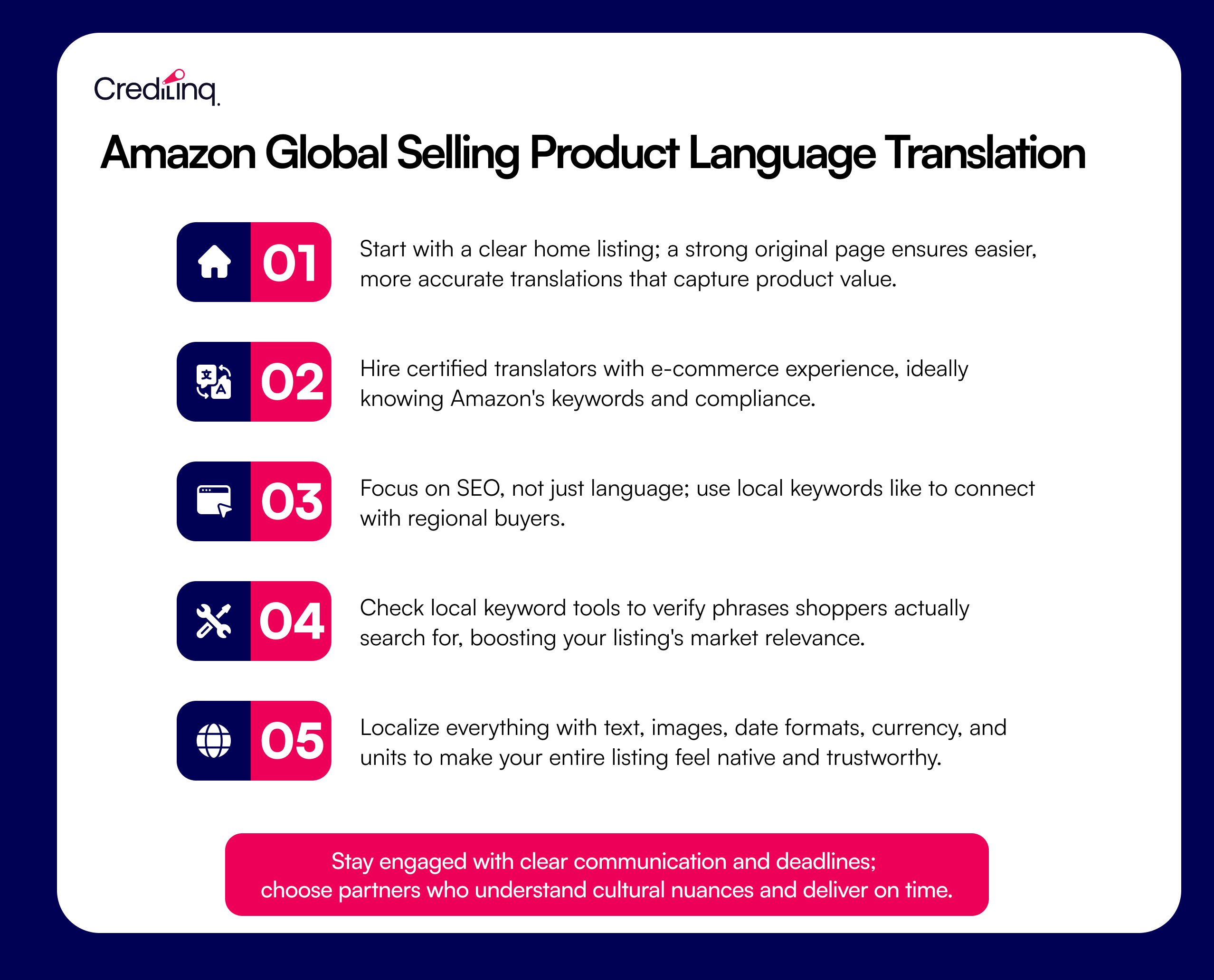
Note: A common problem with language translation is that if your listing sounds awkward or uses the wrong words, shoppers may scroll past.
AI translations work but often miss local keywords, slang, or tone, so your listing might not rank well or connect emotionally with buyers.
Here is how to get it right:
Step 3: Set up fulfillment options (FBA vs FBM)
Enable FBA Export so eligible United States inventory can be purchased by international customers shopping on Amazon.com, with Amazon showing landed costs at checkout.
You can also use Remote Fulfillment with FBA, which lets you sell in Canada and Mexico using inventory stored in the United States.
If you choose Fulfilled by Merchant (FBM), you handle storage and shipping yourself. You must clearly state delivery times, duties, and return rules on your listings.
|
Tip:
|
Step 4: Understand tax requirements
For the United States, you will need to complete your tax interview (W-9 or W-8). You would need to re-run the interview whenever entity details change.
For example, if you move your company’s residency from Australia to the United Kingdom and wish to claim UK treaty benefits on United States-source service fees. You must recertify using a new W-8 form reflecting your UK residency.
In the United Kingdom, you need to plan for value-added tax.
Amazon provides region guides and a VAT Calculation Service that can issue compliant invoices in supported stores (the United Kingdom, Germany, France, Italy, Spain, the Netherlands, Sweden, Poland, Belgium, and Ireland).
|
Tip: Price products with tax included to avoid confusion and improve Buy Box stability. |
Step 5: Launch and promote your products
You can use Amazon’s dedicated ad channel, Sponsored Products, to accumulate traffic in a new marketplace.
You can also enroll in Brand Registry to unlock A+ Content, brand protection tools, and additional advertising and creative formats.
|
Tip: Run Sponsored Product ads first on items you can ship fast, where you already have either local FBA or proven Remote Fulfillment performance. Once you see good delivery times and positive reviews, increase your ad bids and promote more products. |
Best Practices for Amazon Global Selling
Here are nine practices that keep global growth steady and sustainable:
1. Anchor each region with a single source of truth
Keep one master listing and pricing sheet for all regions. This makes it easier to sync content and pricing rules through Build International Listings, so you do not end up with mismatched titles or outdated details across stores.
2. Use Remote Fulfillment as a launch pad
Before sending inventory abroad, test demand using Remote Fulfillment with FBA. It gives you a real view of buyer interest, shipping costs, and review patterns without heavy upfront commitments.
4. Price with currency buffers built in
Add a 1-2% cushion for FX movement to protect thin margins. Exchange rates can change fast, so it is a welcome practice to set a floor for pricing adjustments and review it monthly.
5. Keep documentation ready and digital
Store all trade paperwork (commercial invoices, certificates, VAT registrations, and HS codes) in a single shared folder. Customs holds can sometimes come down to a missing file.
6. Reinvest early profits into compliance and content
First-wave profits should go into VAT setup, localization, and packaging updates. These steps unlock faster customs clearance and better conversion in the long run.
7. Treat returns as a marketing tool
DHL’s 2025 report found that 53%of global shoppers would buy from sellers if returns were free. Make the return rules clear and to the point, even if it is not free, try to make cross-border buyers feel safer and reduce claim rates.
8. Track delivery performance like ad performance
Monitor “delivered on time,” refund rate, and feedback alongside your ad dashboards. High ad spend does not help if logistics drag your seller metrics down.
9. Use flexible financing to smooth cycles
Cross-border cash flow is uneven because supplier deposits usually go out weeks before sales come in. Use financing tools like CrediLinq’s credit line to stage inventory payments, cover duties, or fund last-minute freight without stalling operations.
CrediLinq – Funding Solutions for Global Sellers
Amazon Global Selling opens new markets, but it also multiplies cash needs. CrediLinq was built to make that expansion smoother.
As an approved Amazon lending partner in 16 markets, CrediLinq provides flexible credit lines tailored for e-commerce businesses selling across marketplaces such as Amazon, Shopify, TikTok Shop, eBay, Lazada, Shopee, and more.
Why choose CrediLinq – tailored financing option for international operations
Cross-border selling ties up cash in production, freight, duties, and delayed payouts. CrediLinq solves this by offering a revolving line of credit of up to USD 2 million that sellers can draw from at any time and repay in 3-6 months with no early repayment fees.
Customized solutions are also available upon request. Loan tenors can extend up to 12 months on a case-by-case basis.
You pay only for what you use, with a flat monthly service fee starting as low as 1.5% or a simple fixed annual percentage rate (APR) of 18%.
This flexibility allows you to stage supplier payments or manage last-minute freight without straining your cash flow.
Seamless integration with Amazon operations
CrediLinq connects directly to your Amazon Seller Central account and analyzes your sales data to size credit limits based on performance and does not involve lengthy paperwork.
Funds can be used for:
- Inventory restocks during seasonal peaks
- Freight and customs payments when expanding into new Amazon regions
- Marketing campaigns to accelerate visibility for new ASINs
- Growth expansion across markets, marketplaces and product lines
Because CrediLinq is an Amazon-approved partner, the integration is secure and seller data stays synchronized, so approvals can happen in as fast as one business day.
Supporting sellers across continents
Global sellers rarely stay confined to one region, and neither does CrediLinq.
The platform currently supports funding businesses in the United States, the United Kingdom, and Singapore.
It also offers a credit line using your preferred currency in USD, GBP, and SGD.
Whether you are a United States-based brand entering Singapore or a Southeast Asian merchant scaling into the United Kingdom or the United States, you can receive capital in your operating currency and settle repayments in a predictable way.
Conclusion
Amazon Global Selling gives you an edge with:
- Global visibility, as your products can be discovered in new markets overnight.
- Operational leverage, as Amazon’s fulfillment network handles the distance, so you can focus on demand.
- Market diversification, as one region’s quiet season can be another’s sales peak.
- Data advantage, as every new region adds insight into pricing, preferences, and buyer behavior, you can use everywhere else.
For sellers who master these levers, Amazon Global Selling can become a consistent channel for revenue and business expansion.
Whether you are scaling into new Amazon regions or preparing for the next peak season, access to timely capital is what keeps that engine running.
If you have at least 12 months of sales history on any supported marketplace and $1M or more in combined annual revenue, you are already qualified to take the next step.
Partner with CrediLinq today and get the capital you need to expand your reach, restock with confidence, and make the most of it!
Final Takeaways
- Cross-border selling opens up powerful new revenue streams, but success depends on managing delivery, currency, and duty seamlessly.
- When selling internationally exchange rates, duties, and VAT all shape your true landed price. Add small foreign exchange cushions and use Amazon’s VAT Calculation Service to keep margins predictable and compliant.
- Smooth customs clearance depends on complete, organized paperwork, commercial invoices, VAT certificates, and product compliance documents should always be on hand.
- Global growth ties up cash in freight, duties, and longer payout cycles. Use a credit line that can be drawn at any time so you can restock, pay suppliers, and manage multi-currency operations without delay.
Frequently Asked Questions (FAQs)
What are the risks of Amazon Global Selling?
Expanding internationally brings growth and complexity.
Sellers must navigate shifting regulations, currency swings, infrastructure gaps, and local competition, while adapting to cultural nuances that can influence buyer trust and long-term market success.
How can I manage cash flow when selling globally?
Use staged supplier payments and flexible credit lines to stay liquid, fund restocks early, and keep momentum as sales expand internationally.
When is the right time to expand into new Amazon markets?
Expand once you have steady sales, reliable fulfillment, and repeat customers in your home market. Use data to identify demand abroad, then secure funding to cover inventory, duties, marketing and localization cost.