



Shopify Capital: How it Works, Review, and Best Alternatives (2026)

Overview
Why this matters to you
|
We have seen Shopify grow over the years. Merchants on the platform are now scaling faster and running much bigger campaigns.
Shopify’s gross merchandise volume hit a record USD 292.27 billion in 2024, up from approximately USD 235.19 billion in 2023.
In fact, Shopify’s 2024 Q4 report said the company had recorded seven consecutive quarters of 25%+ revenue growth. With the high demand on the platform, it is important to stay cash-full at all times if you are going to meet up.
Shopify knows this and provides embedded funding for sellers to have access to capital in order to scale their stores or have liquidity before sales revenue is generated.
But the platform’s capital funding has trade-offs:
- It can only be used on your Shopify store.
- Availability to sellers is invite-only and depends on internal eligibility signals.
- Repayment is also linked to your daily sales, which helps when revenue is smooth, but can strain cash during seasonal dips.
These reasons make sellers wary of the idea of securing funding with Shopify Capital.
This guide explains how Shopify Capital works, where it fits, where it does not, and which alternatives give you more flexibility if you sell across regions or multiple channels.
What is Shopify Capital?
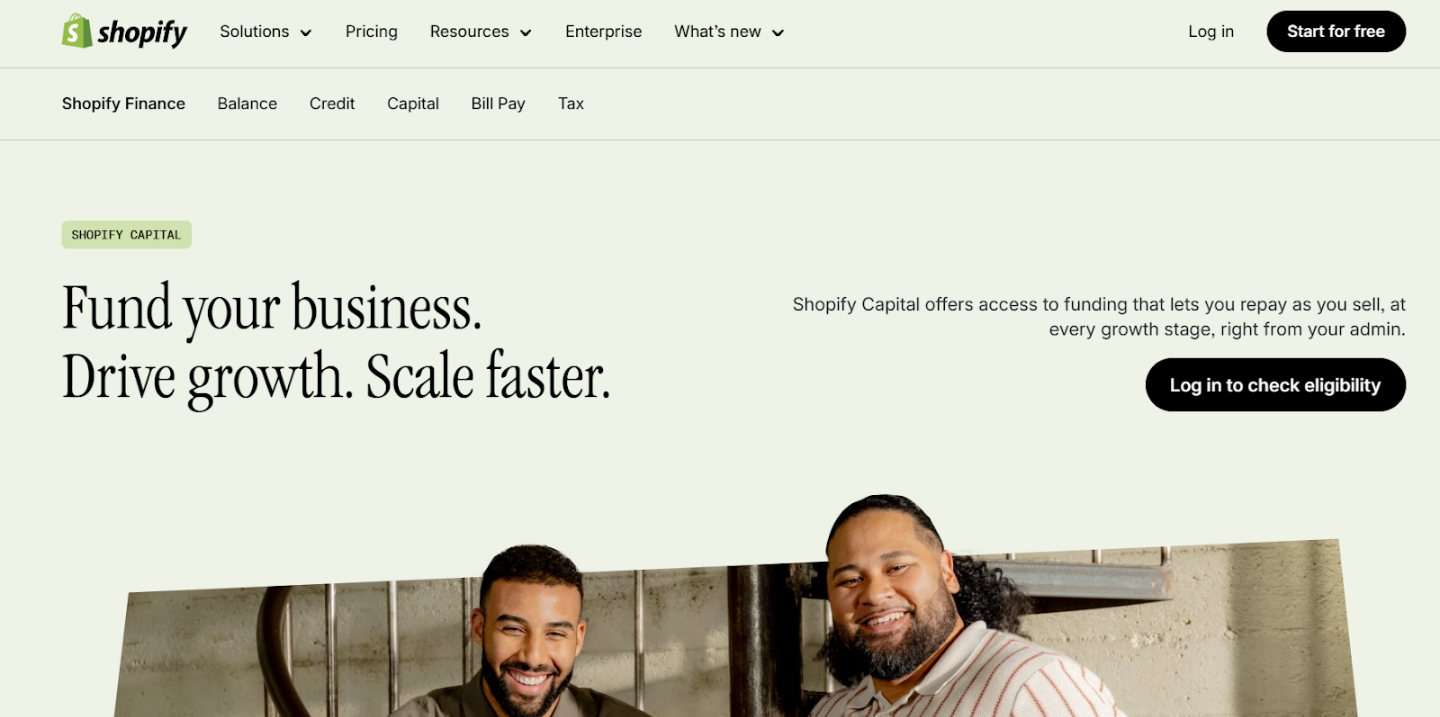
Shopify Capital Funding for Sellers (Source: Shopify)
Shopify provides two distinct forms of funding depending on where your business is registered and which Shopify market you operate in:
- Fixed-term Loans (currently on pause)
- Shopify Capital
– Capital Flex
– Merchant Cash Advance
While Shopify’s term loans have been temporarily suspended as at the time of writing we will be covering details on Shopify Capital offerings alone.
Shopify Capital is an embedded financing program that offers funding to eligible Shopify stores within specific countries.
Capital flex (currently on early access)
Shopify’s Capital Flex is a revolving credit-line funding product that offers continuous access to working capital. Capital Flex is available exclusively to select Shopify merchants based in the United States.
To qualify, your principal place of business and bank account must both be located within the United States and your business entity must meet Shopify Capital’s verification and compliance standards.
The program does not support trusts or informal partnerships. Eligible business types include:
- Sole proprietorships
- Corporations (C-Corp or S-Corp)
- Limited liability companies (LLCs)
- Limited partnerships that are properly structured and verified
How Shopify’s Capital Flex works
- When you apply for Capital Flex, the amount you choose represents what you want to withdraw and not your full borrowing limit.
- You can withdraw funds at any time as repayments immediately replenish available capacity with no renewal thresholds.
- Standard reviews take 1–3 business days, while enhanced reviews may require an additional 2–5 days. Once approved, funds are available for withdrawal within 1–3 business days.
- Fees are charged monthly on the outstanding balance only; when the balance is zero, fees stop.
- You can choose an adjustable repayment rate aligned to your sales pacing, and reduce fees immediately with manual pay-downs.
- You get flexibility and control from your Shopify admin panel.
Key takeaways for Shopify’s Capital Flex
- To qualify, Shopify assesses consistent sales, low dispute rates, account health, and at least USD 50,000 in gross merchandise value (GMV) over the trailing twelve months.
- Best for ongoing and seasonal initiatives where flexible, repeat draws are more efficient than a one-time loan or a fixed-fee advance.
- Cost is usage-based and timing-based. You pay fees only while a balance is outstanding, and there is no penalty for paying down early.
- Your borrowing capacity can increase or decrease with weekly reviews, sales patterns, historical performance, and usage and engagement with shopify services. Maintaining steady sales and low risk may help preserve or grow the limit.
Merchant Cash Advances
Available in the United States, Canada, the United Kingdom, the Netherlands, Ireland, and Spain and sometimes other regions where lending licenses require a non-loan structure.
How Shopify’s MCA works:
- After sending in your application for Shopify’s Merchant Cash Advance, your request is reviewed within 1-3 business days.
- Shopify “purchases” a portion of your future sales revenue in exchange for an upfront lump-sum payment.
- You agree to remit a fixed percentage of daily sales until a total remittance amount (the advance plus a flat fee) is repaid.
The fee is known upfront (no interest or compounding). Repayment duration also varies and depends on your sales velocity.
Key takeaway for Shopify’s MCA
- Repayment speed depends on your sales. Higher revenue clears the balance faster, and slower sales extend the term.
- There is no penalty for “early” repayment since the total owed is fixed.
- Because it is technically a receivables purchase, not a loan, it may not affect your credit score.
- You cannot choose your repayment percentage as it is set when the offer is issued.
Pros and cons of Shopify Capital
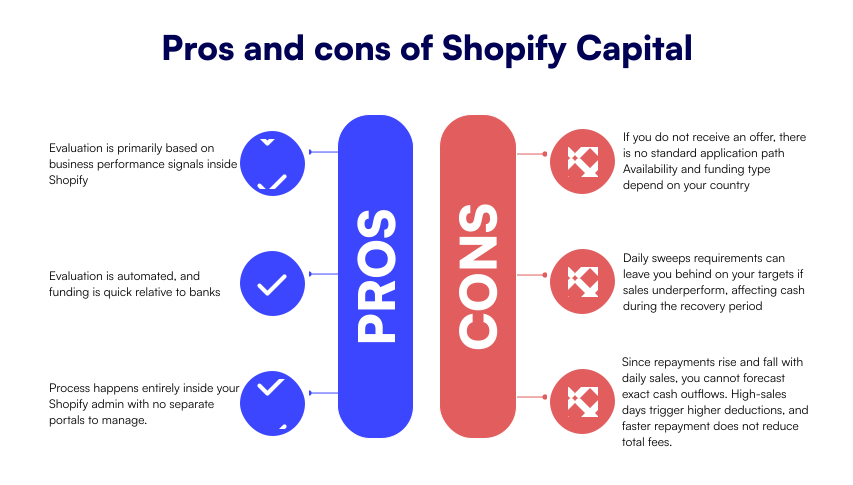
Why Merchants Seek Shopify Capital Alternatives
- Multi-marketplace growth: If you sell across multiple storefronts, geographies, or marketplaces, single-platform financing leaves gaps when cash must move outside the Shopify stack.
- Predictability and control: Some sellers often prefer installment-style schedules or the ability to split draws by deposit, balance, and freight, instead of constant percentage sweeps.
- Pricing transparency: Fixed fees on the total advance versus flat service fees on the drawn portion can generate very different economics when you sell through quickly.
- Currency and payouts: Cross-border operations need multi-currency disbursements for paying suppliers in their local currency, but Shopify’s funding products are limited to specific regions.
Best Shopify Capital Alternatives for 2026
1. CrediLinq
 CrediLinq – Financing for Shopify Sellers
CrediLinq offers a revolving, platform-agnostic line of credit designed specifically for eCommerce sellers.
All you have to do is upload your Shopify store data and get a credit limit sized directly from your verified sales data.
You can use one credit line to fund other marketplaces, including Amazon, eBay, TikTok Shop, Lazada, Shopify, Shopee, and more.
Repayment
Users can choose 3-6 month repayment tenors and pay back in equal biweekly installments with no early-repayment penalties.
Customized solutions are also available upon request. Loan tenors can extend up to 12 months on a case-by-case basis.
Capital range
CrediLinq provides room to scale with an available line of credit of up to USD 2 million.
Pricing and fees
Instead of charging interest or taking a percentage cut of your sales revenue, CrediLinq applies a flat service fee as low as 1.5% per month or a simple fixed annual percentage rate (APR) of 18% on only the amount you actually draw.
Because evaluation is backed by your marketplace performance, there is no need for tax returns or balance-sheet reviews. All you have to do is:
- Sign up with your email and phone number, then complete OTP verification.
- Provide basic company information such as your business name, registration number, and contact details.
- Upload your Shopify data so the platform can assess performance automatically. Bank statements may be requested.
Next, basic identity checks for the business and its principals are conducted, and you may be asked to provide a business license, tax number, ID for shareholders or directors, and addresses. Occasionally, additional documentation may be requested to finalize verification.
There are no restrictions on what funds can be used for. Sellers can choose to use funding to:
- Stock early for peak-season demand or Prime Day-style events.
- Scale new stock-keeping units that already show traction.
- Stage inventory across multiple warehouses or markets.
- Financing ad and creative pushes ahead of major campaigns.
- Negotiating better supplier minimum order quantities and deposit terms.
CrediLinq’s eligibility and coverage
You are eligible for CrediLinq’s line of credit if you:
- Have at least twelve months of selling history on any supported marketplace.
- Record USD 1 Million or more in combined annual sales across connected stores.
- Operate as a registered business entity (not an individual or sole proprietor).
Supported regions: United States, United Kingdom, and Singapore. Disbursements are also available in USD, GBP, and SGD.
Pros and Cons of CrediLinq

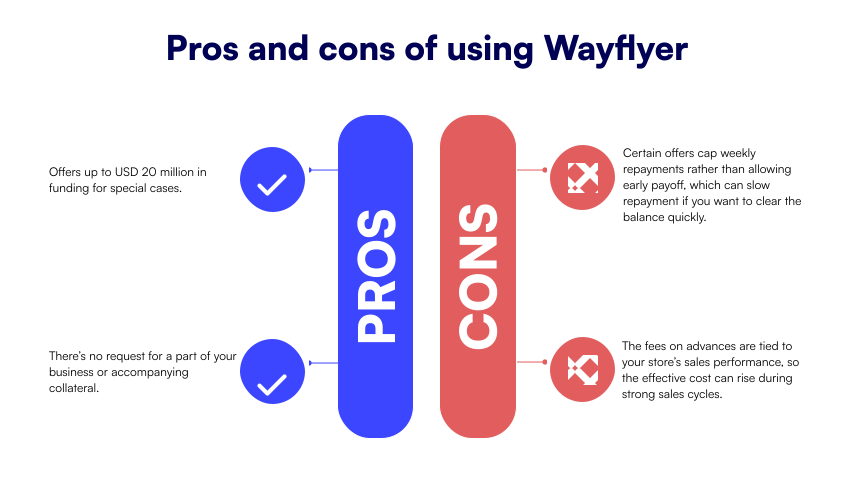
2. Wayflyer
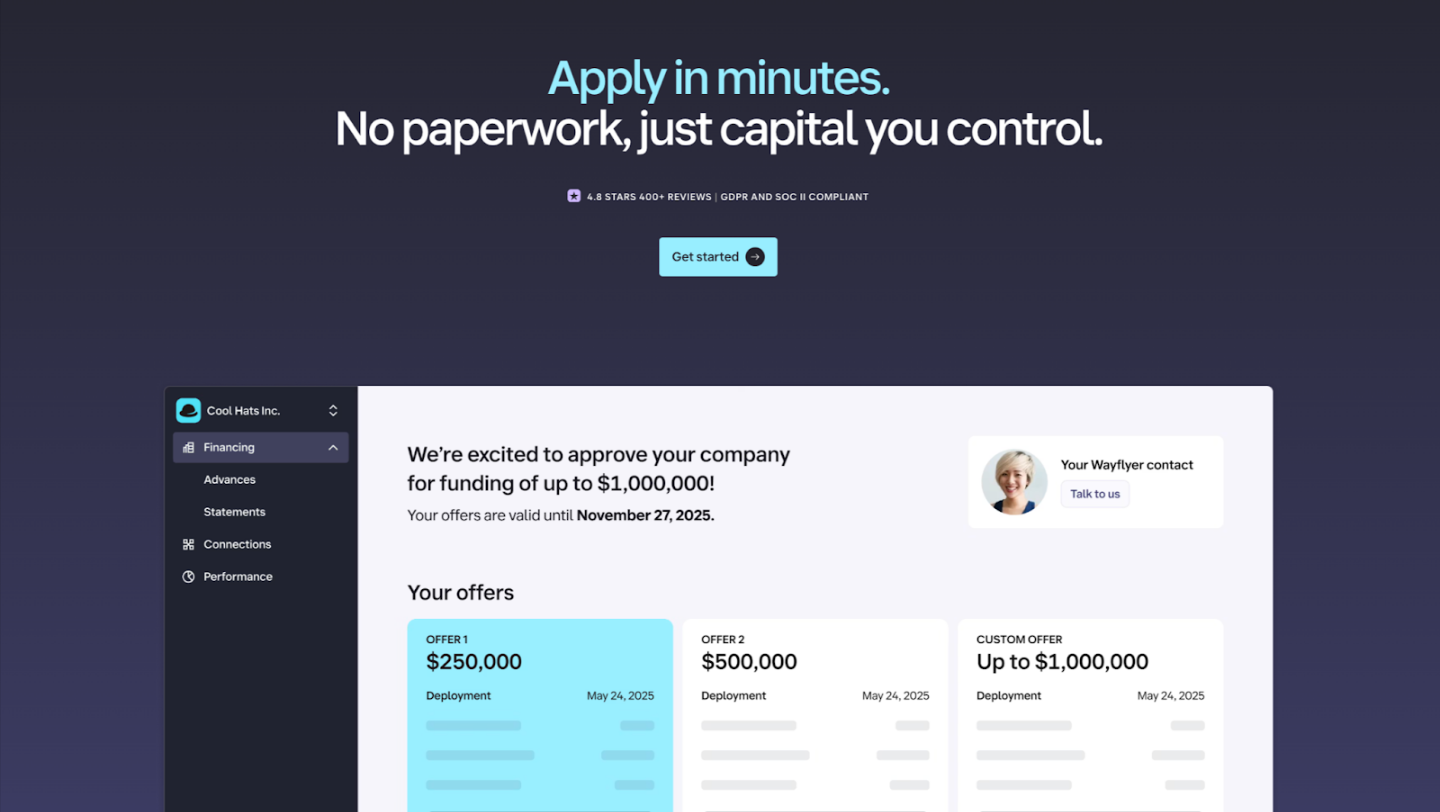 Wayflyer – Capital Funding for eCommerce Sellers (Source: Wayflyer)
Wayflyer specializes in revenue-based advances and short-term financing for eCommerce brands.
Sellers can access cash advances, term loans (3–9 month schedules), or a rolling 12-month facility that renews automatically without reapplying.
Repayment
Payments are deducted automatically, either as a fixed daily, weekly or bi-weekly installment payment for term loans or a percentage of sales revenue for cash advances until the total balance is fully repaid.
Capital range
Funding limits range from USD 5,000 to USD 20 million, typically sized at 1.5 to 3 times your average monthly revenue, subject to their evaluation. Once approved, funds can land in as little as one business day.
Pricing and fees
Wayflyer charges a fixed fee of 5–10 % on cash advances, depending on your store’s performance, marketing efficiency, and risk profile.
The fee is disclosed upfront and does not compound or fluctuate, but it applies to the entire funding amount and not just the portion you’ve used, unlike CrediLinq’s.
This means even if you repay the balance early, you still pay the full agreed fee.
Wayflyer’s eligibility and coverage
To qualify for Wayflyer financing, you must:
- Generate USD 10,000 or more in monthly sales revenue
- Have at least 6 months of operating history.
Supported regions: Wayflyer currently operates in the United States, Canada, the United Kingdom, Australia, Belgium, Denmark, the Netherlands, Germany, Ireland, Spain, and Sweden.
Pros and Cons of Wayflyer
3. ClearCo
 ClearCo Funding for Shopify Sellers
ClearCo offers revenue-based financing and invoice funding for eCommerce brands, including Shopify.
With ClearCo, you can choose between:
- Cash advances, which deposit funds directly into your account
- Invoice funding, where ClearCo pays vendors on your behalf or reimburses past business expenses under the “Receipt Funding” model
- Fixed funding, where you are offered a lump-sum advance
- Rolling financing, where you are offered a revolving line of credit
ClearCo connects to your Shopify, PayPal, or Stripe accounts to verify and evaluate your store’s performance data.
Repayment
- Cash advances: Capped weekly payments, with total term typically around 4 to 6 months.
- Invoice and Receipt funding: Fixed weekly payments over a pre-selected term (4 to 6 months typical), but payment amounts are capped at 30% of weekly revenue in slower periods.
- Fixed funding: No publicly disclosed information on fixed-term funding. To fully confirm repayment and fee terms for this, you may need to request a copy of the term sheet or offer disclosure from ClearCo directly.
- Rolling financing: Repayments are on a weekly schedule for 4, 5 or 6 months.
Capital range
For qualifying brands, total funding capacity can reach USD 4 million.
For invoice funding, applications are reviewed within 1–2 business days, and once approved, funds typically arrive in 0–3 business days.
The receipt funding allows up to USD 1 million within a 60-day window, capped at USD500,0000 per draw.
Pricing and fees
ClearCo offers a fixed fee between 3.63% and 12.5% depending on the extension plan you select.
ClearCo’s eligibility and coverage
You’re eligible for ClearCo funding if you:
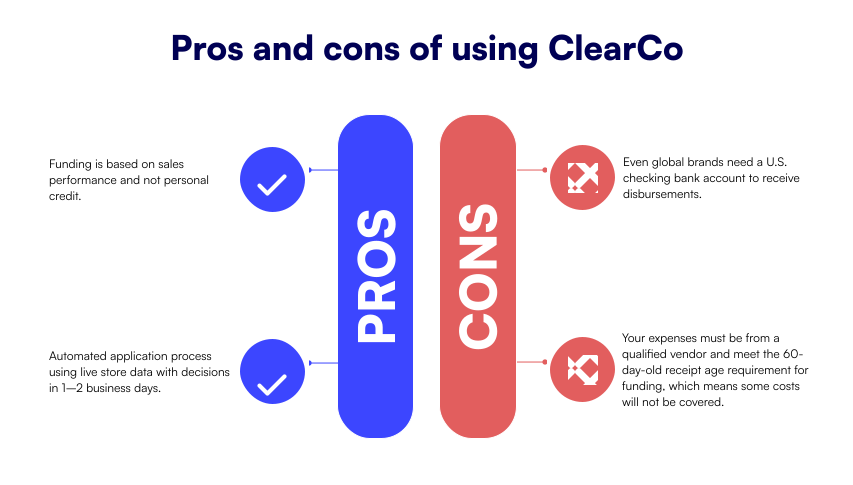
- Maintain access to a U.S. bank account.
- Have at least 12 months of business revenue history.
- Generate USD 10,000+ in monthly revenue.
- Have incorporated (LLC, LTD, or corporation) your store in the United States.
Supported regions: The United States, the United Kingdom, Canada, Ireland, the Netherlands, Germany, and Australia. However, a U.S. bank account is required for most disbursements.
Pros and Cons of ClearCo
Shopify Capital vs Alternatives
 *Customized solutions are available upon request with tenors up to 12 months on a case-by-case basis.
How Shopify’s Revenue-based Financing Model Compares to CrediLinq
Let us say you need USD 100,000 for a 90-day inventory cycle. We’ll peg your average daily sales during the cycle at USD 10,000 (peaks and valleys are possible).
Using this illustration, we’ll compare how Shopify Capital, which uses a revenue-based financing (RBF) remittance model, stacks up against CrediLinq, which provides a revolving credit line with fees tied only to what you draw.
*With Shopify Capital, exact offers may vary, so this is an illustrative apples-to-apples comparison.
Shopify Capital (sales-linked remittance)
Assumptions:
- Fixed borrowing cost (flat fee) = 8% of the advance
- Remittance = 12% of daily sales (auto-deducted)
- Total to repay = USD 100,000 + USD 8,000 = USD 108,000
- With USD 10,000/day sales, daily deduction = 12% × USD 10,000 = USD 1,200
Time to repay:
USD 108,000 ÷ USD 1,200 ≈ 90 days (3 months)
- Now, if you sell faster, you repay faster, but your total fee (USD 8,000) does not drop.
- To find the simple fixed APR cost:
|
Simple Fixed APR(%) = Flat fee (%) ÷ Tenor (months) × 12 |
If repayment is completed in 90 days (3 months) at 8% flat fee, the fixed APR is: (8 ÷ 3) × 12 = 32% APR.
Your fixed annualized cost rises when the term shortens. If you sell more slowly, daily sweeps still occur, and you may hit minimum milestones or maximum term and face potential cash-flow stress in slow weeks.
CrediLinq (revolving credit line)
With CrediLinq, sellers draw capital from a revolving line of credit and pay a flat monthly service fee only on the funds actually used.
Repayments occur through scheduled bi-weekly installments over a 3–6 month term, providing a predictable repayment rather than daily revenue sweeps.
This structure aligns closely with how inventory and supplier payments are made in practice, rather than forcing sellers to hold excess capital upfront.
CrediLinq’s smart tranche-based draw (how sellers actually use capital)
- USD 30,000 supplier deposit for 30 days
- USD 60,000 supplier final payment balance for 60 days
- USD 10,000 freight for 45 days
- Flat monthly service fee = as low as 1.5% per 30 days on drawn funds only
|
Your cost here would be:
Across the 90-day cycle you were never sitting on the full USD 100,000. On average you were using about USD 55,000 of working capital, and you paid USD 2,475 for that access.
That USD 55,000 comes from the weighted average of the total capital amounts you held over 90 days (30K for 30 days, 60K for 60 days, and 10K for 45 days).
To find the simple fixed APR cost, we can use the same approach:
Comparing this to Shopify Capital In the same 90-day cycle, the simple fixed cost with Shopify’s Capital would be 32% APR, assuming repayment completes in three months. In comparison, it would cost almost twice as much on working capital as CrediLinq.
Even if you held the full USD 100K the entire 90 days, your simple fixed APR cost would still be 18%.
But most sellers do not need the full USD 100K for all 90 days.
Tranching typically brings it down:
So the cost relative to purchasing capacity (not fixed APR) would be: (USD 2,475 ÷ USD 100,000) = 2.475% That is the 90-day cost on purchasing capacity, not a rate on capital outstanding.
Annualizing this capacity cost across roughly four inventory cycles per year:
The total cost annualizes closer to ~10% because you are not holding all the capital at once.
Instead of daily sweeps, you get predictable monthly installments repaid through scheduled bi-weekly installments over a 3–6 month tenor.
Early repayment reduces the service fee proportionally, and there are no early repayment penalties. |
Why CrediLinq over Shopify Capital?
Shopify Capital is a suitable option for sellers who prefer RBF models, but it’s worthy to note that the repayment term period can be extensive.
For high-GMV eCommerce businesses, the decision is rarely about whether RBF works at all, but if it holds up once scale and volatility become non-negotiable.
As a seller, you would want to repay early because once inventory sells through, every extra week of holding debt adds avoidable cost.
With revenue-based models like Shopify Capital, repayments are tied to your daily sales are often subject to minimums, caps, or pacing thresholds. While this can smooth cash flow, it also effectively limits how fast you can pay off the advance.
Even when demand spikes, repayment acceleration is not fully in the seller’s control, which can stretch cycles and delay reinvestment.
In contrast, CrediLinq lets sellers draw funds and repay early (e.g., in 3-6 months or sooner) with no additional fees for early repayment. There are no sales-linked caps that restrict how fast balances can be cleared.
In sales-linked RBF models such as Shopify’s, stronger-than-expected revenue accelerates remittances, often increasing the seller’s realized cost of capital.
CrediLinq’s fixed-installment structure avoids this dynamic entirely, so higher revenue improves liquidity without increasing repayment cost or compressing cash flow.
For high-GMV operators, all of these distinctions matter. At scale, growth does not follow a single clean curve. Advertising performance fluctuates, logistics timelines shift, and working capital needs change mid-cycle.
In that environment, models that tie cost or repayment speed to revenue performance can become inefficient.
CrediLinq’s structure preserves upside. Faster sell-through reduces total cost, capital can be reused without reapplying, and repayments remain predictable regardless of revenue volatility.
For sellers managing high-revenue eCommerce businesses, where capital decisions are about operating leverage and speed of reinvestment, CrediLinq offers a cleaner, more scalable financing discipline than revenue-based alternatives like Shopify Capital.
How to Choose the Right eCommerce Funding Partner
- Map your cash cycle: Add up deposit, production, freight, inbound, sell-through, and payout. The duration between all of this is your true term.
- Insist on pricing clarity: Prefer a single, published fee on drawn capital or a clear fixed-fee schedule; avoid layered platform, drawdown, or early-repayment penalties.
- Match repayment to reality: If your revenue is variable, sales-linked remittances can help, but you should verify if the lender requires a minimum payment even when your sales dip. If you need certainty, installments may be safer.
- Draw structure matters: When ordering inventory, you may decide to pay the supplier in stages; a small deposit first, the rest when the goods are ready, and then freight when shipping.
Fixed-fee advances offer funding upfront, and you end up paying fees on money you’re not using yet (you may want to avoid this). CrediLinq supports tranche draws, so you can draw at any time and only pay for what you used.
- Cross-platform and currency coverage: If you sell beyond Shopify, ensure your funding partner can fund all channels and afford you the opportunity to beat foreign exchange spread by giving you multiple currency options.
- Speed vs. governance: Getting funds quickly is good, but do not accept operational lock-ins that restrict payment providers or force specific settings during the term.
Stay fully funded to run your Shopify storefront.
Shopify Capital is a good embedded option when you are eligible, operating in a supported country, and comfortable with sales-linked sweeps and Shopify payment constraints during the term.
However, growth rarely stays inside one platform. When you need multi-store, multi-market flexibility, tranche-based draws, currency choice, and predictable installment schedules, a platform-agnostic credit line is usually the better operating model.
CrediLinq gives serious Shopify brands the flexibility with up to USD 2 million in funding with short repayment terms and a single fee that applies only when you draw cash.
Get started today with CrediLinq to finance your Shopify store.

Final Takeaways
|
Frequently Asked Questions
Is Shopify Capital available everywhere?
No, it is available to eligible stores in the United States, the United Kingdom, Australia, Canada, Germany, and the Netherlands, with product types varying by country.
Can you change payment providers while funded by Shopify Capital?
If you are using Shopify Payments, deactivation is restricted until the total owed is repaid. You need to plan for that operational constraint.
Is revenue-based advance funding better for your Shopify store?
Only when you want a simple fixed fee and can also tolerate sales-linked or fixed daily remittances for the full term, regardless of how fast you sell.