


TL;DR
- Sellers face cash gaps due to delayed payouts, upfront inventory costs, and constant ad spend—even when sales are strong.
- Traditional financing is slow, paperwork-heavy, and not designed for fast-moving e-commerce businesses.
- Merchant cash advance, line of credit, revenue-based financing, term loans, and invoice factoring offer flexible alternatives tailored to online sellers.
- Whether restocking for Prime Day or TikTok Deals For You Days, the right loan type depends on your business model and timing needs.
- With fast approvals, platform-based underwriting, flexible repayment, and cross-border currency support, CrediLinq helps sellers scale without stress.
For many e-commerce sellers, things look great on paper—sales are rolling in, orders are being fulfilled—but the actual money in their account tells a different story.
Suppliers need to be paid upfront, but their earnings do not reach them for weeks. Returns, exchanges, and payout delays from platforms all hold things up.
And while they are waiting, other costs continue to add up—ads, packaging, rent, and team salaries. They are selling consistently, yet somehow always playing catch-up.
In this blog post, we will break down why these cash gaps happen and how working capital loans help e-commerce businesses stay ahead.
The Real Reasons Behind Constant Cash Crunches in E-commerce
E-commerce businesses face a mismatch between when money goes out and when it comes in. This creates cash flow gaps even when sales are strong.
Here are some common reasons why this happens:
- Delayed payouts from platforms: Marketplaces typically release payments only after return windows close, which range from 7 to 14 days. Add to this the processing time, and the actual cash hits your account after 3-4 weeks. This means your money is locked for weeks after each sale.
- Rising platform costs: Shopee recently increased transaction fees from ~3–4% to as high as 9–10%, plus SPayLater seller fees are up to 4.5%. TikTok Shop also raised commission rates by around 1 % in April. Sellers report paying additional fixed 4–5% shipping fees due to mandatory free shipping programs.
- Mandatory inventory deadlines and MOQs: To participate in Amazon Prime Day or TikTok Shop’s DFY Days, sellers must ship inventory into fulfillment centers weeks in advance, requiring 500–1,000+ units. Sellers report being warned several months in advance, locking cash far before the event begins.
- Marketing and ad spend: Marketing is no longer a seasonal activity. With platforms like TikTok Shop shifting to a pay-to-play model, sellers now spend consistently on ads just to stay visible. Organic reach has dropped, and ad budgets starting at $50–$500 per day lock up cash long before any sales come in.
- Scaling across regions demands upfront costs: Digital-first sellers expanding across borders—such as from the United Kingdom to the United States or from Singapore to Australia—face a long list of upfront costs. These include legal registrations (like VAT, GST, and customs documentation), local compliance checks, warehousing fees, marketplace onboarding, and country-specific advertising. On Amazon, joining programs like Pan-EU or NARF triggers referral fees as high as 15% on each sale, depending on the category. Combine that with fulfilment charges and local storage fees, and a major portion of your margin disappears before you even break even in a new market.
Together, these factors create a cycle where you are constantly spending to grow, but waiting too long to recoup the investment. The result: strain on restocking, limited ad budgets, and difficulty scaling across marketplaces.
Why E‑commerce Sellers Need Specialised Working Capital Loans
When faced with a cash crunch, most sellers turn to personal savings. It feels quicker, simpler, and more familiar. But that is not a long-term solution. With tight cash flow, building a reserve that supports your business throughout the year becomes nearly impossible.
Bank loans seem like the next logical option. However, traditional financing is not built for e‑commerce businesses and here is why:
- Slow approvals: E‑commerce runs on speed—you need to replenish inventory in 2 days, not 2 weeks. Most banks take 7 to 21 working days to disburse funds, by which time ad rates may spike or stock deals may expire.
- Complex and outdated documentation: Banks require past income tax returns, audited financial statements, and extensive business histories. But if you run a lean operation on Amazon, Lazada, Shopee, Shopify, eBay, or TikTok Shop, you might not have these documents in traditional formats—even if your revenue is strong. Moreover, banks ignore your real-time sales performance, cart value, marketplace ratings, or revenue potential—all of which matter far more in e‑commerce.
- Excessive paperwork: Beyond core financials, you are asked to provide physical address proof, partner KYC, cancelled cheques, utility bills, and even company resolutions—none of which fit the fast, digital-first setup of most small e‑commerce businesses.
- Rigid repayment terms: Most bank loans follow fixed monthly installments. So, whether you are in peak season or off-season, your repayment stays the same. If you are in a 30-day return window or waiting on a TikTok Shop payout, this can severely strain your working capital.
- Hidden charges despite low interest rates: A 12% annual rate sounds great until you factor in origination, disbursement and processing fees, prepayment charges, legal expenses, and penalties for delayed EMI or early repayment. These often do not show up until the agreement is signed, making it hard to compare true costs.
- No flexibility in fund drawdown or use: Banks typically give you a lump sum loan that must be repaid in full, in fixed cycles. You cannot withdraw what you need, when you need it—and you are committed to repaying the full amount, even if you only needed a fraction.
- Lock-in periods limit flexibility: Some loans come with minimum commitment periods to protect the lender from interest rate volatility or ensure interest is earned for a certain period. This means you cannot repay the loan early without incurring penalties, forcing you to hold onto the loan longer than necessary, even when your business could manage without it.
Types of E-commerce Working Capital Loans
As an e‑commerce seller, you need capital that moves with your sales cycles, supports platform-specific needs, and does not drown you in paperwork. Here is how the most common options compare to traditional bank loans:
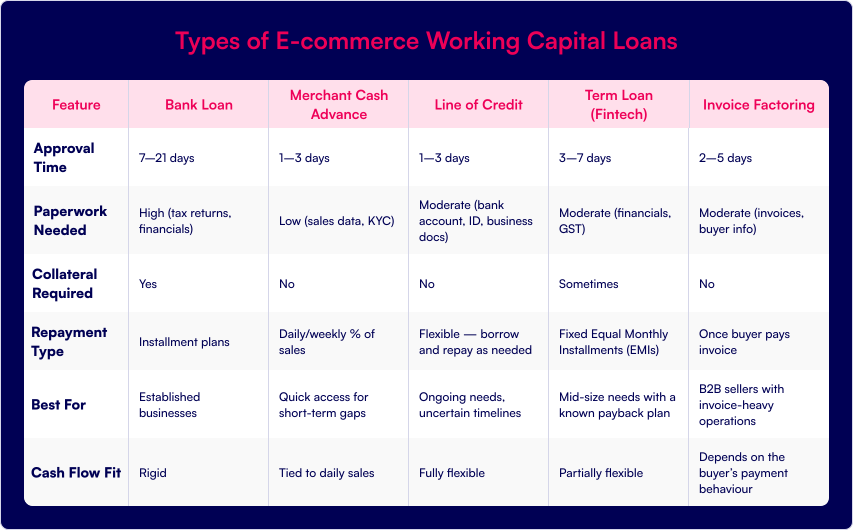
Merchant Cash Advance (MCA)
An MCA, also known as revenue-based financing (RBF), gives you a lump sum in exchange for a fixed percentage of your daily or weekly sales. The lender purchases a portion of your future sales at a discount and automatically collects repayments.
How it works:
- You are typically evaluated based on your sales from the last 3–6 months on the platform (E.g., Amazon, Shopee).
- Approval is quick and does not require a strong credit history.
- The lender deducts a fixed % (say, 10–20%) of your daily or weekly revenue directly from your payment processor.
- The more you earn, the faster you repay — but you repay the agreed total regardless of how long it takes.
- There is a “factor rate” (e.g., 1.2x), which means if you borrow $10,000, you repay $12,000 regardless of how long it takes.
|
Pros |
Cons |
|
Fast approval and disbursal |
High cost due to the factor rate |
|
No collateral or fixed EMIs |
Daily/weekly deductions strain cash flow |
|
Platform-based underwriting available |
Not ideal for long-term or large needs |
Line of Credit (LOC)
A revolving credit facility—you get a credit limit (e.g., $250,000), and you can draw from it anytime. Interest is charged only on what you use.
How it works:
- Creditworthiness is evaluated based on credit scores, business age, and basic financial information.
- Some lenders like CrediLinq now offer platform-integrated LOCs—your e‑commerce sales data helps determine your eligibility and the credit limit.
- You can make multiple draws and repayments, and funds are replenished as you repay.
- Interest is calculated daily or monthly only on the drawn amount.
- No fixed term—you use it as needed.
|
Pros |
Cons |
|
Ongoing access to funds |
Minimum limit on withdrawals in some cases |
|
Flexible use — draw and repay anytime |
Some lenders have early repayment fees |
|
Suits unpredictable or seasonal spending |
Platforms may have additional fees associated with them, such as annual facility fees or drawdown fees. |
Term Loan (Fintech)
A traditional fixed-term loan with monthly EMIs, but issued by digital lenders who assess online business data rather than just balance sheets.
How it works:
- The application is online, with faster credit assessment using marketplace data or payment gateway history.
- Once approved, you get a lump sum and repay over a defined term (6–24 months).
- Interest rates vary depending on risk profile.
- Repayment is fixed, regardless of your revenue performance.
- Some lenders allow early repayment or top-ups after partial repayment.
|
Pros |
Cons |
|
Predictable cost and repayment timeline |
Fixed EMIs regardless of slow periods |
|
Less rigid than bank loans |
May still require formal documents or financials |
|
Good for larger purchases or expansion |
Additional fees may apply—processing fees, early repayment charges, platform service fees, disbursement fees, account maintenance costs, late payment penalties |
Invoice Factoring
A financing method where you sell your unpaid invoices to a third party (factoring company) in exchange for upfront cash.
How it works:
- You submit B2B invoices (not retail orders) to a factor.
- The factor verifies the invoice and advances 70–90% of its value within 24–48 hours.
- When your customer pays, the factor deducts their fee (1–5%) and releases the remaining amount to you.
- Risk depends partly on the buyer—if they delay, you may face penalties.
|
Pros |
Cons |
|
Speeds up cash tied in long payment cycles |
Works only for B2B invoices, not direct sales |
|
No debt or interest—your own sales fund it |
Customer interactions may be handled by the factor, impacting customer relations |
|
No credit checks or long application process |
Fees vary by buyer reliability and region |
How to Choose the Right Loan for Your E-commerce Business
Do not choose a loan based on what is available. Choose based on your business needs and the way your cash cycles work. The right working capital solution should help you grow, not create new stress.
Here is how to evaluate your options more clearly:
1. Define your use case, and match the structure to it
Your loan type should match the problem you are trying to solve.
- Need to restock inventory ahead of a sale like Prime Day or BFCM?
An RBF model, like a cash advance, works well, as repayments adjust with your revenue, so you are not tied to fixed EMIs immediately after a bulk purchase.
- Planning to expand to a new region just in time for Prime Day sales?
A line of credit is more useful, since you can withdraw only what you need, when you need it—say, $50K for the initial setup costs, and more later if needed.
- Planning to launch R&D for a new product?
A term loan is suitable, especially when you have a specific large project in mind and prefer fixed repayment over a set duration.
- Dealing with pending payouts from Amazon or TikTok Shop?
Invoice factoring helps bridge that waiting period, since it gives you cash upfront based on future expected revenue.
2. Check platform compatibility and the underwriting model
Traditional banks assess creditworthiness through tax returns, collateral, and long financial histories — metrics that often fail to reflect the pace and potential of your e‑commerce store.
Alternative lenders take a different approach.
- Line of credit and RBF lenders plug directly into your Amazon, TikTok Shop, Shopify, eBay, Lazada, Shopee, and other dashboards. This allows them to underwrite you based on actual revenue and order history, not just a credit score or asset ownership.
- Invoice factoring tools require access to your pending sales or invoices and typically sync with your accounting tools or marketplace data.
The more closely a lender’s model aligns with how your store runs, the better your chances of securing fair terms, without unnecessary paperwork or delays.
Avoid lenders that require complex documentation, collateral, or lengthy financial histories unless the deal genuinely adds value.
3. Consider repayment flexibility
- Revenue-based financing: Ideal for businesses with fluctuating cash flow. Repayment slows during lean months and speeds up when business is booming.
- Line of credit: Ideal when your cash needs are ongoing but unpredictable, like fluctuating tariff schemes. You borrow only what you need, and interest applies only to the amount you use.
- Term loans: Repayments are fixed and predictable, but can strain cash flow if revenue is not steady.
If you sell across multiple marketplaces and have irregular payout schedules, avoid rigid EMIs and opt for flexible models instead.
What Makes CrediLinq the Ideal Choice for E-commerce Sellers
CrediLinq is not just another lender. It is a funding partner designed around how e-commerce sellers actually operate—fast, flexible, and platform-first.
- Platform-based underwriting: CrediLinq connects directly with Amazon, TikTok Shop, eBay, Lazada, Shopee, and Shopify as well as your Plaid account to assess your sales data in real time. This allows you to access a credit limit of up to $2 million without requiring collateral or too much paperwork.
- Fast approvals, minimal paperwork: No balance sheets or lengthy applications. The process is fully digital and approvals happen in as little as 1 business day, and there is no need to pledge equity or assets.
- Multi-purpose credit line: Use the funds for geo-expansion, restocking inventory, ad spend, new product launches, and cross-marketplace expansion. There are no restrictions on how the funds are used.
- Pay only for what you use: You are charged a flat monthly service fee, starting at 1.5% or a simple fixed annual percentage rate (APR) of 18%on the amount you draw. If you use nothing, you pay nothing.
- Flexible repayment options: Choose repayment timelines that work for your business — in 3-6 months. You can repay in flexible bi-weekly installments. Customized solutions are available upon request. Loan tenors can extend up to 12 months on a case-by-case basis.
- No lock-in period: You’re never locked into long-term commitments. Repay early if you prefer—there are no penalties or hidden charges.
- No equity dilution: You do not give up ownership or control. This is pure working capital, not investment or debt tied to shares.
- Transparent, all-in pricing: There are no hidden platform fees, processing charges, or surprise penalties. Just one transparent service fee—what you see is what you pay.
- Cross-border currency support: When applying, you can select your preferred currency—USD, GBP, or SGD—and the loan will be disbursed in the same currency. Perfect for sellers operating across multiple countries.
Making the Most of Your E-commerce Credit Line
CrediLinq’s revolving credit line is designed to give e-commerce sellers flexible access to funds whenever and however they need it. Here are the most common (and high-impact) ways sellers use it to stay ahead:
- Expanding into new marketplaces: Whether you are listing on Amazon, launching on TikTok Shop, or testing a new category on Walmart, CrediLinq helps fund the upfront costs—product listings, logistics, and initial promotions—without locking you into long-term loans.
- Launching new products: From first-batch manufacturing to packaging and marketing, launching a new SKU involves multiple expenses. Use CrediLinq to manage these upfront costs and better manage cash flow.
- Stocking up for major sales events: Prepare early for Amazon Prime Day, BFCM, or year-end clearances by purchasing inventory in bulk, without dipping into personal savings. With flexible 3-6 month repayment terms, you can time repayments to match post-sale revenue.
- Investing in paid ads: Ad spend on platforms like TikTok Shop, Meta, or Google now requires consistent investment to maintain visibility. Instead of pausing campaigns due to cash crunches, use CrediLinq to run continuous promotions and scale faster.
Cash Flow Should Not Be a Growth Barrier
E-commerce cash cycles are rarely straightforward. Even with steady sales, delayed payouts, upfront expenses, and thin margins make it difficult to build a profit reserve, let alone fund growth.
The right funding solution can help you manage cash flow without slowing momentum. What matters most is choosing a partner that offers capital on simple, flexible terms—without draining your time, energy, or profit.