



Amazon Global Selling: A Practical Guide to UK Entry

|
Overview
|
|
Why This Matters
|
Amazon Global Selling simplifies cross-border expansion by giving sellers access to international marketplaces and tools directly within Seller Central.
For US sellers considering Amazon UK, this means entering a market that generated $43.2 billion in net sales in 2025, making it Amazon’s second-largest European market after Germany.
However, expansion also introduces tax obligations, customs requirements, added operational costs, and logistical complexity. Without careful planning, these factors quietly eat into margins.
In this blog, we outline how US sellers can expand into Amazon UK. We will cover key regulatory requirements in the UK, expansion costs, and the operational considerations needed for sustainable cross-border selling.
Preparing Your Business for the UK Marketplace
Expanding to Amazon UK requires more than listing products in a new region.
Early decisions around business structure and fulfilment directly affect tax exposure, operating costs, and customer experience.
At a high level, sellers need to answer two questions:
- How will the business be structured?
- Where will the inventory be held?
Choose your entity structure
Sellers can either operate through their existing US LLC or set up a UK-based entity.
- Using the same LLC is faster. Through Amazon Global Selling, sellers can extend their US account to the UK and start selling quickly.
Trade-off: Immediate tax compliance and filings; VAT registration required from day one
- Setting up a UK entity adds setup effort but provides flexibility. Sellers need not register for VAT until they cross the annual threshold.
Trade-off: Slower setup, but lower initial compliance burden
So:
- If you are testing demand, use the same LLC
- If you are planning controlled entry with lower upfront compliance, set up a UK entity
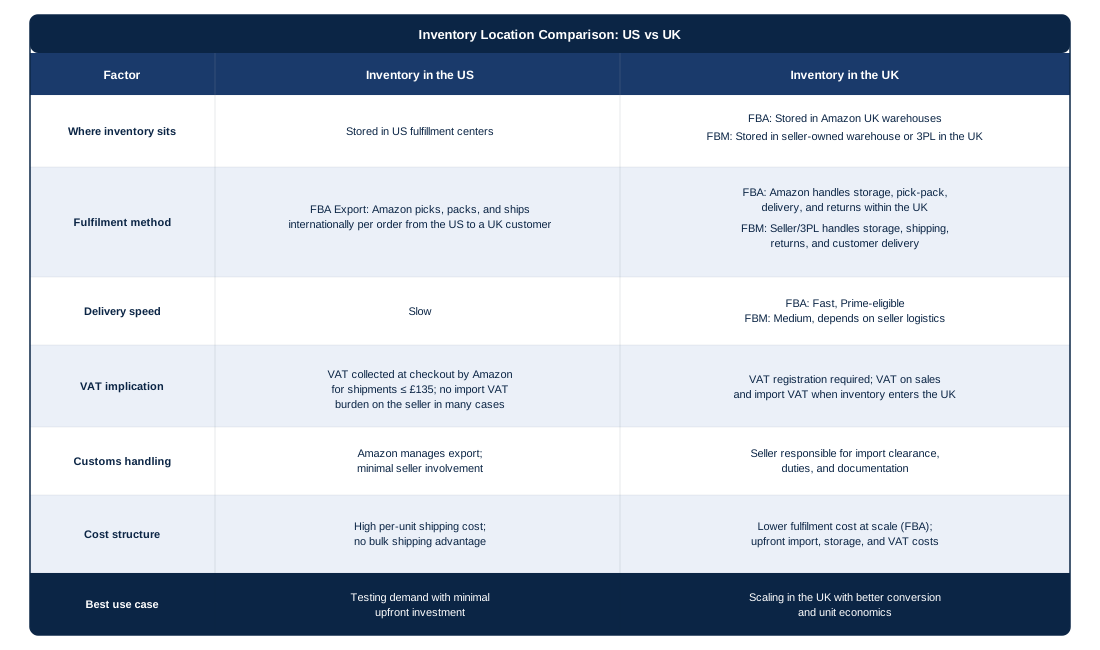
Decide where the inventory will be stored
Once the entity is decided, the next question is whether you will ship from the US or stock inventory in the UK.
Setting Up for Amazon UK Expansion
Amazon Global Selling tools are built into Seller Central, so UK expansion doesn’t require starting from scratch. It’s a matter of linking accounts, meeting UK-specific regulatory requirements, and syncing inventory.
Step 1: Account creation and linking
If you have an existing US Professional selling account, you don’t need a new one.
- Log in to Seller Central and go to the Sell Globally dashboard
- Select the option to create a regional Europe account
- Link your North American and European accounts
You get single-interface management and cap your combined monthly fee at $39.99.
Step 2: Regulatory and tax compliance
Non-compliance can lead to rejected shipments and potential account suspension. Prepare to meet the following requirements:
- VAT Registration: If you store inventory in the UK, you’ll need to register for a UK VAT number through HMRC.
- EORI Number: An Economic Operators’ Registration and Identification (EORI) number is required to move goods into the UK.
- Importer of Record (IOR): Amazon prohibits listing “Amazon” as the IOR. You must appoint a third-party representative or use your own legal entity for customs clearance.
- Product Compliance: Use the Compliance Reference tool in Seller Central to check UK-specific requirements. The most common is the UKCA marking on electronics, which replaced the CE mark for many product categories post-Brexit.
Step 3: Product selection and research
- Use Amazon’s Marketplace Product Guidance tool to get machine-learning-based recommendations on which of your US products have high UK demand
- Cross-reference with UK best-seller lists and category-level competition data to confirm viability before listing
Step 4: Listing your products
Option A (recommended) — Use Build International Listings (BIL) to automatically cross-list and sync your US offers to the UK store, including pricing adjustments.
Option B — Manual upload export recommendations from Marketplace Product Guidance, update prices and quantities in the template, and upload via the inventory loader.
Step 5: Fulfillment setup
Choose your fulfillment method:
If using FBA: Your commercial invoice must include the FBA Shipment ID and a detailed goods description to avoid customs delays.
Step 6: Launch fast and get incentives
New UK sellers can get over £42,000 in potential incentives within the first 90–180 days.
FBA incentives
Criteria: First FBA shipment must be sent within 90 days of listing
- £80 credit via Amazon Partnered Carrier, or £160 credit via Amazon Global Logistics
- Automatic enrollment in FBA New Selection — free monthly storage, removals, and returns processing for eligible new-to-FBA products
- Exemption from the storage utilization surcharge for 365 days after the first inventory receipt
Advertising and promotions
Criteria: Campaigns must launch within 90 days of first listing
- Up to £750 in Sponsored Products credits based on qualifying spend within 30 days of your first campaign
- £40 credit for creating your first Voucher on an eligible product within 90 days
Worth noting: Incentives are available on the Professional selling plan only. Sellers who follow Amazon’s New Seller Guide generate approximately 9x more first-year sales than those who don’t.

Understanding the Cost Structure for UK Expansion
Expanding to Amazon UK introduces a cost layer. The goal is not to track every minor fee, but to understand what materially impacts margins.
1. Selling plan fees
Selling plan fees are based on your sales volume and required tools:
- Professional Plan: Costing £25/month (excl. VAT), this is best for sellers moving 35+ units monthly and those requiring access to ads and reports.
- Individual Plan: Costing £0.75 per unit sold, this is ideal for low-volume sellers testing the market.
Linked account discount: Connecting your North American and European Professional accounts caps your total monthly subscription at ~$39.99 USD.
2. Referral fees
Charged on every sale as a percentage of the total sales price (item + shipping + gift wrap).
- Most categories: 8–15%
- Minimum per item: £0.25–£0.30
- Outliers: Amazon Device Accessories (45%), Jewelry (20% up to £225), Computers (7%)
3. Fulfillment fees
These vary based on how you fulfill orders.
- Fulfillment by Amazon (FBA): Flat fee per unit covering pick, pack, ship, and customer service, calculated by product type, dimensions, and weight.
A 1.5% fuel and logistics surcharge applies to all UK FBA fees from April 17, 2026
- Merchant Fulfilled Network (MFN): No Amazon fulfillment fee. You pay your own carrier or 3PL rates directly.
FBA reduces operational effort but introduces ongoing storage and handling costs that increase with inventory levels.
4. FBA storage fees
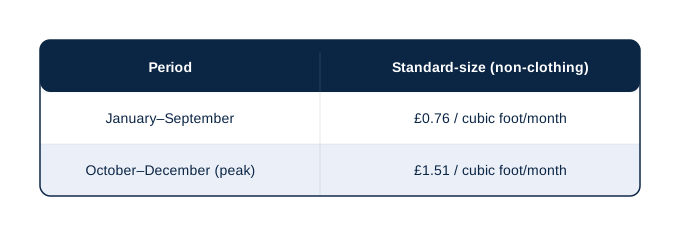
Additional storage charges to watch:
- Aged inventory surcharge — kicks in after 241 days in a fulfillment center
- Storage utilization surcharge — may apply if your utilization ratio exceeds 22 weeks of cover
Note: New sellers are exempt from the storage utilization surcharge for the first 365 days.
5. Other fees to know
The following additional fees are relevant when expanding in the UK marketplace:
- Refund administration: Amazon retains the lesser of £5.00 or 20% of the original referral fee
- High-volume listing: £0.0003/SKU per month above 2 million SKUs
- Closing fee: Fixed fee on media items (books, music, DVDs)
- Advertising: Sponsored Products runs on a cost-per-click model — budget separately
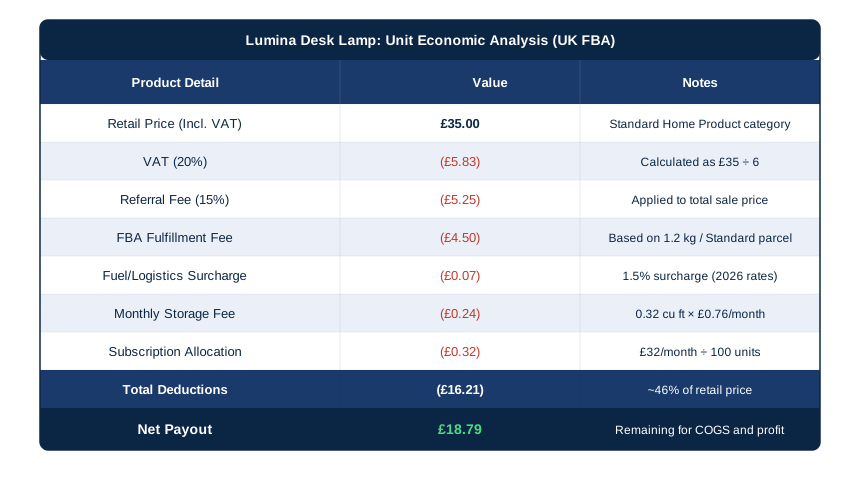
Per-unit cost breakdown
To illustrate how these costs work together, below is a realistic breakdown of a product sold via UK FBA.
Funding Your UK Expansion
Expanding to Amazon UK comes with upfront costs, all before sales stabilize. At the same time, your US operations continue to demand capital. The challenge is not just funding expansion, but doing so without disrupting what already works.
What this needs is on-demand funding, capital you access when a need arises, draw only what you need, and aren’t paying for when you don’t. CrediLinq provides a flexible credit line of up to $2 million, underwritten against your platform sales data.
As an approved financing partner on the Amazon Seller Central app store in 16 markets, CrediLinq connects directly with your Amazon account, using your real-time sales data to underwrite and approve your credit limit. No collateral required, no weeks of processing, and you can get approved in as little as one business day.
- Draw what you need, when you need it — for example, £5,000 for an FBA shipment in March, £3,000 for ads in July, nothing in between
- Pay only for what you use — a flat monthly fee as low as 1.5% per month on the portion drawn; zero charges when idle
- Repayment over 3–6 month terms with no lock-in and no early repayment penalties
To qualify: 12+ months of selling history on a supported platform (Amazon, Shopify, TikTok Shop, Walmart, or eBay) and $30,000+ per month in combined sales.
Case Study: How Blink Entered the UK Market
A practical example of US-to-UK expansion comes from Blink, a Massachusetts-based company that used the UK as its entry point into Europe.
Blink, a home security camera company, validated its concept with a 2014 Kickstarter campaign that sold $1 million in product within six weeks to roughly 7,000 customers.
In November 2016, driven by direct requests from European customers on their US Facebook page, Blink chose the UK as its sole entry point, avoiding overcommitment while their US business was still scaling. They moved inventory into Amazon UK fulfillment centers, localized listings using UK competitor keyword research, and ran Sponsored Products ads and Lightning Deals to build early search rankings.
The results validated the strategy:
- Doubled European sales within the first year (2017)
- Expanded to four additional European stores within six months of the UK launch
- Upgraded to Pan-European FBA to achieve Prime eligibility across all five stores
- Built a multimillion-dollar international business with minimal on-the-ground presence
- Acquired by Amazon in November 2017
Blink did not scale aggressively from day one. It validated demand, used the UK as a single-market entry, and expanded only after traction, minimizing operational and financial risk.

Your UK Expansion, Simplified
Amazon removes much of the operational complexity through its built-in global selling tools, regulatory guidance, and fulfillment infrastructure. The framework is there — account linking, compliance references, Build International Listings, FBA.
If you’re not ready to commit fully, FBA Export lets you test UK demand from your existing US inventory before investing in a dedicated market setup.
When you are ready to scale, the upfront costs are real but manageable with the right capital structure. An on-demand financing partner like CrediLinq means you can move on to inventory, advertising, and compliance costs as opportunities arise, without drawing down operating cash or stalling your US business in the process.
Expansion doesn’t have to be a gamble. With the right infrastructure and flexible capital behind you, the UK market is one of the most accessible first steps into international selling.
Frequently Asked Questions
How much capital do I need for Amazon Global Selling to US/UK markets?
There is no fixed amount. Cross-border selling involves staggered costs across inventory, VAT, shipping, and ads. Instead of large upfront capital, CrediLinq provides on-demand financing—draw what you need, when you need it, and pay only on usage.
What are the qualification criteria for performance-based working capital?
For CrediLinq, sellers need at least 12 months of selling history and business vintage, $30,000+ combined monthly sales, and a registered business. Approval is based on platform performance data from marketplaces like Amazon, TikTok Shop, Walmart, Shopify, eBay, Shopee, and Lazada.
Do I need collateral to finance my first Amazon Global Selling inventory order?
No. With CrediLinq, cross-border selling financing does not require collateral, equity, or asset pledging. Funding is based on your marketplace performance.
How fast can I get approved for marketplace-based funding?
CrediLinq uses platform-based underwriting connected to Amazon and other marketplaces and approvals happen in as little as one business day.
What happens to my credit line if Amazon sales dip temporarily?
Temporary dips do not immediately affect access to your credit line. With CrediLinq, underwriting considers up to 12 months of sales history, making it suitable for seasonal sellers, where revenue may fluctuate across periods.
Are there restrictions on how I use working capital funds for inventory?
No. CrediLinq offers a multi-purpose credit line that can be used for inventory, ads, logistics, or international expansion.