



Highlights
- Amazon FBA sellers importing from China face a structural 60–90+ day Cash Conversion Cycle that locks capital long before revenue arrives.
- Standard Chinese supplier payment terms (30/70 or 20/80) require significant upfront capital before production even begins.
- Sea freight from China to the US West Coast takes 30–45 days door-to-door; East Coast routes average 50–55 days, adding to the liquidity gap.
- Amazon’s 14-day payout cycle, extended by 7-day reserve holds and 3–5 day ACH transfers, means sellers may wait 20+ days post-delivery before funds arrive.
- Landed cost consistently runs 15–30% above product cost alone, catching many sellers off-guard mid-cycle.
- A $50,000 Q4 inventory order can require $65,000–$70,000 in total working capital when all landed cost components are factored in.
- E-commerce financing tools, including a line of credit, Purchase Order (PO) financing, and inventory financing, exist specifically to bridge this gap without equity dilution.
- Credilinq’s line of credit is built around e-commerce cash cycles, not traditional credit metrics, giving brands the capital to fund inventory and scale marketing without pledging assets or handing over equity.
Why This Matters to You
|
The Cash Conversion Cycle (CCC) is one of the most important financial metrics for any e-commerce business managing imported inventory. For Amazon FBA sellers who source from China, it defines precisely how long capital is tied up between the moment a supplier’s deposit is paid and the moment Amazon credits funds to a bank account. For most sellers on this model, that window runs between 60 and 90 days, often longer.
This guide breaks down each stage of the cycle, quantifies the full capital requirement, and maps the financing tools built to bridge the gap.
Why Amazon Sellers Face a 3-Month Liquidity Gap
The liquidity gap experienced by Amazon FBA importers is built into the operational structure of international e-commerce, where every stage of the supply chain introduces a delay that compounds the previous one.
Supplier payment terms establish the gap from day one. The standard payment structure with Chinese manufacturers is a 30% deposit before production begins, with the remaining 70% due before or upon shipment, commonly referred to as 30/70 terms. Some suppliers require 20/80 terms for first-time buyers, which demand an even larger upfront commitment, unlike domestic suppliers who may offer Net 30 or Net 60 terms.
Freight transit adds weeks before the inventory is live. According to Flexport’s Ocean Timeliness Indicator, sea freight from China to US West Coast ports currently averages 37-414 days port-to-port, while East Coast routes average 53–55 days. Adding inland transport, export customs, US import clearance, and Amazon FBA intake pushes the door-to-door timeline to 40–50 days for West Coast destinations and 55–65 days for East Coast. Air freight compresses this to 5–14 days, but at substantially higher per-unit cost.
Amazon’s payout model introduces a final delay. Amazon pays sellers every 14 days on paper. A 7-day reserve hold on recent sales, combined with 3–5 business day ACH transfers, produces a realistic Days Sales Outstanding (DSO) of 20–25 days for established sellers in good standing. For newer accounts or those subject to Account Level Reserve holds, this can extend significantly further.
The three stages of the gap are illustrated in the timeline below.
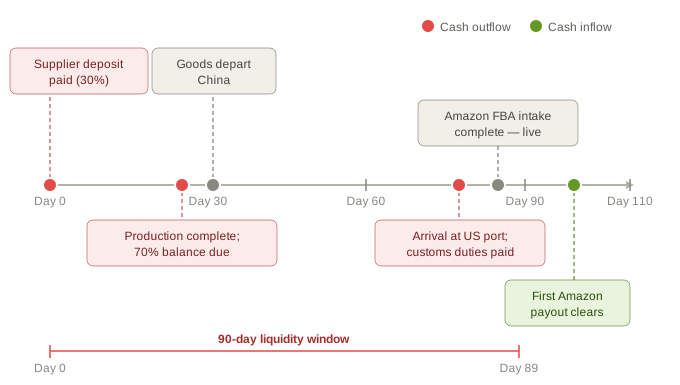
The 90-Day Amazon FBA Liquidity Gap
As the timeline makes clear, every stage of the cycle runs at a deficit, cash flows out continuously from Day 0, while the first inflow does not arrive until Day 89 at the earliest, confirming that the 90-day gap is not a single event but a series of compounding commitments.
Since March 2026, Amazon’s DD+7 policy ties payouts to confirmed delivery rather than shipment, thereby extending the gap for FBA orders. When stacked, the three constraints: deposit, freight, payout delay, produce a structural liquidity gap of 60 to 90+ days during which capital is fully deployed with zero earnings. The pain caused during this window can be alleviated with e-commerce financing.
Mapping the Cash Conversion Cycle for Import-to-FBA Operations
The CCC formula measures how long your capital is locked in operations. As defined by the Corporate Finance Institute, the formula is:
CCC = Days Inventory Outstanding (DIO) + Days Sales Outstanding (DSO) − Days Payable Outstanding (DPO)
For a typical Amazon FBA seller importing by sea freight, the components break down as follows. DIO captures every stage from capital commitment to sale, including supplier production time, freight transit, customs clearance, Amazon intake, and inventory holding time before purchase.
DSO captures the Amazon payout lag described above. DPO reflects how long the seller can defer payment to suppliers. For most Amazon importers, this offers the least flexibility of any component, since Chinese manufacturers require deposits before production and balances before shipment, yielding a DPO of just 0–15 days.
Applied to a realistic sea freight seller, the calculation produces:
CCC = 85 days (DIO) + 20 days (DSO) − 10 days (DPO) = 95 days
Nearly three months of capital gets locked in the operating cycle, with no revenue during that period.
Understanding what drives those 85 DIO days, and precisely how much capital each stage demands, starts with calculating the true landed cost of your inventory.
Understanding Landed Cost and Its Full Impact on Capital Needs
One of the most common and most expensive planning mistakes Amazon sellers make is budgeting only for the product cost when projecting working capital requirements. The true financial commitment required before inventory reaches an Amazon warehouse is the landed cost, and it consistently runs 15–30% above the factory price alone.
The table below presents the full capital picture for a $50,000 product order shipped by sea, showing both the cost components and the CCC stage at which each payment is due. This timing dimension is what converts a landed cost estimate into a working capital plan.

Note: Actual logistics costs may vary based on shipment size, seasonality, and supplier terms. Freight costs, in particular, include multiple sub-components such as fuel surcharges, peak season fees, and compliance charges, which can introduce variability beyond the base estimates shown above.
The table clearly shows that capital is not deployed all at once, but is drawn out over the full 90-day cycle in multiple tranches, each one arriving before the previous outlay has generated any return. A seller who has budgeted $50,000 for an inventory order but has not accounted for the $8,000–$17,500 in downstream landed costs will face a mid-cycle shortfall that can stall customs clearance, delay Amazon intake, or force rushed air freight decisions at significant additional expense.
E-commerce Financing Options to Bridge the Gap
Professional Amazon sellers use e-commerce financing (line of credit, inventory financing, PO financing, etc.) as a planned operational tool, just as a manufacturer uses a revolving credit facility to bridge production cycles. The right financing instrument depends on which stage of the CCC the capital needs fall into.
The comparison table below covers the main e-commerce financing options across the criteria most relevant to FBA importers:

A line of credit is the most adaptable tool for sellers with recurring inventory cycles. Rather than taking a lump sum and paying interest on unused capital, sellers draw funds precisely when needed, to cover the supplier deposit on Day 0, the 70% balance before shipment on Day 30, and customs duties on arrival, and then repay as Amazon payouts clear. CrediLinq’s line of credit is built for exactly this use case, with the following structure:
Ownership stays yours, always: Financing through CrediLinq requires no equity. For brands at the $3M–$5M stage, trading ownership for short-term working capital is a cost that compounds long after the inventory cycle ends. Fund your next reorder, bridge a payout gap, while retaining the same cap table you started with.
Fixed repayments, not a share of your revenue: Every installment is a predetermined bi-weekly amount, set from day one. What you owe each fortnight is what you planned for, making cash flow projections reliable rather than reactive.
Your assets stay unencumbered: Your eligibility for financing is determined by how your e-commerce business performs, not by what it owns. No inventory liens, no equipment pledges, no real estate on the line. Brands that operate asset-light, with stock at a 3PL and manufacturing at a supplier, are eligible for financing based on how their e-commerce business performs, can access capital on equal footing with those that own physical infrastructure.
One facility, every channel: Whether you sell on Amazon, TikTok Shop, Shopify, Walmart, eBay, or all of the above, the same line of credit supports the full operation. As your distribution strategy grows more complex, your capital source does not need to keep pace with new applications, separate facilities, or platform-specific restrictions.
The cost you see is the cost you pay: Fixed monthly fees starting from 1.5% p.m. or a simple fixed annual percentage rate (APR) of 18% is applied on the drawn amount, with no other hidden charges. Before drawing a single dollar, you can calculate the total financing cost and build it into your margin model, your landed cost estimate, or your campaign budget with complete accuracy and transparency.
Capital when the cycle calls for it, not before: Rather than taking the full amount upfront and carrying idle funds, you draw when needed, at the precise moment, for e.g. advance supplier deposit, balance payment at shipping, and duties at custom clearance. Supplier deposit when the order is placed, balance payment when goods are ready to ship, and duties when the container clears customs.
Repayment windows built around e-commerce, not banking calendars: A 3–6 month tenor is designed to cover the actual time it takes for an entire inventory cycle to complete, from first outlay to final marketplace payout.
Proven Tactics to Shorten Your Cash Conversion Cycle
Financing bridges the gap, but optimizing the CCC reduces the amount of financing the business needs in the first place. Three levers have the most direct impact on FBA importers.
Negotiate a balance payment against the bill of lading. As supplier relationships mature and order volumes grow, pushing for the 70% balance to be payable against the bill of lading rather than before shipment adds 7–15 days to the effective DPO and reduces the total CCC by the same amount, without any third-party financing cost.
Switch fast-turning SKUs to air freight selectively. The DIO reduction often offsets the higher per-unit cost of air freight. A SKU with strong sell-through velocity that ships by sea (adding 40+ days of DIO) may generate better working capital efficiency via air if it reaches FBA and starts selling 30 days sooner, particularly ahead of peak season windows where timing is revenue-critical.
Apply for financing before you need it. Sellers who secure a line of credit ahead of Q4, rather than when cash is already constrained, consistently access better terms, faster approval, and more flexible drawdown options. Capital access and peak demand windows do not align unless planned for in advance.
Quick Optimization Tactics Checklist
☐ Negotiate a balance payment against the bill of lading
☐ Switch fast-turning SKUs to air freight selectively
☐ Apply for a line of credit before peak season
Case Study: Funding a $50,000 Q4 Inventory Order
Consider a US-based Amazon seller placing a $50,000 private-label order with a Chinese supplier, targeting an October 15 go-live for Q4. Under standard 30/70 terms, $15,000 is paid upfront on August 1 as the deposit.
The remaining $35,000 balance, along with freight, insurance, and shipping-related charges (typically $5,000–$8,000, including fuel surcharges and terminal fees), is due in early September before shipment. This brings the total pre-shipment outflow to approximately $40,000–$43,000.
Upon arrival in October, additional costs such as customs duties, port handling, and Amazon FBA prep and labeling (approximately $3,500–$4,500) become payable. By the time inventory is live, the seller has deployed approximately $58,000–$60,000 in total landed cost.
Sales begin on October 15, but due to Amazon’s 14-day payout cycle and reserve hold, the first meaningful cash inflow does not arrive until early November. This creates a ~90-day window during which nearly $60,000 in capital is fully committed with no incoming cash.
With a CrediLinq line of credit, the seller draws approximately $55,000–$58,000 in two tranches: $15,000 in August for the deposit and $40,000+ in September for the balance and shipping costs. Repayments begin as fixed bi-weekly instalments aligned with the November payout cycle.
This structure allows the seller to preserve working capital reserves throughout the cycle, enabling continued Q4 ad spend and operational flexibility. The total financing cost, typically under 3% for a 3–4 month tenor, is known upfront and can be factored into the landed cost before placing the order.

Key Takeaways for Cash-Efficient Growth
- The Cash Conversion Cycle is the single most important working capital metric for Amazon FBA importers; it determines how much capital the business requires at any revenue level
- Landed cost runs 15–30% above product cost alone; accurate working capital planning begins with a complete landed cost calculation, not just the supplier invoice
- The 90-day liquidity gap is structural, and so financing should be built into the operating plan from the start, not accessed in response to a shortfall
- A line of credit is the most capital-efficient tool for sellers with recurring inventory cycles, because it aligns drawdown and repayment with CCC stages rather than imposing a fixed lump-sum structure
- CCC optimization via better supplier terms, selective air freight, and proactive financing reduces the capital requirement over time and improves the efficiency of every financing dollar used.
Frequently Asked Questions
What is an ideal Cash Conversion Cycle for Amazon FBA sellers?
An ideal Cash Conversion Cycle for Amazon FBA sellers is under 60 days. Most sea freight sellers operate on 80–100-day terms; optimizing supplier terms and inventory turnover can significantly close this gap.
How do I accurately track landed cost for imported inventory?
You can accurately track the landed cost of imported inventory, including product cost, freight, customs duties, insurance, port fees, broker charges, and Amazon FBA prep. Total landed cost typically runs 15–30% above factory price.
What financing options are available for e-commerce businesses with long cash conversion cycles?
A line of credit suits recurring cycles best. PO financing works for large pre-season orders. Inventory financing unlocks capital tied up in existing stock.
How do currency fluctuations impact my Cash Conversion Cycle?
A weakening US dollar increases the effective dollar cost of the 70% balance payment between order placement and shipment, expanding the capital requirement mid-cycle without warning.
Can Amazon sellers achieve a negative Cash Conversion Cycle?
Yes, Amazon sellers can achieve a negative CCC by selling inventory before paying suppliers in full. However, in practice, this requires very fast turnover and strong supplier credit terms; most FBA importers should target CCC reduction first.