


Complete Guide to Amazon Inventory Financing in 2026


TL;DR
- Amazon’s 2026 fee changes and tighter FBA limits force earlier, larger buys, so cash goes out long before payouts land.
- CrediLinq, an approved Amazon lending partner in 16 markets, offers a flexible credit line up to $2M with short 3-6 month terms and transparent flat fees.
- Other options include Payoneer receivables advances, SellersFi term loans and Line of Credit, ClearCo invoice or receipt funding, and Wayflyer revenue advances.
- Select partners that offer transparent pricing, early repayment flexibility, and multi-market coverage.
Why this matters to you
- Amazon’s new fees punish low stock; If you cannot restock early, you lose rank, sales, and momentum.
- Financing bridges the gap between supplier deposits and delayed payouts so you stay in control.
Amazon recently increased its low-inventory-level fee which pushed sellers to hold more stock and made staging inventory at scale more complex.
Amazon has said no new fee types will be introduced again in 2026, but the pressure to plan inventory early is now more intense.
Here’s what you should know:
- The low-inventory-level fee continues, but at the FNSKU level instead of the parent-ASIN level: If your FBA products dip below 28 days of supply you’ll still pay extra, so keeping stock thin may come at a cost.
- Placement fee adjustment: Standard-size products will see an inbound placement service fee increase of $0.05 per unit increase on average when using the minimal splits option. Additionally, Large standard-size products between 3-20 lb will be updated to include five new shipping weight bands.
In the heat of all this, capacity limits were tightened through mid-2025 for key Amazon FBA windows, especially in the run-up to Prime Day.
By May, storage allowances dropped from about six months of forecasted sales to five, and some sellers reported cuts of up to 75%! Limits still stayed tight into July, leaving far less room to stage large inbound shipments in advance.
What does this mean for you?
In order to avoid penalties and delays, you need to bring in inventory earlier and in smaller, smarter tranches. This takes careful planning and a lot of cash flow to do wisely.
Inventory financing provides you with cash; the needed leverage to pull orders forward, split shipments to match your space, and stay ahead of fees without draining your reserves. It also helps you manage the cashflow gap by bridging between Amazon’s stocking requirements and their payout delays.
When Should You Use Inventory Financing
The right moment to use an inventory financing company is when your supplier terms and your marketplace payouts do not line up, but you know your products will move.
Here are the clearest scenarios where it makes sense:
Seasonal peaks
Sales can spike and empty your stock before you know it. This is common during Prime Day, Black Friday, or the holidays.
Inventory financing helps when you expect demand to rise faster than your current supply.
You can pull purchase orders forward to secure the lowest number of units your supplier is willing to sell in a single order and hold safety stock. With short-term coverage financing of 90 to 180 days, you would have time to sell through and collect payouts.
The key is to order based on proven demand from last year, not pile up slow-moving items.
Supplier negotiations
Suppliers usually offer better pricing if you commit to bigger orders or meet higher minimums. Inventory financing helps when the discount is greater than the cost of financing.
This way, you have access to cash flow to place larger orders, handle deposits and final payments, and secure production slots without straining your cash.
Just be careful not to overcommit and only finance products you know will move, or you risk tying up money in unsold stock.
Scaling product launches
When a new product is selling well, financing can help you scale faster. Strong reviews, low returns, and quick sell-through are signals that it may be worth backing up with bigger orders.
Inventory financing lets you cover packaging, tooling, and larger runs in stages, so you only pay for what is actively being produced.
The smart move here is to make sure you use it for re-orders of proven winners and not for testing unproven ideas.
Unexpected spikes
Sometimes demand jumps overnight and a product goes viral or a competitor drops out, and sales double before you can restock.
Inventory financing helps you respond quickly by covering urgent orders or even expedited shipping.
With short 90 to 180-day terms, you can refill shelves fast without putting strain on your cash flow.
Long lead times and cross-border freight
Overseas sourcing often means paying deposits months before products ever arrive. Most suppliers typically want 30 to 50% upfront and the rest before shipping, even while your current stock is still selling.
Financing bridges that gap by covering deposits and balances so production stays on track.
With 90 to 120-day terms, split into deposit, balance, and freight, you can keep cash free while making sure supply lines do not stall.
What is Amazon Inventory Financing?
Amazon inventory financing is short-term capital offered to sellers. It can come directly through Amazon’s lending programs or through partnered and third-party providers.
Sellers use it to secure inventory now to meet demand, and repay once revenue flows back. This type of financing smooths cash flow management and keeps your store from stalling during peak cycles.
Amazon inventory financing for FBA sellers
Inventory financing for FBA (Fulfillment by Amazon) sellers is short- or medium-term funding that bridges the upfront costs of sourcing and moving products into Amazon’s fulfillment network.
It allows FBA sellers to cover purchase order deposits, freight and insurance, labeling and prep requirements, and placement or storage fees before sales revenue arrives.
Amazon inventory financing for FBM sellers
Inventory financing for FBM (Fulfillment by Merchant) sellers is short- or medium-term funding that uses existing inventory as collateral.
It lets FBM sellers access cash to bridge gaps between purchasing stock and sales revenue. Because FBM sellers handle their own storage, packaging, shipping, and returns logistics, financing often helps with upfront costs in those areas.
Unlike FBA, FBM sellers do not depend on Amazon’s fulfillment centers, which means they do not benefit from Amazon’s inbound or placement services. This gives them more control, but also more responsibility.
Amazon Lending Programs

Amazon’s Seller Lending Program (Source: Amazon)
Amazon Lending is a financing program that enables eligible independent Amazon sellers to access funds through two distinct channels:
- Amazon Lending (Invite-Only Program in Seller Central): This embedded financing experience is available only by invitation on the Seller Central homepage when a pre-qualified offer is available.
While still called “Amazon Lending,” this program no longer represents direct Amazon-issued credit but rather Amazon-facilitated loans from external financial institutions.
Here is how the onboarding flow works, as explained by Amazon Lending’s leadership during Amazon Accelerate 2025:
- Invitation surfaces automatically when sellers meet performance and account-health criteria.
- The seller clicks “Review details” to view offers from integrated partners such as Parafin, Lendistry, QuickBooks Capital, or Uncapped.
- After consenting to data sharing, they are redirected to the partner’s portal to select loan terms and complete the process.
- Amazon Seller Partner Appstore (Open Program via Third-Party Financing Partners): Beyond the invite-only model, Amazon also features a range of official third-party financing providers listed in its Seller Partner Appstore.
These partners, such as CrediLinq, offer open-access funding options that sellers can apply for directly, without waiting for an Amazon invitation.
- Each provider sets its own eligibility, credit limits, and repayment terms.
- Application and loan management occur on the partner’s platform, not inside Seller Central.
Who Amazon Lending is designed for
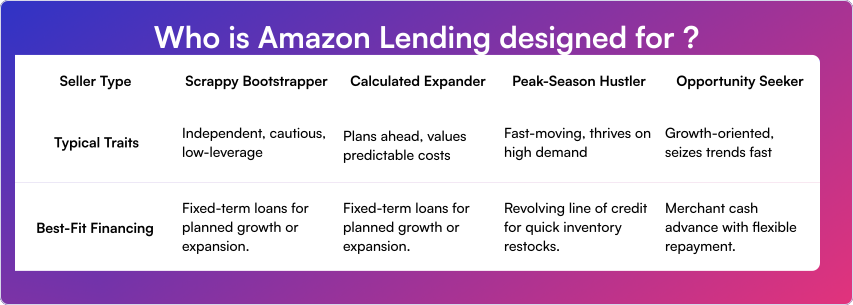
Amazon identifies four broad seller “styles,” each matching a distinct borrowing mindset and product type:
Source: Amazon Accelerate 2025
Understanding where you fit helps you choose the right financing model, and avoid over- or under-leveraging during key retail cycles.
Benefits of Amazon Lending for inventory-focused sellers
- Repayment linked to Amazon payouts: This reduces the need to manage separate payment schedules or worry about missed due dates, less admin overhead and less chance of penalties.
- Minimal outside credit requirements: Amazon Lending partners often assess funding based on your sales performance, making personal credit history less central than with traditional bank loans.
- Speed of approval: Sellers can apply online via Seller Central, often receive a decision in less than 1 to 3 business days, and get funds in 1 to 2 business days after approval.
Limitations of Amazon Lending invite-only program
- Eligibility struggles: . Only sellers who receive an invitation within Seller Central can apply, which limits availability to those who meet specific account-health and sales-performance thresholds.
- Limited loan transparency: Loan terms and pricing details vary by provider and are not always visible until after pre-qualification. This lack of upfront disclosure can make it difficult for sellers to compare options or forecast costs confidently.
- Limited geography: Amazon Lending’s embedded program is restricted mainly to U.S. sellers, leaving many international or multi-market businesses without access. For ecommerce brands selling across multiple regions, that lack of coverage makes it less practical.
Tips to properly use Amazon Lending
- Match funding to purpose: Use lines of credit for flexible inventory cycles, term loans for planned expansions, and MCAs for quick growth opportunities.
- Track ROI: For example, if a USD 30K ad campaign brings USD 75K in incremental sales, your ROI is 2.5×, a simple benchmark Amazon recommends using before accepting financing.
- Prepare early. Maintain healthy stock levels, account metrics, and cash-flow records, Amazon says these directly influence whether you receive an invitation.
Top Alternative Inventory Financing Solutions for Amazon Sellers
1. CrediLinq
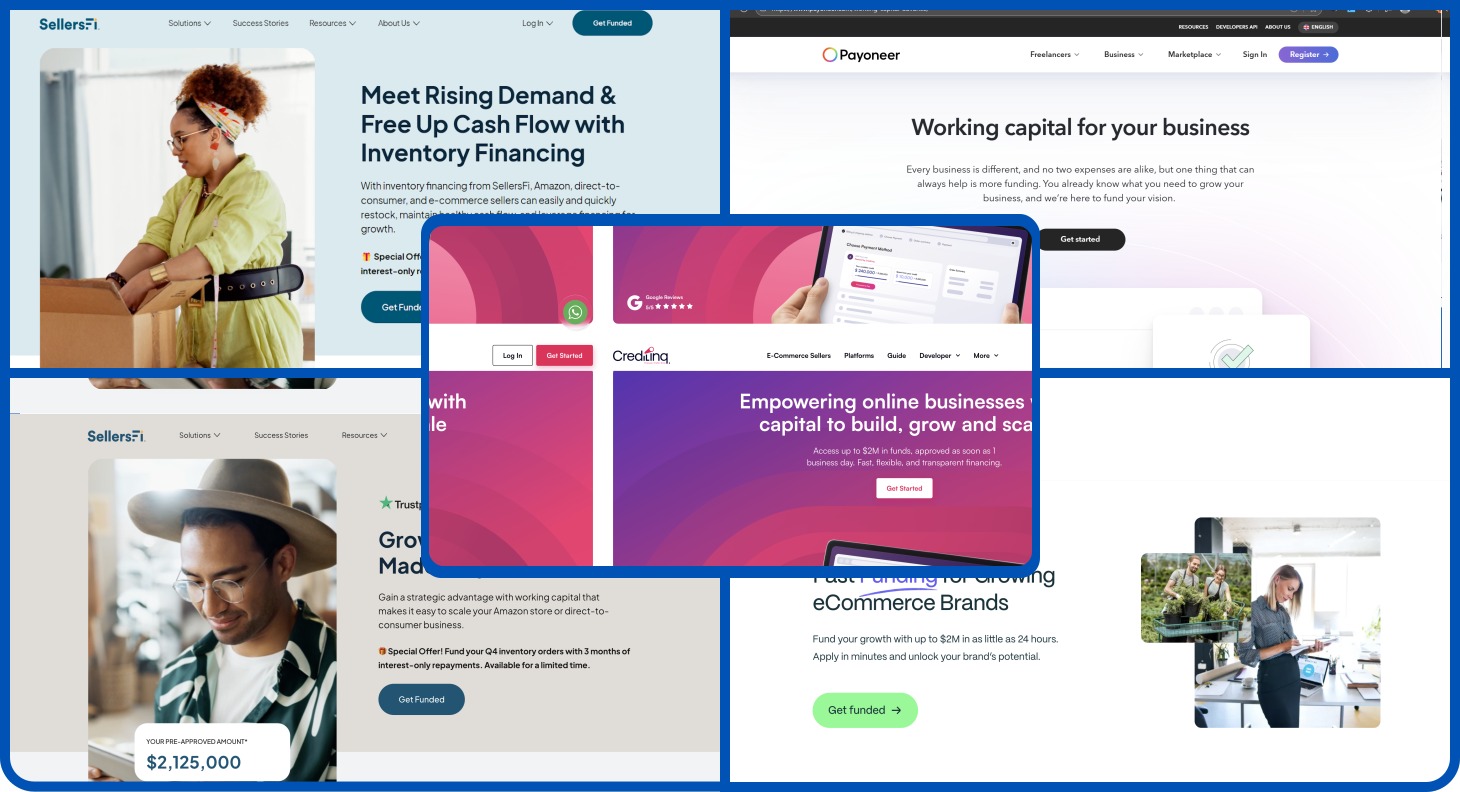
CrediLinq offers a revolving line of credit tailored for professional, 7-figure Amazon sellers and is an Amazon approved lending partner in 16 markets. Connect your Amazon (or other supported stores) to get funding sized from your sales data, with approvals in as little as 1 business day.
That means you can secure cash fast for markets and marketplace expansion, purchase orders, freight, and warehouse preparations with credit limits of up to $2M. Repayment is short-term in 3–6* months, and with flat transparent fees without giving up equity or pledging collateral.
*Customized solutions are available upon request. Loan tenors can extend up to 12 months on a case-by-case basis.
CredilLinq’s eligibility requirements
You’re eligible for CrediLinq’s Line of Credit if you have:
- At least 12 months of selling history on supported marketplaces
- $1M+ annual sales across any of the supported stores including Amazon, TikTok Shop, Shopify, eBay, Lazada, and Shopee
- A registered business entity (not an individual/sole proprietor)
CrediLinq’s geography
- Supported regions include the United States, the United Kingdom, and Singapore.
- Funding is also available in USD, GBP, or SGD depending on where you operate.
- CrediLinq is cross-border friendly, making it easier to fund supplier payments globally without getting squeezed by double FX conversions.
CrediLinq’s fee and pricing
- Flat service fee, starting at 1.5% per month, or a simple, fixed annual percentage rate (APR) of 18% on the drawn amount
- No compounding interest, no hidden add-ons, and no FX markups
Pros of CrediLinq for inventory financing
What makes CrediLinq advantageous is that it gives sellers all three things needed for running cash flow in eCommerce without being locked into unreasonable funding demands:
- Flexibility
- Control
- Ownership
Instead of rigid, one-size loans, you get a revolving credit line that grows with your sales, meaning every new order can be financed without starting a new application. You retain the control to decide when and how much to draw, paying only for what you use, as well as how the funds will be utilized.
Because approvals are powered by live marketplace data from CrediLinq’s selected marketplaces that include Amazon, eBay, Lazada, Shopee, Shopify, and TikTok Shop, sellers skip the usual tax returns, balance sheets, and paperwork. CrediLinq also connects to your Plaid account to evaluate funding eligibility in real time.
CrediLinq has international coverage across the East and West, and sellers can get paid via three currencies (USD, GBP, and SGD), which helps avoid costly double conversions and foreign exchange markups.
And since financing is structured as working capital rather than equity, you retain full ownership and freedom to scale your business at your own pace.
What you need to know
Funding is only available to registered businesses and not individual sellers.

2. Payoneer Capital Advance
Payoneer Capital Advance is a revenue-advance (or receivables purchase) product for Amazon and other marketplace sellers.
The offers you receive are based on the historical sales performance of your Amazon stores associated with your Payoneer account, as well as future sales.
Funds land within minutes, and repayment happens automatically as a fixed percentage of future payouts over 1 to 6 months. Sellers can receive offers up to 140% of their store’s monthly payout, capped at USD $750,000 for the largest offer levels.
Payoneer’s eligibility requirements
- Your Amazon store must be connected to Payoneer via their Store Manager.
- Payments from the Amazon store must go into a Payoneer USD, GBP, or EUR balance
- You must have at least 6 months of selling history on Amazon
- Performance metrics must meet minimum thresholds:
- Order Defect Rate < 1%
- Late Shipment Rate < 4%
- Pre-fulfillment Cancellation Rate < 2.5%
Payoneer’s geography
Payoneer supports inventory lending for Amazon stores in the United States, Germany, France, Spain and Italy.
Payoneer’s fees and pricing
Payoneer charges a flat, transparent 3.5 to 5% fee for its short-term (3-month) capital advances, automatically collected from marketplace disbursements.
Pros of Payoneer for inventory financing
- Sellers with good standing on loan repayments get rolling offers
- No interest-based payments, only a flat fee from the start
Watch out for
- If your supplier or shipping costs are in a currency different from your Payoneer advance currency, foreign exchange fluctuations may add risk; You may need an extra buffer for currency conversion costs or changes in exchange rates
- Funding deposits are wallet-based (your Payoneer balance) rather than being pushed into another bank automatically unless you withdraw
3. SellersFi
SellersFi offers four different funding products for sellers:
- Working Capital: Flexible short-term financing to keep operations running smoothly. Access $5,000–$2.5M for 3–15 months, with approvals in as little as 2 business days.
- CommercePay: Unlock cash upfront based on your sales performance and repay gradually through a fixed revenue share.
- Daily Payout: Receive up to 90% of your previous day’s Amazon sales instantly, ensuring steady cash flow for restocks and growth.
Approvals take about 2 business days and repayment terms range from short-term (fixed percentage fee for the working capital, sales-based deductions for the daily payout and commerce pay offers.
Sellers can receive funding from $25K up to $2.5M for working capital loans and a Line of Credit of up to $10M.
While SellersFi looks at your credit report, it does so through a soft pull that leaves your score untouched.
SellersFi’s eligibility requirements
- You must have at least 6 months of sales history on Amazon
- Record at least $20K in sales in monthly net sales and in good standing
- For its Amazon lending path, visibility is invitation/eligibility-based within Seller Central; the tab appears if you qualify
Note: Eligibility criteria may differ by product, but the same core requirements generally apply across Working Capital, CommercePay, and Daily Payout options.
SellersFi’s geography
SellersFi lists coverage for entities in the United States, the United Kingdom, Canada (excluding Quebec), and Australia (selling in USD) for its capital loans.
SellersFi’s fees and pricing
- The working capital loans is based on a fixed percentage off your sales as outlined in your working capital proposal (Fees vary for each applicant)
Pros of SellersFi for inventory financing
- High potential limits for established accounts and interest-only windows on some offers
- Multiple product loan types (term, revenue-based) to match different inventory cycles
Watch out for
Early repayment within the first 90 days of your loan term triggers a prepayment fee, even though interest only accrues up to the actual payoff date
4. ClearCo
ClearCo offers capital advances to finance eCommerce businesses, including Amazon sellers.
The platform also offers Receipt Funding to reimburse past expenses of up to $1M within 60 days, capped at $500K. Sellers can also pay vendors directly with Invoice Funding.
Subject to diligence, some brands have access to up to USD $4 million in funding capacity. Applications are reviewed in 1 to 2 business days, and funds typically arrive within 3 business days.
Repayments follow weekly or scheduled pay-as-you-go plans, with invoices extendable over 4 to 6 months for a fixed fee.
ClearCo’s eligibility
- Brands with 12+ month revenue history and monthly revenue exceeding $10K are ideal
- Your business must have an incorporated status in the United States (e.g., corporation, LTD, or LLC), with access to a U.S. bank account
ClearCo’s geography
The platform provides funding to businesses in the United States, Canada, the United Kingdom, Ireland, the Netherlands, Australia, and Germany.
ClearCo’s pricing and fees
- Pricing depends on your business’s revenue and the extension plan you choose
- Fees range from 3.63% – 12.5%, based on the length of your plan
Pros of ClearCo for inventory financing
- Weekly/capped repayment schedules help avoid large, sudden hits
- Reimbursement of prior business expenses gives sellers some flexibility via receipts
Watch out for
- Capped weekly repayment schedules can slow down repayment if you want to clear the balance quickly
- Receipt funding is subject to an “approved vendor list” and receipt age, so not all expenses may qualify
5. Wayflyer
Wayflyer specializes in revenue-based advances. You can access cash advances and term loans with fixed 3 to 9 month schedules, or rolling financing that renews for 12 months without reapplying.
Limits range from $5K to $20M. Offers are often around 1.5 to 3 times of your monthly revenue, which is also subject to underwriting.
If approved, an offer will be available in 1 business day. Payments are deducted automatically on a set schedule, often daily, until the balance is cleared.
They do not require signing up for spend restrictions or giving up equity.
Wayflyer’s eligibility
- Sellers must have been in business for at least 6 months
- You have to record up to $10K+ in monthly sales revenue
Wayflyer’s geography
Wayflyer operates in the United States, Canada, the United Kingdom, Australia, Ireland, Spain, the Netherlands, Belgium, Denmark, Germany, and Sweden.
Wayflyer’s pricing and fees
Fees are fixed between 5-10 percent of the cash advance you get; the exact rate depends on your business, risk, and revenue.
Pros of Wayflyer for inventory financing
- Quick funding and relatively high ceilings (up to $20M for proper cases)
- No required collateral or personal equity stake
Watch out for
- Because Wayflyer’s advances are tied closely to your store’s sales performance. If your ads underperform or your inventory runs low, your revenue drops, but repayments still continue.
- Wayflyer uses weekly repayment caps, which can slow down repayment if you want to clear the balance quickly.
A Comparison of Amazon Lending Partners for Inventory Financing

|
Abbreviation key: ● ODR – Order defect rate ● LSR – Late shipment rate ● PCR – Pre-fulfilment cancellation rate |
Note: The table highlights a selected subset of available financing products for each Amazon funding provider and is not an exhaustive list of all its options.
How to Choose the Right Inventory Financing Partner
Here is a step-by-step way to make the right choice:
Step 1: Map your cash cycle
Write down how money actually moves in your business through the following stages:
- Deposit to supplier
- Production days
- Shipping time
- Inbound warehousing or FBA storage
- Stock check-in
- Marketplace payout
- Sell-through
Add it all up, and that total tells you the loan term you will really need.
Step 2: Set your must-haves
Look for a partner that:
- Connects directly to your preferred eCommerce marketplace. Partners that are compatible with multiple platforms are a plus.
- Has a fixed and clear monthly fee instead of layered charges
- Keeps paperwork light (marketplace data instead of bank statements)
- Can approve and fund you as quickly as you need it
Step 3: Shortlist and compare
Narrow it down to 2–3 providers. Ask each for a sample offer based on a real order you are planning. Check their acceptable limit, fees, repayment terms, and whether you will need to reapply every cycle.
Step 4: Check the real cost
Do not just look at the headline fee. Calculate the:
- Effective monthly cost = Total fee ÷ loan term × 30
- Margin impact = Gross margin – (financing cost + fx/transfer + duties if advanced)
This shows how much profit you really keep.
Step 5: Test their flexibility
Before you sign, check how adaptable the partner is to your actual operations:
- Draw structure: Can you take funds in parts for supplier deposits, final balances, and freight, instead of one lump sum? This may lower your cost because you only pay for what you actually use.
- Early repayment: If you sell through faster than expected, can you repay early without penalty (and ideally with fee savings)? This is important if your product finds itself in fast-moving sales cycles.
- Rolling access: Do you keep a pre-approved limit you can draw from repeatedly, or do you have to reapply every time? Rolling lines save time and prevent funding gaps.
- Multi-store and multi-market coverage: Can one facility cover all your Amazon, Shopify, eBay, TikTok Shop, or regional stores, or are you forced into separate accounts? This matters a lot if you plan on scaling.
- Repayment options: Are you locked into daily sweeps tied to sales, or can you choose between fixed installments and sales-based deductions? Flexible repayment helps you keep your ad budget and cash flow safe.
- Currency support: If you sell cross-border, can funds be disbursed without FX markups? This is important to protect your margins.
Step 6: Check for red flags
Walk away if you see hidden fees, or long lock-ins that outlast your sales cycle, requests for heavy paperwork, or repayment terms that eat into ad spend during slow weeks.
Bottom line: Choose a partner that matches the pace of your inventory with repayment options that line up with how your stock actually moves.
CrediLinq’s Advantage for Amazon Sellers
Let us say you need $100K to restock ahead of Prime Day.
Your supplier asks for 30% down and 70% before shipment, plus another $6–8K for freight. Your Amazon payouts stretch 60–90 days and you are at the earliest of that window.
With CrediLinq’s financing, you can split that funding and get $30K for deposit, $70K balance, and freight fee when due on a 90-180 day term. All you do is pay a flat service fee starting at 1.5% per month on the amounts you actually draw, and if sales clear faster, you repay early without penalty.
That means $100K for 00 days could cost as little as $4.5K, compared to $6K–$10K with many fixed-fee advances that charge on the full amount. The credit line itself scales up to $2M if you have to take more.
As an approved Amazon lending partner in 16 markets, CrediLinq helps you protect margins, restock on time, and keep ads running without draining cash.
Your Inventory Fuels Your Momentum
When you can cover deposits early and meet surging demand without draining your reserves, you turn cash flow friction into a competitive edge.
The sellers who win on Amazon are the ones who move fastest. With the right inventory financing partner, you can keep your shelves full and momentum squarely in your hands.
Get started today with CrediLinq to finance your store’s inventory.
Frequently Asked Questions
How does inventory financing work?
A lender fronts the cash for supplier payments, and you repay from future sales. Terms typically run 30–120 days, aligned with production, shipping, and payout cycles.
What are the benefits of inventory financing?
Inventory financing bridges the cash gap between supplier prepayments and Amazon payouts to prevent stockouts and help you negotiate bulk discounts without draining working capital.
When should sellers use inventory financing?
Best during seasonal peaks, for bulk discounts, to scale successful launches, cover sudden demand spikes, or manage long overseas lead times.