

Highlights
- Scaling to a $250k production run for a skincare or cosmetics brand means balancing sourcing ingredients, manufacturing, testing, and multiple other touchpoints where expenses occur months before revenue is realized
- Raw ingredients and manufacturing form the largest cost components, requiring early capital commitment
- Ingredient lead times combined with 30–50% upfront supplier payments create immediate working capital pressure
- Typical production-to-revenue cycles span 4–6 months, locking capital without returns during this period
- CrediLinq’s line of credit enables brands to draw capital exactly when needed for ingredient procurement and production, instead of giving up equity or collateral
- It also offers a transparent fee structure and a predictable, non-revenue linked repayment schedule, easing out payback pressure.
Why This Matters to You
For skincare brands scaling through ecommerce channels like Amazon or TikTok Shop, growth is no longer limited by demand but by how efficiently capital is deployed across the production cycle.
The biggest risk is not lack of sales, but misaligned timing between cash outflows and inflows. Without structured financing:
-
- Brands delay ingredient procurement and miss demand spikes
- Production cycles stretch, causing stockouts and lost revenue
- Founders rely on retained earnings, limiting growth velocity
- Equity dilution becomes an expensive fallback for short-term capital needs
- Revenue-based financing can erode margins due to suboptimal revenue-sharing structures, while traditional term loans often extend beyond a single production cycle, reducing financial flexibility
Introduction
Scaling a skincare brand feels straightforward until your first major production run of $250K or more. Demand can accelerate quickly. A single viral moment on TikTok Shop or marketplace traction on Amazon can compress months of projected sales into weeks.
But production timelines don’t move at the same pace. Ingredients may still be in transit. Stability testing may be underway. Manufacturing hasn’t started because deposits are pending.
This creates a structural disconnect embedded in most production cycles. Cash outflows happen early, while revenue comes in much later. Across high-growth skincare brands, this gap between spending and earning is one of the most common reasons production slows down at scale.
The U.S. skincare market, valued at over $35 billion and expected to nearly double to $62+ billion by 2033, is projected to grow at a steady ~7.5% CAGR. For scale-up brands, growth is constrained less by demand and more by capital readiness, especially when moving into larger production cycles (> $250K+) that require upfront investment in ingredients, testing, and compliance.
For ecommerce skincare brands navigating this gap, access to flexible working capital becomes critical. Instead of relying on lump-sum loans or retained earnings, solutions like CrediLinq’s line of credit allow brands to draw funds as needed across procurement, testing, and production, and repay as revenue starts flowing in.
Understanding how this gap forms and how to finance around it is critical before your next batch.
How Capital Flows in a $250K Production Run
In skincare manufacturing, costs are not evenly distributed across the timeline. A significant portion of capital is committed upfront, well before production begins or revenue is realized.
The table below breaks down how capital is typically allocated across each stage of a $250k production run.

Note: These ranges reflect how cosmetic production costs typically behave at scale.
Managing Stability Testing Expenses and Timelines
Stability testing is the most underestimated cost in a scale-up production cycle. It is mandatory for retail entry, non-negotiable for safety substantiation under MoCRA, and can be painfully slow. Real-time testing runs as long as the product’s intended shelf life, typically 12 to 24 months for skincare, because it must mirror actual storage conditions rather than simulate them. Accelerated testing compresses this by exposing formulations to elevated temperature and humidity to simulate two years of aging in approximately 12 weeks.
The cost per SKU in the US ranges from roughly $1,500 to $8,000 for a standard full-panel study covering accelerated, real-time, challenge, and packaging compatibility testing. The lower end applies to straightforward emulsions with simple preservative systems; the upper end applies to actives-heavy formulations (retinol, vitamin C, peptide serums) that require chemical assay validation alongside physical and microbiological testing. A multi-SKU launch of three to five products can therefore put total testing spend in the $10,000–$20,000 range, which is a meaningful cost.
Major US retailers including Sephora, Ulta, and Target require documented safety and stability data before approving a product listing. Requirements differ by retailer and product category: Sephora’s “Clean at Sephora” program mandates ingredient disclosure and specific batch-level testing for certain formulations (such as 1,2-Dioxane and Ethylene Oxide testing for products containing ethoxylated ingredients), while Ulta’s Conscious Beauty program requires compliance across safety, cruelty-free, and ingredient transparency pillars. The common thread is that stability and compatibility data must be in hand before a buyer conversation can advance, and a failed test at this stage means reformulation, not just a timeline delay.
Most brands initiate testing only after finalizing formulas, which is precisely the mistake that pushes test completion past the launch window. A smarter approach is to run accelerated and real-time protocols in parallel with production, rather than sequentially. Running both simultaneously costs more upfront, additional lab fees and sample batches, but it can cut 8-12 weeks off the path to retail-ready status, directly compressing the gap between capital deployment and first revenue.
Two structural realities define the cash exposure in this production model. Ingredient procurement commits capital months before manufacturing begins. Stability testing then holds that capital in place during a mandatory waiting period that neither speed nor spend can fully eliminate. Together, they create a 130-to-180-day window in which cash is fully out and nothing has come back. For most founders, that window is wider than any operating reserve can comfortably absorb, which is why manufacturing financing has become less of an option and more of a structural necessity for e-commerce skincare brands trying to grow without sacrificing launch momentum.
Financing Options for Cosmetic Manufacturing Batches
There are multiple financing options available for cosmetic manufacturing today. However, not every financing product fits every stage of the production cycle. Using the wrong financing vehicle can increase costs, restrict flexibility, or create repayment pressure at the wrong time.
Each option differs in how capital is accessed, how it is repaid, and what it ultimately costs. Understanding these differences, especially the annual percentage rate (APR) or effective cost of capital, helps brands make better decisions as they scale production.
Various financing options for cosmetic manufacturing
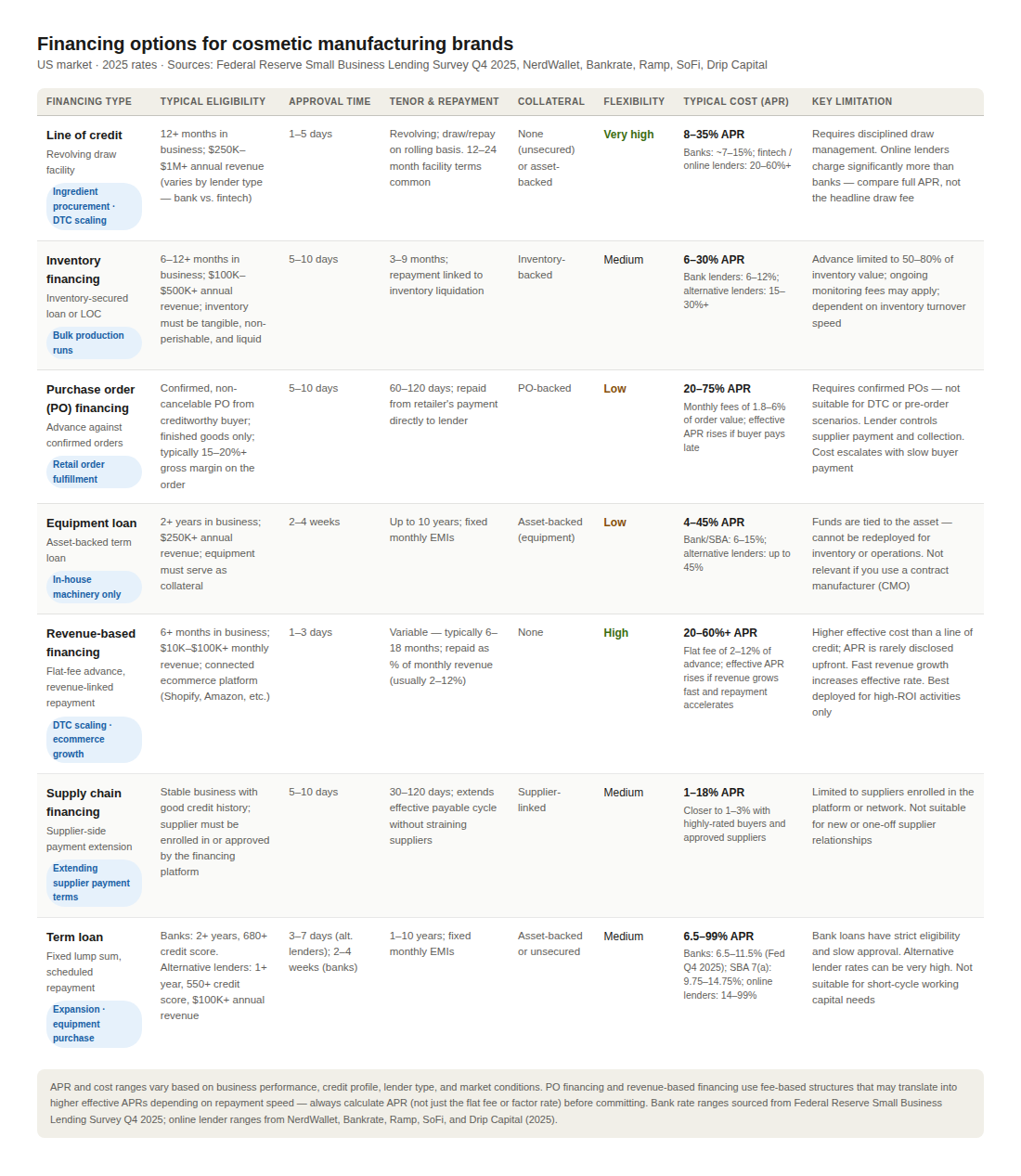
Line of credit — A revolving facility that lets you draw what you need and repay as revenue comes in — ideal for brands with recurring production cycles. The key distinction is lender type: bank rates averaged between 6.99% and 7.91% in Q3 2025, while fintech lenders charge between 8-35% in general. For ecommerce skincare brands specifically, platforms like CrediLinq offer fast, flexible access to capital without the delays, rigid terms, or paperwork-heavy processes of traditional lenders — qualifying based on platform sales history rather than credit scores or physical collateral.
Best for: Ingredient procurement, DTC scaling
Inventory financing: Activates once goods are in production or in transit. Inventory financing interest rates typically range from 6% to 30% APR depending on lender type, inventory quality, and risk profile. Repayment ties to inventory liquidation rather than a fixed schedule, which suits the cyclical nature of skincare production runs. Best for bulk production runs.
PO financing: Advances capital against a confirmed retailer purchase order; the lender pays your supplier and is repaid when the retailer settles. APRs can range from 20% to upward of 50%, and can reach 75% when fees are converted to annualized rates, making margin math critical before committing. Best for first-time large retail placements where the order exceeds available working capital.
Equipment loans: These are relevant only if you’re bringing manufacturing in-house. Funds are tied to the asset and cannot be redeployed for inventory or operations. Not applicable if you use a contract manufacturer.
Revenue-based financing: A flat fee (typically 2–12% of the advance) repaid as a percentage of monthly revenue. The effective APR depends on how quickly the loan is repaid, faster revenue growth means higher effective cost. Best for DTC scaling with high-ROI deployment; avoid using it to cover operational losses.
Supply chain financing: Lets you pay suppliers on your timeline while they receive payment immediately through a financing intermediary. Cheapest of the seven types for well-qualified buyers, but limited to enrolled supplier networks.
Term loan: A fixed-sum loan repaid through scheduled installments. Bank loans averaged 6.6%–11.5% APR in Q1 2025 per Federal Reserve data; alternative lenders range from 14% to 99% APR. Best suited for expansion or equipment, not for short-cycle working capital needs where the repayment schedule won’t align with the production cycle.
Projecting Cash Flow Against Ingredient Lead Times
Ingredient lead times don’t just delay your production; they also increase your costs and thus define your entire financing strategy.
Most specialty actives, such as retinol, niacinamide, peptide complexes, and imported botanical extracts, carry 60–90-day lead times from overseas suppliers, plus a 30–50% upfront payment at the time of order. Add minimum order quantities (MOQ) requirements that force capital commitment upfront at scale, and the pressure compounds fast.
Here’s what a realistic U.S.-based ecommerce brand’s cash cycle looks like on a $250k run:
Day 0–15 | Ingredient Procurement
Purchase orders placed with overseas suppliers. A 30–50% advance payment is required upfront before production begins. Capital is committed before a single unit is manufactured.
Day 30–75 | Freight Transit + Customs Clearance Goods depart the supplier’s facility. Sea freight from Asia to the US takes 30–45 days port-to-port. Add inland transport, export documentation, US customs clearance, and import duties, all payable before goods are released.
Day 75–90 | Ingredients Received; Manufacturing Begins
Raw materials arrive at the contract manufacturer. Quality checks, formula batching, and filling begin. The remaining supplier balance (50–70%) is typically due at this stage if not already paid.
Day 90–100 | Stability Testing + Quality Sign-Off
Finished batches enter accelerated stability testing and quality assurance checks. Regulatory and retail compliance requirements must be met before inventory can be released for fulfillment. This stage can extend the timeline if issues arise.
Day 100–120 | Inventory Ready; Fulfillment Prep Begins
Finished goods are packaged, labeled, and prepared for dispatch. Products are prepped for Amazon FBA intake or Shopify 3PL delivery, including labeling, carton markings, and shipment creation.
Day 120–130 | Inventory Live; First Sales Begin
Stock arrives at fulfillment centers and goes live on marketplace or DTC channels. Sales begin, but cash has not yet returned; marketplace payouts and retailer payment terms introduce a further lag.
Day 130–180 | Revenue Realized
First sales revenue clears through Amazon’s 14-day payout cycle, Shopify payment processing, or retailer Net 30–60 terms. This is the first point in the cycle at which cash inflows begin to offset the original capital outlay, approximately 4–6 months after Day 0.
Total capital deployment window: 130–180 days.
Cash outflow begins: Day 0.
First cash inflow: Day 130 at the earliest.
Peak capital at risk: Days 100–130 — fully deployed, not yet recovered.
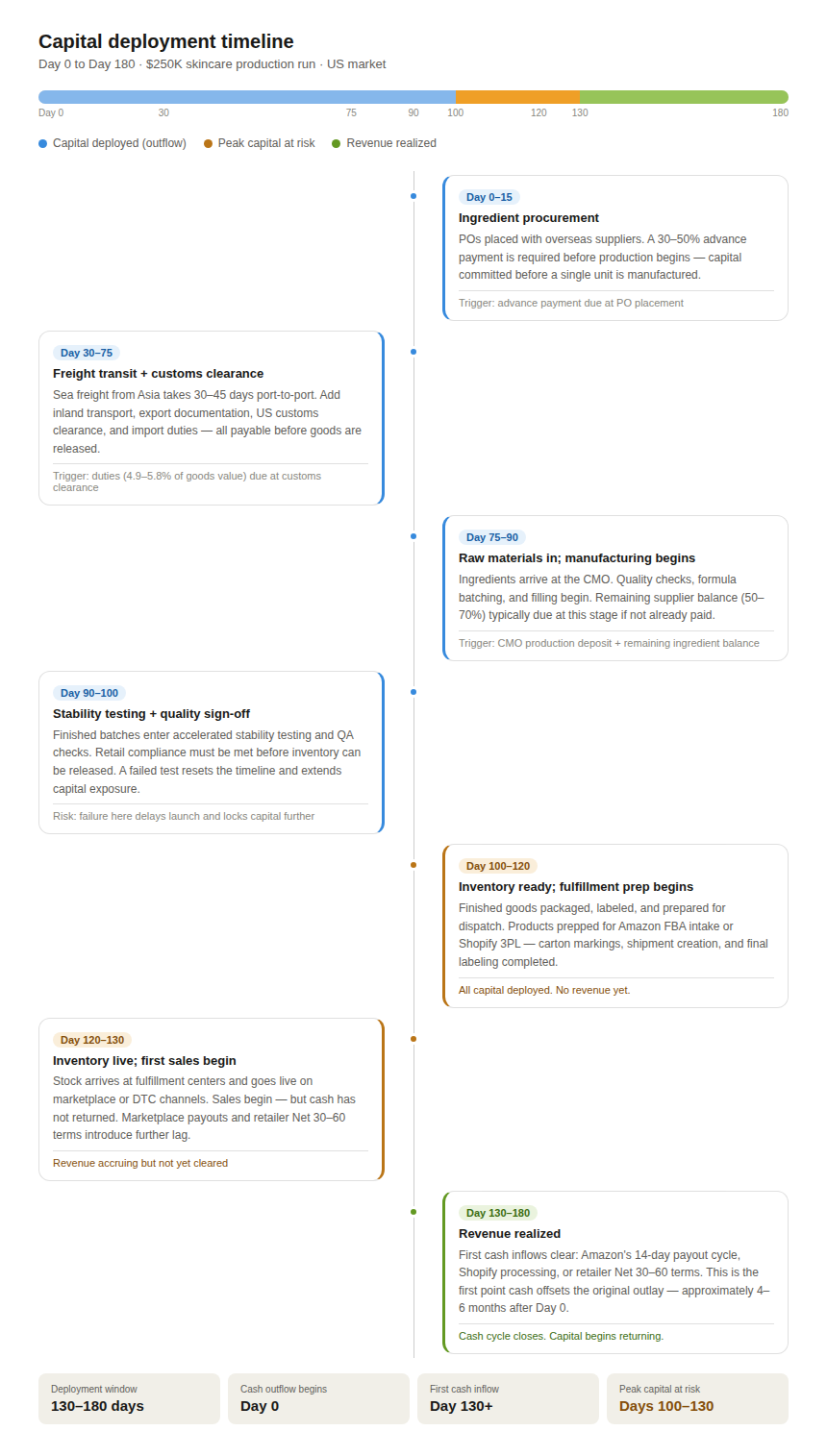
If you have already run one or two batches at this scale, you’ve likely seen some version of this play out: a 4–6 month window during which capital is fully committed with zero revenue. For brands scaling on Amazon or TikTok Shop, where demand can spike overnight, this creates a dangerous mismatch between demand and supply.
This is where many founders get stuck: relying on retained earnings to fund each run, delaying ingredient orders until cash is available, then missing the demand window entirely.
Why Flexible Financing Beats Traditional Loans for Cosmetics Manufacturing
A $250K production run doesn’t spend itself in one go; it bleeds capital across six to eight distinct milestones over four to six months. Traditional lenders issue a lump sum upfront and expect fixed repayments on a schedule that has nothing to do with how ingredients move, how testing runs, or when retailers pay. That mismatch is where brands run into trouble. Revolving working capital solves this by putting capital deployment on the same timeline as the production cycle itself.
This is where revolving working capital becomes critical for private label cosmetics: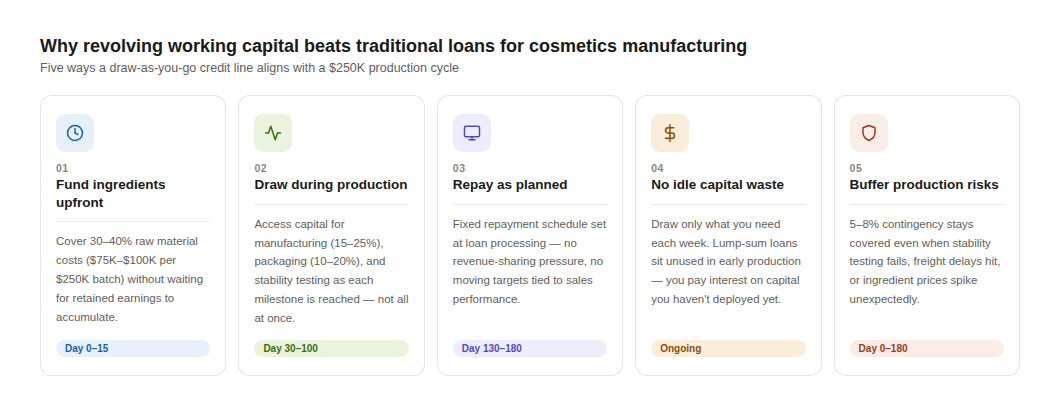
Tips to Strengthen Your Cosmetics Supply Chain
At a $250k scale, your supply chain stops being just logistics. It starts affecting cash flow directly. Every weak link carries a cost.
- Single-supplier dependency for a critical active ingredient means that a single shipping delay can extend your entire cash cycle by weeks.
- No safety stock means that a reorder triggers a new 60–90-day lead time while finished goods are still in transit.
- Reactive freight booking during peak seasons can add $3,000–$8,000 or more in unplanned costs.
To ensure a smooth supply, a mature brand would ensure:
- Dual sourcing for one or two critical active ingredients, even a domestic backup supplier at a price premium, dramatically reduces cycle risk.
- A 30–45 day buffer inventory of high-velocity ingredients, financed as part of the production cycle rather than drawn from operating cash.
- Forward freight agreements that lock in predictable costs.
- Supplier pricing agreements tied to six-month procurement windows, combining MOQ discounts with cost certainty.
Each of these improvements requires upfront capital. Most brands delay them because of the working capital pressure they’re already under.
Preparing a Cosmetic Manufacturing Financing Plan
Lenders approve financing when they clearly understand the cash cycle. A strong application for a $250k production run includes:
- Ingredient Procurement Plan
List key suppliers (especially for imported actives)
Specify lead times and MOQs
Clearly define payment terms (e.g., 30–50% upfront, balance before dispatch)
This shows how much capital is locked early and how dependent you are on supplier timelines.
- Manufacturing Schedule
Identify contract manufacturer and production capacity
Outline deposit requirements and final payment structure
Include key delivery milestones (batching, filling, finished goods)
This helps lenders understand when major cash outflows occur and how predictable production is.
- Stability Testing Plan
Name the lab partner and testing protocols (accelerated, compatibility, real-time)
Define expected completion benchmarks
Indicate whether testing runs parallel to production
This demonstrates regulatory readiness and reduces the risk of delayed market entry.
- Revenue Channel Breakdown
Map expected sales across:- Amazon
- Shopify
- TikTok Shop
- Walmart or retail
- Support with historical data or realistic projections
This validates demand and shows how quickly inventory can convert into sales.
- Cash Collection and Payment Terms
Document payout cycles for each channel:- Amazon (bi-weekly payouts + reserves)
- Shopify (faster settlement cycles)
- Retail (Net 30 / 60 / 90 terms)
Estimate when revenue is actually realized in cash terms
Alternative lenders evaluate operational data and cash flow predictability rather than hard collateral or audited financials. This matters for fast-growing skincare brands without a traditional balance sheet.
Staying Liquid Through the Gap Between Production and Revenue
Financing a $250K skincare production run means committing capital in stages across a cycle that can stretch four to six months before a single dollar comes back. Ingredient deposits go out on Day 0. Freight and customs duties land on Day 30–75. Manufacturing deposits, stability testing fees, and fulfillment prep costs follow in sequence — all before inventory goes live, and well before Amazon’s 14-day payout cycle or retailer Net 30–60 terms return anything.
For most founders, this gap is wider than any operating reserve can comfortably absorb, and traditional lenders, with their slow approvals, collateral requirements, and rigid repayment schedules, are structurally misaligned with a production cycle that doesn’t move in straight lines.
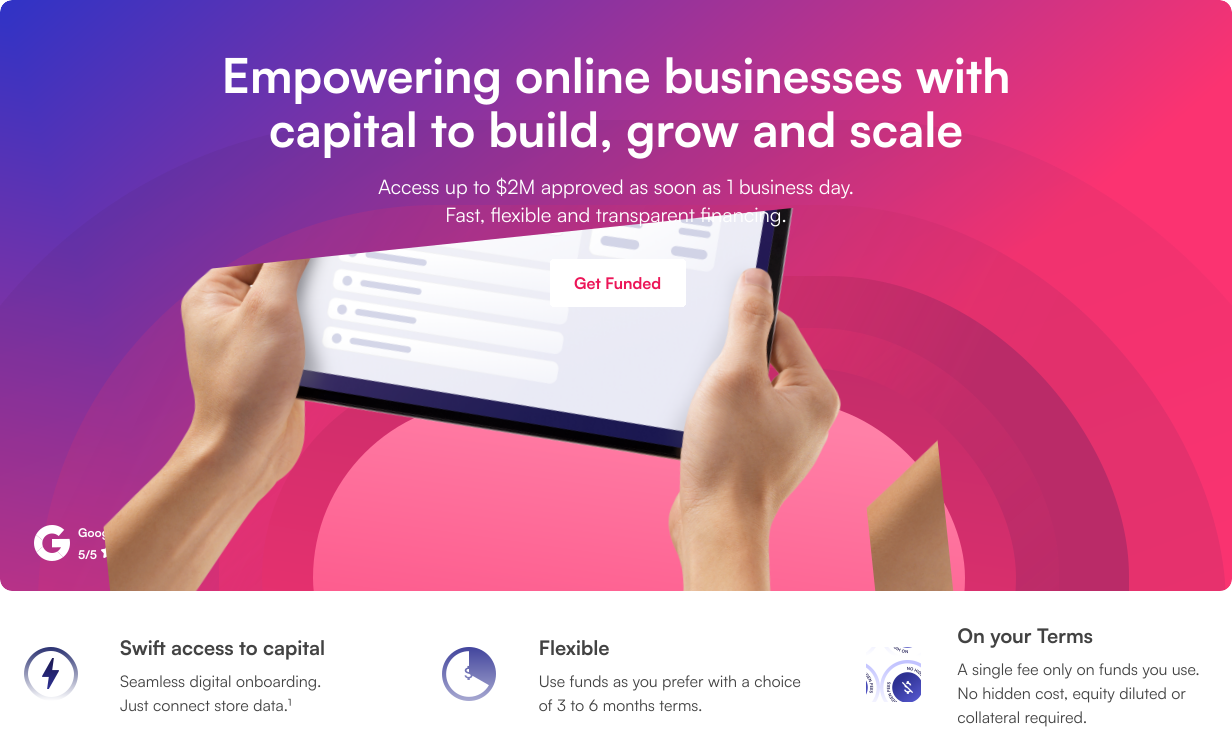
CrediLinq’s credit line is built for exactly this kind of non-linear, inventory-driven cash cycle. It underwrites your business using real-time sales data from Amazon, Shopify, eBay, TikTok Shop, Lazada, or Shopee, giving you access to up to $2 million in working capital without collateral, financial statements, or heavy paperwork. Approvals take as little as 1 business day, so you’re not waiting weeks for a bank decision while your ingredient supplier’s payment window closes.
With CrediLinq, you get:
- Pay only for what you draw, with single fixed service fees starting at just 1.5% per month or a simple annual percentage rate (APR) of 18%
- Short 3–6 month repayment options that align with typical skincare production and sell-through cycles
- No lock-ins, no hidden charges, and no restrictions on how funds are used — draw for ingredient deposits, manufacturing costs, stability testing fees, or fulfillment prep as each stage of the production cycle demands
- No collateral required, and no penalty for early repayment as inventory clears faster than projected
For skincare brands navigating their first large-scale production run, the difference between a stalled launch and a smooth one often comes down to having capital available at the right stage of the cycle, not after the fact. CrediLinq gives you the liquidity to stay on schedule from Day 0 procurement through to the first revenue clearing on Day 130 and beyond.
Key Takeaways
- A $250K skincare batch ties up capital for 4–6 months before a single dollar returns, and most operating reserves aren’t built for that.
- Ingredients and stability testing hit hardest, earliest. Both require significant upfront spend.
- Testing in parallel with production is necessary at scale. Running both protocols simultaneously cuts 8–12 weeks off your launch timeline, time that directly reduces financing costs.
- Most financing products aren’t built for cosmetics manufacturing cycles. Term loans, RBF, and PO financing each misalign with production timelines in different ways. Choosing the wrong one compounds the cash gap.
- Revolving credit beats lump-sum debt for cosmetics manufacturing. Drawing at each milestone and repaying as inventory clears keeps cost of capital low and cash flow predictable.
- CrediLinq’s line of credit provides financing flexibility – to be able to draw capital as and when needed, which helps scale up cosmetic manufacturing without unbearable repayment burdens.
FAQs
- How long does cosmetic manufacturing financing approval usually take?
Approval typically takes 3–14 days, depending on loan type, documentation, lender type, and clarity of cash flow projections. Alternative lenders can process approvals much faster, sometimes within 1 business day, which matters when timelines are tight. - Can I finance raw materials purchased overseas?
Yes. Many lenders support international procurement, especially when tied to production plans and supplier agreements. Currency risk and shipping timelines may influence structure. - What credit score is ideal for inventory financing?
Most lenders prefer 650+, but strong revenue and sales performance can offset lower scores. CrediLinq’s line of credit relies on your store data and sales history rather than personal credit scores. - How do lenders view stability test delays?
Lenders accept delays if planned. Unanticipated delays increase perceived risk unless backed by revised timelines and contingency planning. - What’s the biggest mistake brands make in financing production?
Seeking funding too late, after cash flow stress begins, limits options, increases costs, and delays production cycles. - Does CrediLinq provide financing for skincare brand scaleups and cosmetics manufacturing?
Yes. CrediLinq’s line of credit is designed for exactly the cash cycle challenges that skincare and cosmetics brands face at scale.