


The Ultimate Guide to eCommerce Supply Chain Management

Overview
- The eCommerce supply chain is the connected path from suppliers to customers, stitched together by planning, procurement, warehousing, fulfillment, transportation, delivery, and returns.
- Last-mile delivery remains the most expensive segment, which makes speed and accuracy in upstream steps even more critical.
- CrediLinq’s financing allows you to restock your eCommerce store on time, split supplier payments, and protect rankings during demand spikes.
Why this matters to you
- Your margins are won or lost in the timing between supplier deposits, freight, duties, and platform payouts.
- Without accurate inventory, you risk overselling, stockouts, ad waste, and avoidable returns.
According to a report by Maersk, 4 out of 5 businesses think supply chain challenges are a major factor affecting business growth.
Every successful eCommerce business is built on a supply chain that runs quietly in the background, getting products where they need to be, when they need to be there.
For eCommerce sellers, the function of supply chains can show up in the small windows where growth may be won or lost. A delayed restock or a missed shipping slot can flatten your momentum just like that.
The supply chain is key to operating a hassle-free business and you must understand and be informed on how it works as a seller.
This guide walks you through the supply chain step by step, you will see where most sellers hit friction, and how tools like CrediLinq help you keep every part of your supply chain funded and moving on time.
What is an eCommerce Supply Chain?
A supply chain is the set of activities and partners that convert a purchase order into fulfilled customer demand and then close the loop through returns.
In ecommerce, that chain is digitally connected and time-compressed. It spans planning, procurement, warehousing and inventory control, order management, pick-pack-ship, transportation, last-mile delivery, and reverse logistics.
Key components of an eCommerce supply chain
At its core, the eCommerce supply chain coordinates demand signals and physical flow across:
- Supplier: Manufactures or sources your product and accepts staged payments tied to production milestones.
- Warehouse: Stores inbound inventory and maintains accurate counts across locations.
- Fulfillment center: Converts orders into shipments through receiving, slotting, picking, packing, and handoff.
- Carrier: Transports packages through the middle mile and last mile to the doorstep or pickup point.
- Customer: Receives the order; their experience feeds reviews, reorders, and returns.
How eCommerce Supply Chain Differs from Traditional Supply Chain

The eCommerce supply chain operates on a completely different rhythm from the traditional retail model.
While both share the same core objective of moving goods efficiently from supplier to customer, eCommerce compresses every stage into a faster, more unpredictable cycle that mirrors digital consumer behavior.
Speed and variability
Online demand is volatile by design. A viral post, influencer endorsement, or price promotion can drive sudden spikes that overwhelm static supply models.
For instance, Labubu dolls saw sales jump up to 1,142.3% in the Americas in just the first half of 2025.
The pump was driven by so many viral social-media mentions and celebrity endorsements. They generated USD 677 million in revenue in the same time period compared to USD 418 million in all of 2024.
Traditional supply chains operate on planned promotions and predictable sales windows. Inventory flows are batched, making them easier to forecast.
Unit economics
eCommerce supply chains break down the bulk model into millions of micro-fulfillment cycles. On the contrary traditional supply chains move goods in cartons and cases to a single store, warehouse, or regional depots.
In eCommerce, each order usually represents a unique pick-pack-ship workflow. That shift multiplies handling costs, magnifies the probability and impact of errors, and demands accuracy and efficient warehouse design to sustain margins.
Last-mile dominance
In ecommerce, the final leg of delivery consumes a disproportionate share of cost, as studies estimate the last mile accounts for up to 41% of total logistics spend.
In traditional supply chains, the customers complete the last mile themselves by visiting stores, and the seller has little to do with delivery performance or the bearing cost as well.
Return intensity
Returns are where ecommerce diverges most visibly from offline models. In traditional retail, return rates average 9%, typically handled in-store with minimal logistics cost.
For eCommerce businesses, these returns went as high as 16.9% to 30% of total orders in 2024. Collectively, buyers returned over $890 billion worth of products in the same year.
How the eCommerce supply chain works
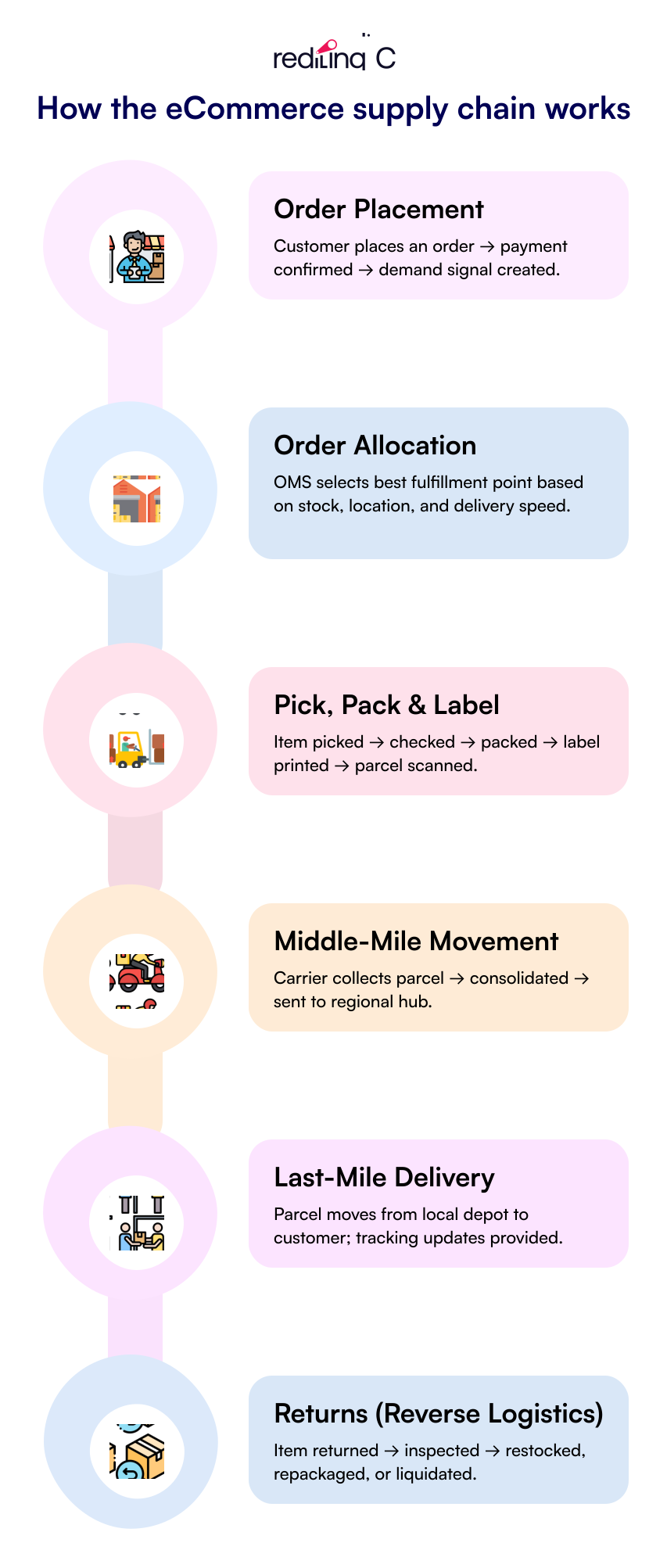
Every ecommerce order triggers a sequence of connected steps. Here is how that movement happens:
1. Order placement
The customer places an order in your store or marketplace. As soon as payment is authorized, it creates a live demand signal in your system. This confirms that the product needs to be picked, packed, and shipped.
2. Order allocation
Your order management system (OMS) checks where the item is in stock and assigns the order to the best fulfillment point.
- It considers inventory levels, customer location, promised delivery time, and carrier cutoffs (the latest time a parcel can leave the warehouse to meet delivery windows).
- The goal is to fulfill from the closest and fastest location while keeping shipping costs low.
3. Picking, packing, and labeling
Once the order is assigned, the warehouse or fulfillment center takes over:
- A picker retrieves the item from storage.
- It moves to the packing station, where it is checked for accuracy and packed securely.
- A shipping label is printed and scanned, creating a digital record that tracks the parcel’s journey.
4. Middle-mile movement
The package is picked up by a carrier and consolidated with others moving in the same direction.
- This stage, often called the middle mile, covers transport from the fulfillment center to regional hubs or sorting facilities.
- Accuracy here ensures parcels reach the right delivery zones without delay.
5. Last-mile delivery
From the local depot, the parcel enters the last mile, which is the final and most visible leg.
- Delivery partners route packages to customers’ homes or to pickup points.
- Real-time tracking updates keep both you and the buyer informed until the delivery is completed.
6. Returns and reverse logistics
If the customer initiates a return, the process runs in reverse:
- The product is sent back to your warehouse or a returns center.
- It is inspected, sorted, and either restocked, repackaged, or liquidated depending on its condition.
Benefits of Effective eCommerce Supply Chain Management
1. Higher service levels
When your inventory, fulfillment, and delivery systems operate with consistency, you keep promises and keep customers happy.
- You can hit delivery windows more reliably and thereby reduce the number of customers who leave because things arrive late or wrong.
- Happy customers reorder more, leave positive reviews, and help you win organic ranking and lower acquisition cost.
2. Revenue protection: minimizing stockouts and overselling
When your chain works well, you avoid two silent killers of revenue:
- Being out of stock (lost sales, lost ranking)
- Overselling (leading to disappointed customers, refunds, and bad reviews).
If you maintain stock where it matters, you keep ads running profitably, you keep your product visible in marketplaces, and maintain conversion momentum.
3. Lower total landed cost
Effective chain management means you avoid emergency actions (air-freight, rush carriers, wrong picks) that kill margins. Better forecasting and inventory positioning reduce the need to expedite shipments at high cost.
Challenges in eCommerce Supply Chain Management
Two of the biggest hurdles sellers face today with supply chain management are transportation and the need for adaptability to market changes.
Transportation and logistics issues
-
Rising delivery costs: Delivery partners constantly deal with rising fuel prices, fair wages, and limited capacity, all of which are passed on to sellers through surcharges or higher carrier rates.
A.P. Moller–Maersk warns that logistics flexibility is shrinking as United States carriers introduce steep peak-season surcharges, up to $8.75 per residential delivery and as high as $94 for oversized parcels.
- Global shipping disruptions: The Red Sea crisis in 2024 and recurring congestion at major ports in the United States and Europe extended transit times by 30% for many sellers. Ocean carriers had to reroute ships around Africa, adding up to 14 days to the shipping time and extra costs to every order.
Adaptability to market changes
-
Volatile demand cycles: One viral TikTok product can drain your stock in days, while another can fade before your shipment clears customs.
Sellers now live in what experts call the “attention economy,” where product visibility shifts by the week. Those without flexible restocking options risk sitting on unsold inventory or missing profitable surges altogether.
-
Economic and policy shifts: Interest rate hikes, fuel price swings, and trade tensions have all made logistics and financing harder to predict.
For example, the U.S. Customs and Border Protection ended the duty-free threshold of USD 800 for imports, meaning all shipments into the U.S. must now clear customs and face duties.
Meanwhile, the new European Union customs and VAT rules in 2025 show that a wider number of suppliers selling goods worth up to €150 will now be responsible for paying import VAT.
-
Labor shortages and automation gaps: Warehousing and trucking sectors face ongoing labor constraints.
The United States Chamber of Commerce-related Worker Shortage Index shows many states in the country still have fewer than one worker for each job opening in logistics-intensive industries.
A study by Descartes Systems Group found that 37% of organisations are experiencing high labour shortages in the logistics sector, with 61% reporting that transportation disruptions were caused by understaffing.
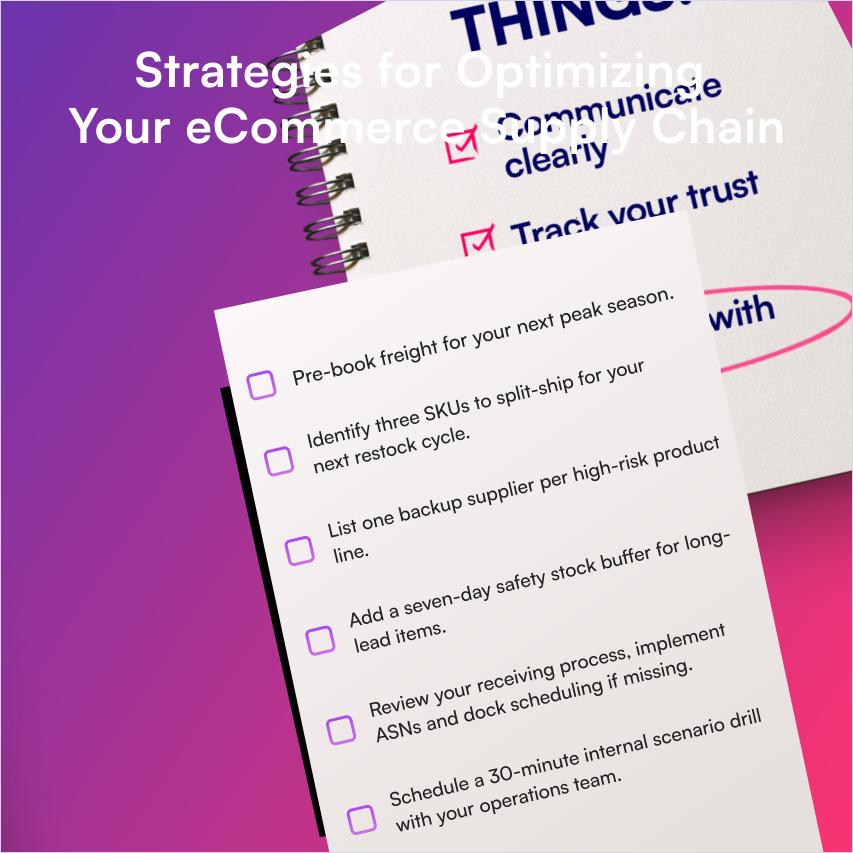
Strategies for Optimizing Your eCommerce Supply Chain
Below are practical plays you can run now to improve your supply chain:
1. Ensure inbound logistics efficiency
To do this, you should:
- Stage supplier payments: Break deposits into production milestones, such as tooling start, pre-shipment inspection, and vessel loading. This approach keeps cash aligned with real work completed and reduces exposure if schedules slip.
- Book capacity earlier: Reserve freight space well before peak seasons. During high-demand periods, carriers raise prices and shorten cutoffs, forcing last-minute shippers to pay premiums. Booking early allows you to avoid this.
- Split shipments: Avoid putting all your stock in one shipment. Divide orders based on speed, value, or demand certainty. Send a small early batch first to stay in stock and then ship the rest later. This protects you from total sellouts if one shipment faces delays or customs issues.
- Use predictive signals: Watch category search trends and your own order book.
For example, if you use Amazon’s Brand Analytics, you may check the “Top Search Terms” report, and if you notice leading indicators lift (like a sharp increase in impressions or clicks for a keyword tied to one of your SKUs), you could pull orders forward by a week so that stock lands before the wave.
2. Diversify your suppliers
Relying on a single factory or region exposes your business to unnecessary risk. Political tension, natural disasters, or labor shortages in one location can halt production overnight.
How to do it:
- Map your current suppliers and identify single points of failure.
- Qualify at least one backup manufacturer in a different country or region.
- Keep “warm” backup suppliers active with small, periodic orders to ensure readiness
3. Re-evaluate Your Inventory Strategy
The Just-in-Time (JIT) model, where you restock only when needed, works well in a stable world but collapses during delays. Instead, slowly shift towards a just-in-case (JIC) approach.
Keep small, strategic buffers of high-value or long-lead products. A JIC model allows you to absorb supplier or shipping delays without halting sales completely. With this model, you would be able to:
- Identify SKUs with unpredictable lead times.
- Hold a modest safety stock.
- Review these levels quarterly to avoid overstocking.
4. Optimize warehouse management
- Design for flow: Organize your warehouse for speed. Place fast-moving SKUs closer to packing areas and group them by zone to reduce picker travel time.
- Standardize receiving: Require advance shipping notices and dock appointments. Fewer surprises in receiving means cleaner counts and faster processing into your warehouse shelves.
5. Make room for contingency plans
You cannot prepare for every crisis, but you can prepare to respond quickly when one hits.
How to do it:
- Identify your top three risks (e.g., supplier failure, transport delay, warehouse shutdown).
- Define specific responses, assign roles, and create clear communication channels.
- Re-evaluate these scenarios at least once a year.
6. Build flexible and agile operations
Flexibility lets you adjust quickly to changes in demand, costs, or logistics.
How to do it:
- Cross-train employees to handle multiple roles (picking, packing, labeling).
- Maintain a small surge workforce for peak periods.
- Invest in automation tools such as pick-to-light systems or barcode scanners.
- Work with multiple carriers to keep delivery options open when capacity is tight.
The Role of Green Supply Chain Management in eCommerce
Green supply chain management means running your entire or parts of your products lifecycle in a way that reduces waste and pollution. It focuses on cleaner sourcing, packaging, transport, and returns to become more environmentally responsible.
eCommerce growth has amplified the environmental footprint of logistics and packaging. Emissions from transportation, packaging waste, and energy use across the supply chain impact the environment.
Here are ways you can reduce the effects of this:
- Move more volume from air to sea and rail where possible. Heavy reliance on air couriers can materially elevate transport emissions.
- Design packaging for reuse where return rates are high.
- Invest in better pre-shipment quality control to lower avoidable returns.
Enhance Your Supply Chain with CrediLinq

Funding touches nearly every stage of the ecommerce supply chain because every movement of goods (from production to delivery) costs money before it earns money.
Here is where most sellers feel the pressure on the supply chain and how CrediLinq eases you off it:
When sourcing and paying suppliers
Your supplier asks for 30–50% upfront to reserve materials and production slots, with the balance due at a deadline before shipment. If you wait for marketplace payouts, you may miss your window or slip behind competitors.
CrediLinq connects to your eStore (Amazon, TikTok Shop, Shopify, eBay, Shopee, Lazada, and beyond) and gives you a revolving line of credit from $50K up to $2 million that you can draw in tranches to pay suppliers.
Approvals can be as fast as one business day, so you do not lose your production slot, and you can repay over two to four months as the inventory lands and sells.
Dealing with change orders
A component shortage may force you to switch vendors, or you may have to upgrade packaging to reduce damage.
With CrediLinq, you can use a small, same-week draw to fund the change order.
You would only be paying a flat monthly service fee as low as 1.5% or starting from a simple fixed annual percentage rate (APR) of 18% on the amount you use and not on your entire limit, so you do not punish your margins to keep production on track.
During freight booking, insurance and customs duties
Space must be booked and paid for before your cargo even moves. Also, peak seasons like Prime Day and Black Friday add extra cost due to the rush. Before you take another breath, you have duties and VAT that are due at clearance, not after the sale.
With CrediLinq, you can draw down in the currency you need (USD, GBP, or SGD) to pay carriers and brokers on time. Because pricing is flat and transparent, you can model landed cost per unit easily and avoid surprise finance charges.
When splitting shipments to reduce timing risks
Sending everything in one load is cheaper on paper, but risky. If that container is delayed, you risk stocking out.
With CrediLinq, you can, for instance, draw an amount for the fast shipment, then draw once again for the ocean when the vessel confirms. You repay both from sell-through without carrying the full cost the whole time.
While prepping for warehouse fulfillment
You pay for receiving, labeling, storage fees, and sometimes extra hands or overtime to hit deadlines. If you underfund this step, your boxes may have to sit still, delaying orders.
CrediLinq allows you to pull a three-to-four-week funding tranche to clear backlogs, then close it as orders convert. Because CrediLinq’s facility is a working-capital line, you do not give up equity or pledge personal collateral to cover temporary spikes.
Funding launch with ads
Paid advertising costs funds, and in some cases, turning ads off to “save cash” could cost you your rank and a drop in sales. You may really want to keep your product adverts on, but you find that cash is tied up in deposits, freight, and duties.
With CrediLinq, you can get a draw to bridge the first payout lag while sales are up. Since the credit line scales with your sales data, you would not be reapplying for a new loan every time you grow.
Processing returns and reverse logistics
Returns are a very sour thing for sellers generally; even worse is that they may still require cash.
You may have to pay for repackaging sometimes, and if you get a returned product, you may not be able to sell it as “new” on your main store, so you list it on an outlet marketplace or liquidation site at a discount to clear it fast.
With CrediLinq, you take only what you need for the returns bulge, then repay as recovered units sell through. No compounding interest to penalize a temporary event.
Positioning for opportunity buys
A supplier could be offering a limited-time discount for a larger MOQ, or a competitor goes out of stock and demand shifts your way, or you could be the first to list a viral TikTok consumer product in your store.
With CrediLinq, you can grab the deal and top up your inventory one cycle earlier, then roll down as sales catch up.
Conclusion
The best way to manage your growth is to do it in fragments. Your supply chain already tells you where to act next, like inbound dates that warn of delays, or forecasts hint at demand. When you read these signals and fix weak links early, your operations stay calm and customers stay loyal.
One critical aspect you must give attention to in your supply chain is funding. Funding is the fuel that keeps the chain moving and solid.
With on-demand working capital at each chain link (deposit, balance, freight, duties, etc), you do not pause campaigns, delay replenishment, or lose rank.
In a business where timing is important, having on-demand capital at each stage of the supply chain can be the difference between scaling smoothly and falling behind.
Keep your supply chain moving smoothly with CrediLinq’s funding.
Frequently Asked Questions
What metrics should I track in my eCommerce supply chain?
Track inventory accuracy, order fulfillment rate, on-time delivery, stockout frequency, and return rate. These show where money leaks, how fast you move products, and how reliable your operations really are.
What is an example of an eCommerce supply chain?
A seller orders from a supplier, ships goods to a warehouse, fulfills customer orders through carriers, delivers to homes, and handles returns for resale or refund.
What is eCommerce supply chain management?
It is the process of planning, sourcing, storing, and delivering products sold online while keeping costs low, deliveries fast, and inventory accurate to create a smooth customer experience and steady cash flow.